
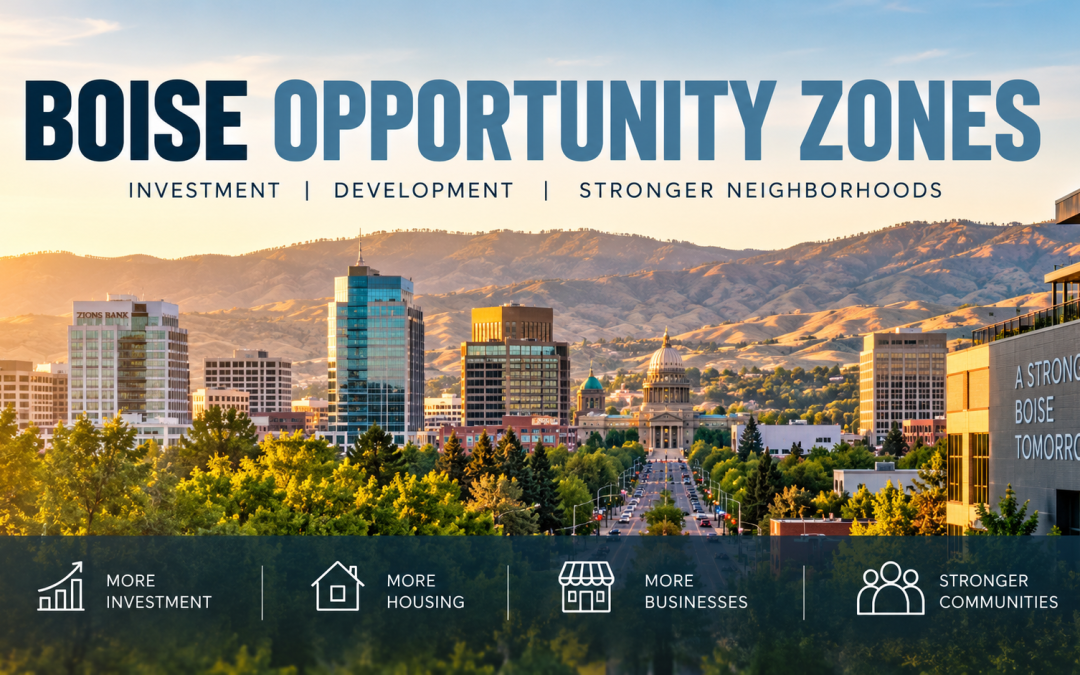
Boise’s Proposed Opportunity Zones Could Open a New Chapter for Investment and Development
Boise may soon have another tool to attract investment into some of the city’s most important growth and redevelopment areas.
Five parts of Boise have been recommended for the next generation of federal Opportunity Zones. If the federal government approves the nominations, the designations could influence where investors look for development and redevelopment opportunities over the next decade.
For Boise commercial real estate, the bigger story isn’t simply the tax incentive. It is where these zones are located and how private capital could respond.
According to reporting by IBR Staff in the Idaho Business Review, Idaho has recommended five Boise areas for Opportunity Zone designation: Downtown, Shoreline, the University District, South Boise Village and West Boise. The proposed zones were submitted through Gov. Brad Little and the Idaho Department of Commerce for federal consideration.
The original Idaho Business Review article can be found here: https://idahobusinessreview.com/2026/09/10/idaho-boise-five-areas-opportunity-zone-designation/
If approved by the U.S. Department of the Treasury, the new designations are expected to begin January 1, 2027, and remain in effect for 10 years.
Why These Five Boise Areas Matter
The locations are arguably more interesting than the designation itself.
These aren’t simply five random areas on a Boise map. Each offers a different type of opportunity for investors, developers, landlords and businesses.
Downtown Boise is the region’s primary employment, entertainment and urban development center. Additional investment incentives could strengthen the case for redevelopment, mixed-use projects, housing and improvements to older or underused properties.
Shoreline sits close to Downtown and the Boise River corridor. Its location creates opportunities tied to housing, employment, recreation and connectivity to the city’s urban core.
The University District benefits from proximity to Boise State University and a large population of students, employees and nearby residents. Over time, investment could support housing, retail, services and mixed-use development serving this population.
South Boise Village presents a different opportunity. Smaller parcels, established neighborhoods and existing commercial properties could make redevelopment and infill particularly important here.
West Boise has significant existing commercial development and access to major transportation corridors. Depending on the final boundaries, the designation could create new reasons for investors to examine older retail centers, commercial properties, housing opportunities and redevelopment sites.
That variety is important.
Opportunity Zones aren’t limited to one property type. Capital could potentially flow toward housing, commercial real estate, operating businesses and redevelopment projects, creating opportunities across several parts of Boise’s economy.
Investment Incentives Could Change Development Math
Commercial development usually comes down to whether the numbers work.
Land costs, construction costs, financing, rents, operating expenses and expected returns all affect whether a project moves forward.
Tax incentives don’t automatically make a bad project good. But they can improve the economics of a project that is already close to being feasible.
That could matter in today’s development environment.
Construction costs remain a major consideration for Boise development, while higher financing costs have made some projects harder to justify. An additional incentive for qualified investment could make certain redevelopment or ground-up opportunities more attractive to investors with long-term capital.
That is especially relevant for properties that are underused relative to the value of their location.
An older commercial building, aging shopping center, vacant parcel or low-density property may suddenly deserve another look when it sits inside an area receiving additional investment attention.
For property owners, that could eventually translate into more buyer interest.
For developers, it could create another variable when evaluating sites.
And for investors, it may create opportunities to combine long-term Boise growth with federal tax advantages.
What This Could Mean for Boise Commercial Real Estate
The Opportunity Zone designation itself won’t create development.
Private capital still has to find projects that make financial sense.
But incentives can influence where investors spend time looking for those projects.
That can create a ripple effect.
More investment interest can lead to property acquisitions. Acquisitions can lead to redevelopment. Redevelopment can bring new housing and businesses. Those businesses create demand for retail, office and service space.
This is where the impact could extend beyond investors using the tax program.
For retail leasing in Boise, additional housing and employment in these districts could strengthen demand for restaurants, fitness concepts, medical users, neighborhood services and other businesses that depend on nearby customers.
For landlords, redevelopment can improve surrounding property values and introduce new customers and businesses into an area.
For tenants, growing districts can create opportunities to enter neighborhoods before rents and competition increase.
For developers, the proposed zones may help identify where Boise expects infrastructure, planning policy and private investment to work together over the coming years.
And for commercial property investors, the map itself may become an important prospecting tool.
The City Is Signaling Where It Wants Investment
Another important part of this announcement is how Boise selected the proposed areas.
According to the Idaho Business Review, city staff considered economic conditions, infrastructure, zoning, development planning and existing incentives. Community feedback was also part of the process.
That tells investors something useful.
These areas weren’t selected solely because they qualify for a federal program. They overlap with places where Boise sees opportunities for additional investment and growth.
That doesn’t guarantee every proposed development will receive city support. Zoning, entitlements, infrastructure capacity and neighborhood concerns will still matter.
But investors evaluating Boise commercial property should pay attention whenever planning priorities, infrastructure and financial incentives begin pointing toward the same parts of town.
Those signals can sometimes identify emerging investment areas before the market fully prices in the change.
Local Insight: Watch the Properties Inside the Boundaries
My biggest takeaway is simple: don’t just watch whether the Opportunity Zones are approved. Watch what happens to the real estate inside them.
If the federal designations move forward, I would expect more investors and developers to begin studying these five Boise areas closely.
The first opportunities may not necessarily be large new developments.
Some of the most interesting deals could involve older buildings, vacant land, obsolete retail properties, small infill sites and properties where redevelopment has previously been difficult to justify.
Investors should also look beyond today’s income.
A property that appears ordinary based on its current use could have much greater long-term value if new housing, infrastructure, businesses and investment begin concentrating around it.
There is also an important caution.
An Opportunity Zone designation does not automatically make a property a good investment. Investors still need to evaluate zoning, access, utilities, construction costs, achievable rents, tenant demand and exit value.
The tax treatment should support the real estate strategy—not replace it.
What Happens Next
The proposed Boise Opportunity Zones still require federal approval.
If approved, the new designations are expected to become effective January 1, 2027, beginning a 10-year period that could shape investment decisions across Downtown Boise, Shoreline, the University District, South Boise Village and West Boise.
Between now and then, commercial real estate investors should pay attention to the final boundaries and start identifying properties that could benefit from increased capital flowing into these districts.
The most important opportunities may appear before construction cranes arrive.
For Boise investors, developers, landlords and business owners, understanding where capital is likely to move next can be just as valuable as understanding where it is moving today.
Mike Gioioso (joy-OH-so) has for 16+ years been helping companies of all sizes buy, build, and lease perfect places for business in greater Boise, Idaho and beyond.
www.streetsmartidaho.com mike@streetsmartidaho.com 208-209-9166
Tags: #boisecommercialrealestate, #boiseopportunityzones, #boiserealestate, #boisedevelopment, #boiseinvestmentproperty, #boisecommercialproperty, #boiserealestateinvesting, #opportunityzonesidaho, #idahoopportunityzones, #boiseeconomicdevelopment, #downtownboise, #westboise, #southboisevillage, #boiseuniversitydistrict, #shorelineboise, #boiseredevelopment, #boisemixedusedevelopment