
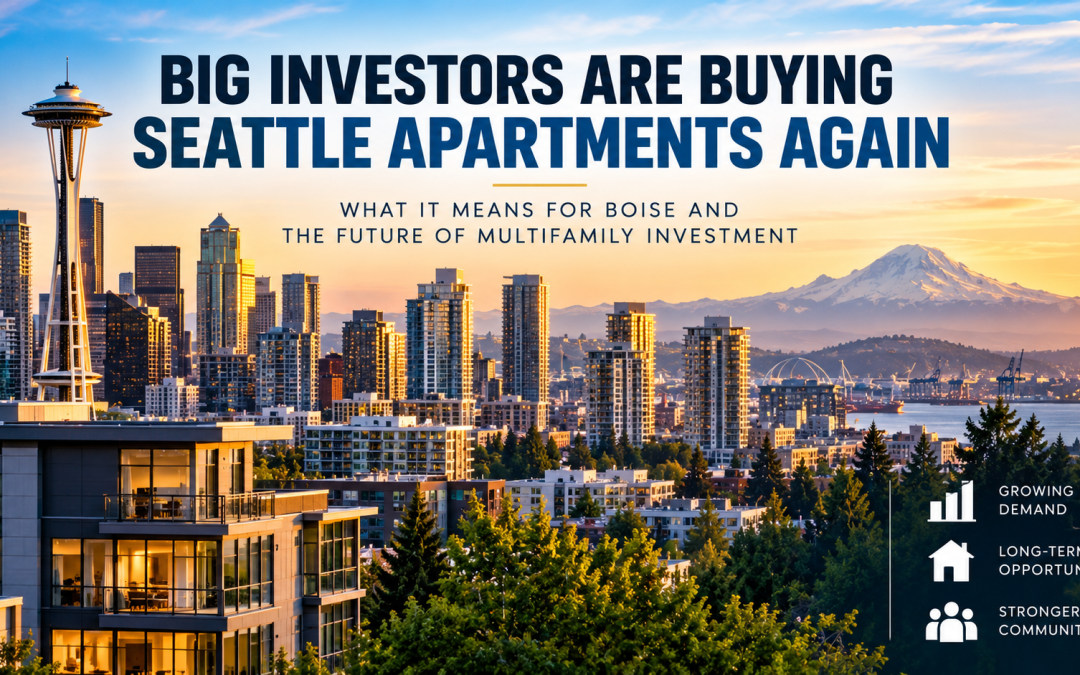
Big Money Is Returning to Seattle Apartments. What Boise Investors Should Watch Next
Some of the biggest real estate investors in the country are putting serious money back into Seattle apartments—and that may tell us more about the direction of the multifamily market than today’s rent numbers do.
Seattle still has challenges. Apartment concessions remain common, the office market is struggling with high vacancy, and some major employers have reduced their real estate footprints.
Yet institutional investors are buying again.
According to reporting by Randyl Drummer of CoStar News, several major apartment transactions have recently closed across the Seattle region, including a record-setting purchase by global real estate investment manager BGO.
You can read the original CoStar News article here: https://product.costar.com/home/news/1544443443
For those of us watching Boise commercial real estate and multifamily investment, Seattle provides an important case study: large investors may be positioning for the recovery before the recovery becomes obvious.
Institutional Capital Is Moving Before the Market Fully Recovers
The numbers behind Seattle’s recent apartment transactions are significant.
BGO reportedly spent more than $500 million acquiring two Seattle multifamily properties.
That included The Ayer, a newer apartment tower in Seattle’s Denny Triangle, which sold for approximately $353 million. The transaction reportedly set a new city record for total apartment sale price.
BGO also acquired the Independent apartments in Seattle’s Ballard neighborhood for approximately $152 million.
Meanwhile, Mesirow Financial purchased Island Square on Mercer Island for approximately $157 million.
These aren’t small private investors hunting for distressed duplexes.
They are sophisticated institutional buyers deploying hundreds of millions of dollars.
And they’re doing it while Seattle still has plenty of uncertainty.
That is what makes the activity interesting.
Institutional investors don’t necessarily need today’s fundamentals to look perfect. They need to believe tomorrow’s fundamentals will be better—and that today’s purchase price adequately compensates them for waiting.
Investors May Be Betting on a Supply Reset
One of the most important forces affecting multifamily real estate isn’t just demand.
It’s supply.
Apartment markets across the country have spent the past few years absorbing a large wave of new construction. More available units gave renters choices and forced many landlords to compete aggressively through concessions and slower rent increases.
Now that equation is beginning to change.
Higher construction and financing costs have slowed development pipelines in many markets. Fewer projects starting today can mean fewer new apartments delivering several years from now.
Seattle investors appear to be paying attention to that timeline.
CoStar’s reporting indicates that buyers increasingly believe apartment pricing has adjusted enough to justify acquisitions, particularly when combined with expectations for slower construction and future employment growth.
National multifamily conditions are also improving. CoStar reported stronger apartment demand during the second quarter as construction moderated, while CBRE has projected a sizable increase in U.S. multifamily investment activity this year.
Seattle appears to be participating in that recovery.
Apartment transaction volume across the region reached approximately $5 billion during the past year, according to CoStar data cited in the article. That’s roughly twice the level seen around the market’s recent low.
Capital isn’t simply talking about coming back.
It is starting to move.
Why Boise Multifamily Investors Should Pay Attention
Seattle and Boise are very different apartment markets.
But investment cycles don’t operate in isolation.
Large West Coast markets can provide clues about how institutional capital is thinking about real estate several years ahead.
The Boise multifamily market has experienced its own version of the supply story.
Strong population growth encouraged substantial apartment construction across Boise, Meridian, Nampa and other parts of the Treasure Valley. As new units delivered, renters gained more choices and landlords faced greater competition.
That can put pressure on rents and increase concessions in the short term.
But development pipelines don’t remain elevated forever.
When financing becomes harder and construction costs remain high, fewer projects pencil. Eventually, new deliveries can fall while population and household growth continue.
That is when the balance between supply and demand can begin shifting back toward landlords.
Investors buying during that transition aren’t necessarily buying because today’s rents are spectacular.
They’re buying because they believe future rents and occupancy will justify today’s basis.
That’s the lesson Boise investors should take from Seattle.
Not Every Apartment Property Is Recovering Equally
There’s another important message buried inside Seattle’s investment comeback.
Capital is being selective.
Newer apartment properties, strong neighborhoods and transit-oriented locations are receiving much more attention than many older properties.
One example illustrates the difference.
A 198-unit apartment community in Kent reportedly sold for about $45 million after previously trading for roughly $43.3 million in 2019.
After several years, the increase was relatively modest.
Compare that with the record pricing investors have been willing to pay for newer, higher-quality Seattle assets.
That spread tells us something important.
A recovering multifamily market doesn’t lift every property equally.
Location matters.
Age matters.
Amenities matter.
Replacement cost matters.
And the amount of future capital required to keep an older property competitive matters.
The same principle applies to Boise investment property.
Two apartment communities located only a few miles apart can perform very differently depending on construction quality, unit mix, surrounding development, schools, access, employment centers and competing supply.
Boise’s Development Pipeline May Matter More Than Today’s Vacancy
When evaluating Boise multifamily investments, I think one of the most important numbers to watch over the next few years will be the development pipeline.
Today’s vacancy tells us where the market is now.
The pipeline helps tell us where it could be headed.
Investors should pay attention to how many projects are proposed versus how many actually break ground.
Those are two very different numbers.
A proposed apartment project doesn’t create new competition until it gets financed and built.
If construction starts decline while the Treasure Valley continues adding households, the existing apartment inventory could eventually benefit from tightening conditions.
That could support occupancy.
Then rents.
Then property values.
And eventually, new construction.
That’s how real estate cycles work.
Local Insight: The Best Buying Window May Feel Uncomfortable
There’s a reason buying near the bottom of a real estate cycle is difficult.
It rarely feels like the bottom.
If rents were climbing rapidly, vacancies were falling, interest rates were low and everyone expected values to rise, sellers would probably already be pricing those expectations into their properties.
Opportunity often appears when the outlook is still uncertain.
Seattle’s recent institutional purchases demonstrate that point.
Major investors are committing substantial capital even though the city continues dealing with apartment concessions, employment shifts and a deeply challenged office market.
They’re apparently looking several years ahead.
Boise investors should consider doing the same.
That doesn’t mean buying every apartment property that hits the market.
It means looking for situations where current pricing reflects today’s challenges while the property’s long-term fundamentals remain strong.
In Boise, that might mean a well-located apartment community facing temporary competition from new construction.
It could mean an older property with rents below market that needs renovation.
Or it could mean development land that doesn’t pencil today but sits in the path of long-term population and employment growth.
The key is buying the right basis—not simply buying because something is cheaper than it used to be.
What Investors Should Watch Next
For Boise and Treasure Valley multifamily investors, I’d keep an eye on several signals together: apartment construction starts, concessions, occupancy, rent growth, transaction volume and financing conditions.
No single indicator will announce that the market has turned.
Instead, the evidence usually builds gradually.
Seattle’s recent transactions may be showing the early stages of exactly that process.
Large investors appear willing to move before the market reaches full recovery because waiting for perfect conditions can mean paying a much higher price.
That’s the bigger lesson for Boise commercial real estate investors.
Don’t just ask what the apartment market looks like today.
Ask what supply, demand, rents and property values could look like three to five years from now—and whether today’s pricing gives you enough upside to wait for that future.
Mike Gioioso (joy-OH-so) has for 16+ years been helping companies of all sizes buy, build, and lease perfect places for business in greater Boise, Idaho and beyond.
www.streetsmartidaho.com mike@streetsmartidaho.com 208-209-9166
Tags: #boisecommercialrealestate, #boiserealestate, #boisemultifamily, #boisemultifamilyrealestate, #boiseapartmentmarket, #boiseapartments, #boiseinvestmentproperty, #boiserealestateinvesting, #boisemultifamilyinvestment, #boiseapartmentinvestment, #boisedevelopment, #boiseapartmentdevelopment, #treasurevalleycommercialrealestate, #treasurevalleymultifamily, #treasurevalleyapartments, #idahocommercialrealestate, #idahomultifamily, #multifamilyinvestment