
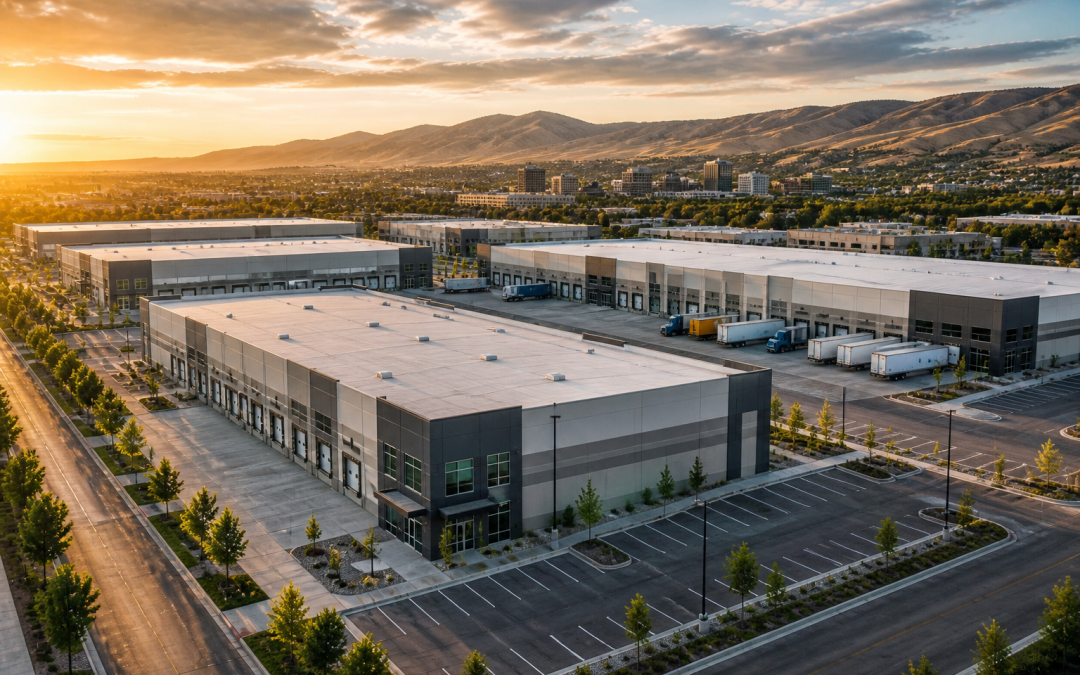
Boise Industrial Reset: Why New Logistics Supply Is Driving Vacancy—and What It Means Next
For years, Boise commercial real estate—especially industrial—felt like it could do no wrong.
Space was tight. Rents were climbing. Developers couldn’t build fast enough.
Now, the market is shifting—and a new report shows exactly where the pressure is coming from.
What Just Happened in the Boise Industrial Market
According to reporting by John Gillem in CoStar News (read the original article here: https://product.costar.com/home/news/847892381), the Treasure Valley’s logistics sector is going through a clear rebalancing phase.
Here are the key takeaways:
- Industrial vacancy has climbed to 11.8%, up sharply from just 1.2% in late 2021
- Roughly 14 million square feet of new logistics space has been delivered this decade
- About 28% of that new inventory is still available
- Over the past year alone, more than half of newly delivered space remains unleased
- Newer buildings are seeing significantly higher vacancy rates than older properties
In short: supply has finally caught up—and in some cases, overshot demand.
What’s Changing: New Buildings Are Driving the Vacancy Spike
This isn’t a broad-based slowdown across all industrial properties.
It’s very specific.
New construction is the pressure point
Buildings delivered in the 2020s are sitting at nearly 30% vacancy, while older properties remain much tighter, closer to mid-single digits.
That tells you something important:
Tenants didn’t disappear—they just didn’t expand fast enough to fill all the new space.
Big-box logistics is feeling it the most
Large-format buildings—especially those over 250,000 square feet—are seeing the highest availability.
Why?
- Fewer tenants can absorb that size
- Leasing decisions take longer
- A single deal can swing market stats
And right now, a lot of that space is still waiting for its first tenant.
Why It Matters for Boise Commercial Real Estate
This shift is a big deal—but it’s not necessarily bad news.
It’s a market correction, not a collapse.
1. Tenants finally have leverage
For years, industrial users in Boise had limited options.
Now:
- More choices
- More negotiating power
- Potential for concessions or better lease terms
If you’re a logistics user, distributor, or light manufacturer, this is the window you’ve been waiting for.
2. Landlords and developers need to adjust strategy
Speculative development worked incredibly well coming out of the pandemic.
Today, the strategy is changing:
- Preleasing matters again
- Building size and flexibility are critical
- Differentiation (clear height, loading, location) matters more than ever
Not all buildings will lease at the same pace—and the best assets will still outperform.
3. Boise development is hitting a maturity phase
This is what a growing market looks like.
Boise is no longer:
- An undersupplied, early-stage industrial market
It’s becoming:
- A more balanced, competitive environment
- One where timing, product type, and tenant demand all matter
That’s a healthy evolution for long-term stability.
Local Market Impact: What to Watch Next
Even with rising vacancy, this isn’t the end of Boise’s industrial growth story.
Here’s what I’m watching closely:
Absorption of large-block space
A few major leases could quickly shift the narrative—especially in big-box logistics.
Pipeline pressure
There’s still around 2 million square feet under construction, much of it large-format.
Until that gets absorbed, vacancy will likely stay elevated.
Sublease trends improving
One positive sign: sublease availability is declining compared to last year, which suggests tenants are stabilizing rather than pulling back further.
My Take: This Is Where Smart Deals Get Done
This is the kind of moment that separates average deals from great ones.
In Boise commercial real estate, we’re moving from:
- A landlord-driven market
To:
- A more negotiated, opportunity-rich environment
For investors:
There may be chances to acquire newer assets at better pricing—or partner on lease-up strategies.
For tenants:
This is your chance to secure space that simply wasn’t available 24 months ago.
For developers:
The next wave of projects will need to be more targeted, more flexible, and more demand-driven.
The market isn’t breaking.
It’s resetting—and that creates opportunity.
Mike Gioioso (joy-OH-so) has for 16+ years been helping companies of all sizes buy, build, and lease perfect places for business in greater Boise, Idaho and beyond.
www.streetsmartidaho.com mike@streetsmartidaho.com 208-209-9166
Tags: #boisecommercialrealestate, #boiseindustrialmarket, #boiselogisticsrealestate, #industrialvacancyboise, #boisewarehousespace, #treasurevalleyindustrialmarket, #boisedevelopmenttrends, #logisticsrealestatetrends, #industrialleasingboise, #boiseinvestmentproperty, #bigboxwarehouseboise, #industrialsupplyanddemand, #speculativedevelopmentboise, #boiserealestatetrends, #commercialrealestatetrends2026