
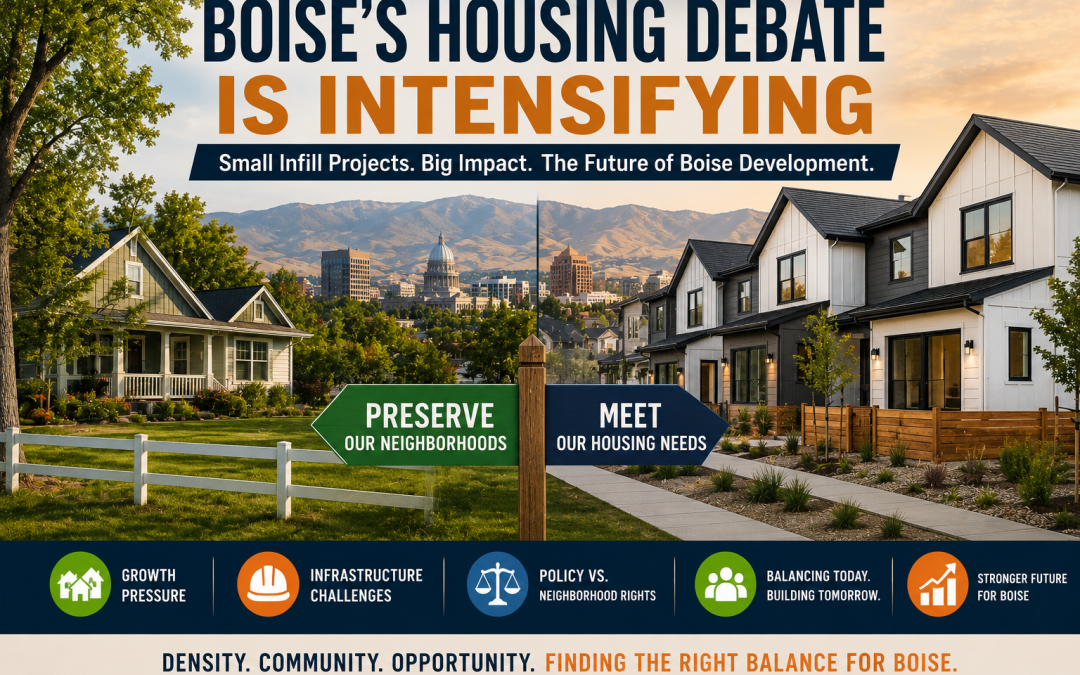
Boise’s Housing Debate Is Intensifying — And Small Infill Projects Are Becoming the Front Line
One of the biggest battles shaping the future of Boise development is no longer happening only around massive apartment complexes or large subdivisions.
It is happening lot by lot.
And a recent Boise City Council decision shows just how divided the city has become over density, neighborhood character, and the future of housing growth.
According to reporting by Haadiya Tariq in the Idaho Press, Boise officials recently approved a proposal known as Cotterell Cottages despite strong opposition from nearby residents. You can read the original article here: Idaho Press article
The project would add three multifamily homes on a nearly one-acre property near Maple Grove Road alongside an existing residence.
To move forward, the property required rezoning to allow higher density housing.
While the scale of the project is relatively small, the reaction surrounding it highlights a much larger issue:
Boise is entering a new phase of infill development where neighborhood preservation and housing demand are increasingly colliding.
Why Small Infill Projects Are Becoming So Controversial
The strongest opposition from neighbors focused on preserving the area’s existing character.
Residents described the neighborhood as spacious, green, and rural in feel despite being inside Boise city limits.
Many argued that adding tightly clustered homes would fundamentally change the neighborhood’s identity.
Those concerns are becoming increasingly common throughout the Treasure Valley as Boise pushes toward higher-density housing strategies.
The city continues facing pressure from:
- rising housing costs
- population growth
- limited land supply
- affordability challenges
- infrastructure constraints
As available development land becomes scarcer, smaller infill projects are becoming one of the few remaining ways to increase housing supply inside existing neighborhoods.
That means more rezoning debates like this are likely coming.
Boise Is Continuing To Push Density
One of the most important details in the Idaho Press article is that city planning staff described the project as a “transition” between higher-density housing nearby and lower-density homes farther west.
That language matters.
It reflects Boise’s broader planning philosophy:
gradually introducing additional density into established areas instead of concentrating all growth on the outskirts of the city.
From a planning perspective, infill development can help:
- reduce suburban sprawl
- improve land efficiency
- support transit
- increase housing supply
- reduce infrastructure expansion costs
But politically, these projects are often difficult because they directly affect existing neighborhoods.
The challenge for Boise leaders is balancing:
- housing demand
- neighborhood compatibility
- infrastructure limitations
- long-term growth planning
And that balance is becoming harder every year.
Infrastructure Concerns Are Becoming a Bigger Issue
Another major theme in this debate involved sidewalks, pedestrian safety, and infrastructure.
Several residents argued the surrounding area lacks adequate sidewalks and pedestrian connectivity to support additional density.
That concern is significant because infrastructure is becoming one of the defining issues in Boise commercial real estate and residential development alike.
Growth is happening faster than many neighborhoods were originally designed to handle.
As Boise continues densifying, cities may increasingly face pressure to invest in:
- sidewalks
- roadway improvements
- traffic management
- utilities
- stormwater systems
- pedestrian infrastructure
That could eventually affect development costs, timelines, and entitlement processes throughout the region.
CC&Rs Versus City Growth Policies
The debate also highlighted another issue becoming more common across Idaho:
conflicts between private neighborhood covenants and city zoning policies.
Neighbors argued that the development conflicted with existing CC&Rs requiring larger lot sizes.
However, city officials clarified that private covenant disputes fall outside the city’s approval authority.
That distinction matters because it reinforces an important trend:
cities may approve projects that still face separate private legal challenges tied to neighborhood restrictions.
As Boise continues growing, these conflicts between:
- city housing goals
- neighborhood expectations
- HOA restrictions
- property rights
could become increasingly common.
Local Market Impact: Boise’s Growth Model Is Changing
For years, much of the Treasure Valley’s growth happened through outward suburban expansion.
But Boise is increasingly turning inward.
That means smaller infill projects, lot splits, cottage developments, and rezoning requests may become a larger part of the city’s future housing strategy.
For developers and investors, that creates both:
- opportunity
- political risk
Smaller infill projects can sometimes move faster and fill critical housing gaps.
But they can also trigger strong neighborhood resistance that complicates approvals.
This trend could eventually influence:
- Boise land values
- entitlement timelines
- redevelopment opportunities
- neighborhood commercial demand
- mixed-use infill projects
- housing affordability discussions
My Take
This project may seem minor on paper.
But I think it represents a much bigger turning point for Boise.
The city is gradually shifting away from purely low-density growth patterns and moving toward a more urbanized development model.
That transition is not going to happen without conflict.
Many longtime residents understandably want to preserve neighborhood character and open space.
At the same time, Boise’s continued growth means the city must find ways to add housing somewhere.
And increasingly, “somewhere” is becoming existing neighborhoods.
From a Boise commercial real estate perspective, this matters because residential density often drives future retail demand, neighborhood services, walkability, and long-term redevelopment opportunities.
The debates happening today over small housing projects may ultimately shape how Boise grows for decades.
Mike Gioioso (joy-OH-so) has for 16+ years been helping companies of all sizes buy, build, and lease perfect places for business in greater Boise, Idaho and beyond.
www.streetsmartidaho.com mike@streetsmartidaho.com 208-209-9166
Tags: #boisecommercialrealestate, #boisehousingdevelopment, #boiseinfilldevelopment, #boisedevelopment, #boisezoningchanges, #boisehousingshortage, #boiselanduse, #boisedensitydebate, #boiseneighborhoodgrowth, #boisemultifamilyhousing, #treasurevalleydevelopment, #idahohousingmarket, #boisecitycouncil, #boiseredevelopment