
Boise’s New Dual-Branded Marriott Tower Signals the Next Phase of Downtown Hospitality Growth
Downtown Boise continues evolving — not just upward, but toward a more experience-driven urban economy.
The city’s newest high-rise hotel is more than another place for visitors to stay. It reflects several major trends shaping Boise commercial real estate right now, including mixed-use hospitality development, experiential dining, downtown investment, and the growing demand for flexible travel accommodations.
According to reporting by Idaho Press journalist Haadiya Tariq, a new 15-story Marriott project has officially opened at 1005 W. Grove St. in downtown Boise. You can read the original reporting here: Two sides to one coin in Boise’s newest high-rise hotel
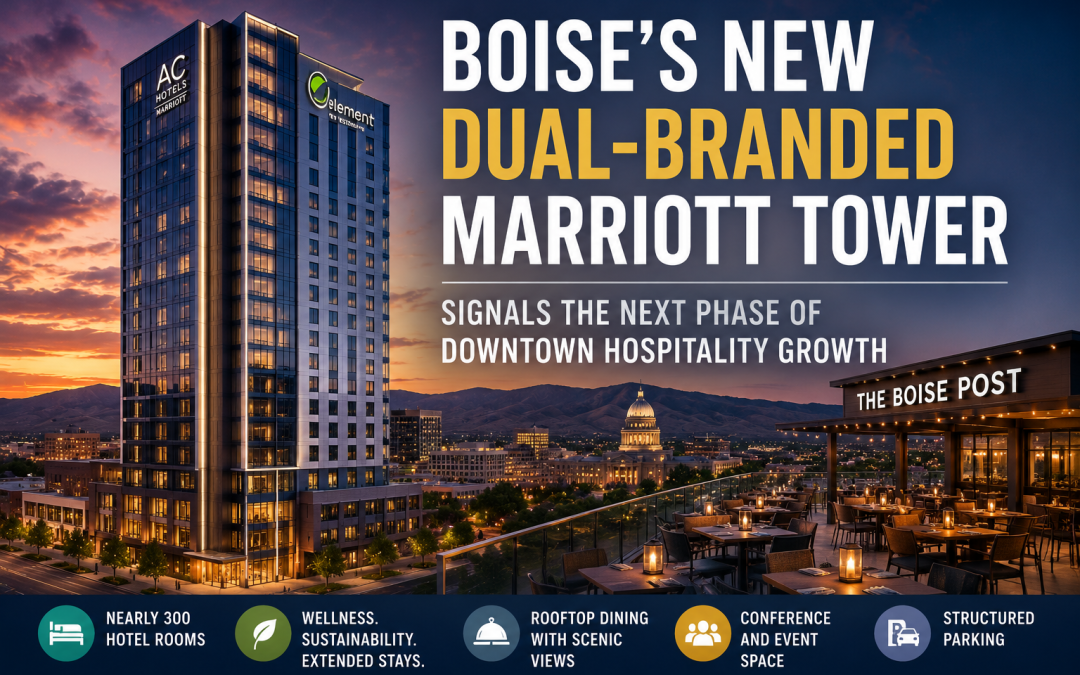
The project combines two Marriott brands — AC Hotels and Element Hotels — inside one tower, bringing nearly 300 hotel rooms, structured parking, conference space, and a rooftop restaurant into the downtown core.
But the bigger story is what this type of development says about where Boise development is heading next.
Hospitality Projects Are Becoming More Experience-Focused
One of the most important commercial real estate trends happening nationally is the shift away from “commodity” hospitality projects.
Hotels increasingly need to offer experiences, branding, lifestyle appeal, and food-and-beverage destinations rather than simply rooms.
This new downtown Boise project appears built around exactly that strategy.
The dual-brand concept allows the property to target multiple customer types at once:
- Business travelers
- Extended-stay guests
- Leisure travelers
- Conference attendees
- Downtown tourists
- Regional visitors
The Element Hotels side focuses heavily on wellness, natural light, sustainability, and longer stays.
The AC Hotels side emphasizes modern luxury, darker design elements, and a more upscale boutique-style atmosphere.
That flexibility matters because Boise’s visitor base is becoming more diverse.
Downtown Boise Continues Moving Toward a More Urban Identity
At 15 stories and roughly 180 feet tall, the project now ranks among the tallest buildings in Boise.
That may seem symbolic, but it also reflects something larger:
downtown Boise continues transitioning into a more vertically oriented urban core.
For years, Boise’s growth story centered mostly around suburban expansion in places like Meridian, Nampa, and Caldwell.
But downtown investment momentum has accelerated as more developers pursue:
- High-rise residential projects
- Mixed-use development
- Hospitality investments
- Structured parking
- Entertainment-driven retail
- Rooftop dining concepts
- Conference and event space
This project adds several of those elements into one development.
That creates more foot traffic, more restaurant demand, and more activity supporting surrounding retail leasing in Boise.
Rooftop Dining and Hospitality Are Becoming Economic Drivers
One of the most interesting aspects of the project is the rooftop restaurant concept known as The Boise Post.
Rather than functioning as a traditional hotel restaurant, the concept appears designed to compete as a standalone dining destination for both visitors and locals.
That distinction is important.
Across many western U.S. cities, hospitality projects increasingly rely on food-and-beverage experiences to drive revenue and differentiate properties.
The Boise Post leans heavily into regional identity with:
- Idaho-inspired cocktails
- Locally sourced ingredients
- Regional agricultural products
- Elevated dining experiences
- Scenic rooftop views
That type of destination-driven hospitality creates additional economic impact beyond hotel stays alone.
It can also help support downtown nightlife, tourism, conventions, and local spending activity.
Why This Matters for Boise Commercial Real Estate
This project reflects several major themes currently shaping Boise commercial real estate:
Mixed-use development is becoming more valuable
Developers increasingly want projects that combine hospitality, dining, parking, conference space, and entertainment into one integrated property.
Downtown land is becoming more strategic
As Boise grows, downtown parcels capable of supporting vertical density become increasingly valuable.
Experience-driven businesses continue outperforming
Consumers increasingly prioritize destinations and experiences over traditional transactional spaces.
Tourism and convention activity matter more
As Boise attracts more regional business activity, hospitality infrastructure becomes increasingly important for economic growth.
My Take
This hotel project is about more than tourism.
It is another sign that downtown Boise is becoming a more mature urban environment with stronger hospitality, entertainment, and mixed-use demand.
Projects like this help reinforce Boise’s image as a regional business and lifestyle destination rather than simply a smaller secondary market.
And as Boise continues attracting population growth, corporate activity, conventions, and tourism, expect more developers to pursue projects that blend hospitality, residential, retail, and experiential components together.
That evolution could continue reshaping downtown Boise for years to come.
Mike Gioioso (joy-OH-so) has for 16+ years been helping companies of all sizes buy, build, and lease perfect places for business in greater Boise, Idaho and beyond.
www.streetsmartidaho.com
mike@streetsmartidaho.com
208-209-9166
Tags: #boisecommercialrealestate, #downtownboisedevelopment, #boisehoteldevelopment, #boisehospitalitymarket, #boisemixedusedevelopment, #boiseretailmarket, #boisedevelopment, #boiseofficemarket, #treasurevalleycommercialrealestate, #boisetourismgrowth, #downtownboiserealestate, #retailleasingboise, #boiseinvestmentproperty, #boiserestaurantdevelopment, #boiserooftopdining