
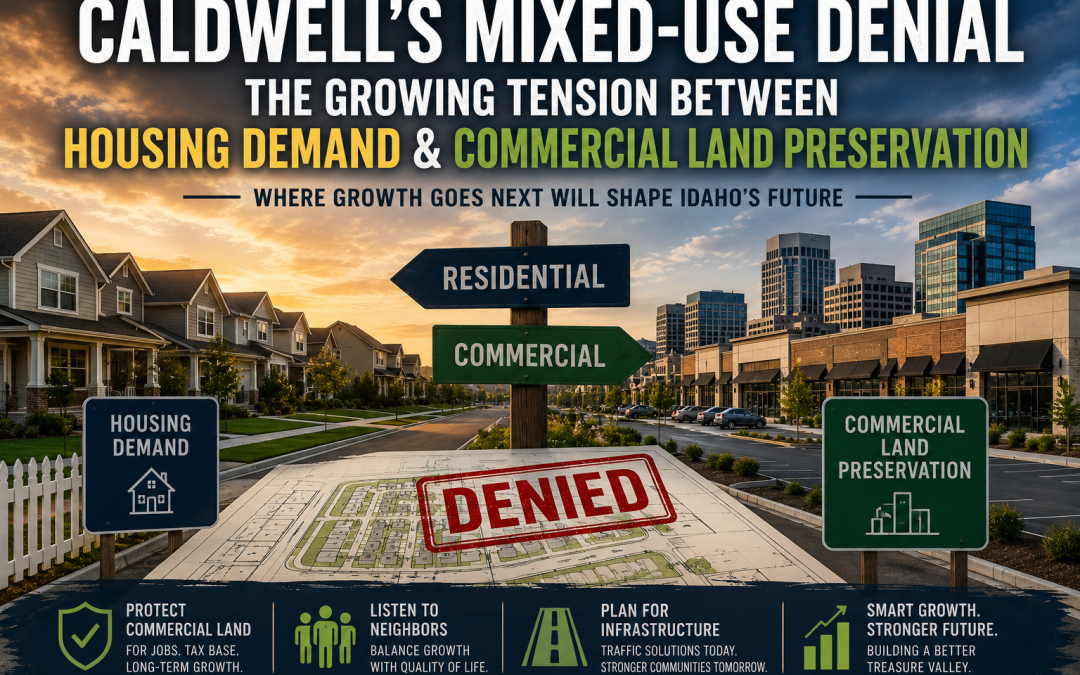
Caldwell’s Mixed-Use Denial Shows the Growing Tension Between Housing Demand and Commercial Land Preservation
One of the biggest challenges in Idaho real estate right now is not whether growth is happening.
It is figuring out where that growth should go.
A recent development debate in Caldwell highlights a growing issue that many Treasure Valley cities are now facing:
how to balance housing demand with the need to preserve commercial land for future economic growth.
According to reporting by Mariela Esquivel-Rodriguez in the Idaho Press article, the Caldwell City Council ultimately denied a proposed mixed-use subdivision known as the Ambrosia Subdivision after a split vote led to a deciding vote by the mayor.
The proposed project would have included:
- 56 single-family homes
- Seven commercial lots
- A rezoning request for part of a commercially zoned parcel
- Development on approximately 16.5 acres near Ustick Road and South 10th Avenue
The outcome may seem hyper-local, but it reflects much larger conversations happening across Boise commercial real estate and throughout the Treasure Valley.
Cities Are Becoming More Protective of Commercial Land
One of the most important aspects of this story is that some city leaders were hesitant to convert commercially zoned property into residential use.
That is becoming a much bigger issue across fast-growing Idaho communities.
As population growth accelerates, cities are trying to avoid a long-term imbalance where too much land becomes housing while not enough remains available for:
- Retail development
- Office space
- Employment centers
- Industrial growth
- Service businesses
- Tax-generating commercial uses
That matters because commercial land plays a major role in:
- Local job creation
- Sales tax generation
- Infrastructure funding
- Long-term economic sustainability
In many western growth markets, cities are beginning to push back more aggressively when developers request rezoning away from commercial use.
Neighborhood Pushback Is Becoming More Common
The article also highlighted another increasingly common development trend:
neighbor opposition centered around traffic, density, and compatibility concerns.
Nearby residents reportedly raised issues involving:
- Increased traffic
- Privacy impacts
- Two-story homes near single-story neighborhoods
- Overall project intensity
To the developers’ credit, the report described efforts to revise the project and negotiate with neighbors by:
- Increasing lot widths
- Adding more single-story homes
- Adjusting portions of the site plan
- Offering development agreement concessions
That reflects how entitlement processes across the Treasure Valley are becoming more collaborative — but also more difficult.
Developers today often must balance:
- City planning goals
- Community feedback
- Housing demand
- Infrastructure constraints
- Economic feasibility
Mixed-Use Development Is Still a Major Idaho Trend
Even though this proposal was denied, mixed-use development remains one of the strongest long-term trends in Boise-area real estate.
Cities throughout the Treasure Valley continue looking for ways to create projects that combine:
- Housing
- Retail
- Walkability
- Public gathering areas
- Commercial services
The challenge is determining where those projects fit best.
Some communities want mixed-use density concentrated in:
- Downtown cores
- Major corridors
- Designated growth areas
- Transit-oriented locations
Others remain cautious about introducing residential uses into commercially planned zones.
That tension will likely continue shaping Boise development conversations for years.
Why Traffic and Infrastructure Are Becoming Bigger Issues
One of the key debates in the council discussion involved traffic concerns and whether enough supporting evidence existed regarding vehicle impacts.
That issue is becoming increasingly important throughout Idaho commercial real estate as rapid growth places more pressure on:
- Road systems
- Intersections
- Utilities
- Schools
- Emergency services
- Public infrastructure
As the Treasure Valley grows outward, transportation planning is becoming one of the biggest variables affecting development approvals.
Projects located near already strained corridors may continue facing heavier scrutiny moving forward.
Local Insight: The Treasure Valley Is Entering a More Selective Growth Phase
For years, many Idaho communities were largely focused on encouraging development.
Now some cities are shifting toward managing development more carefully.
That is an important change.
Local governments are increasingly evaluating:
- Long-term land use strategy
- Commercial land preservation
- Infrastructure capacity
- Neighborhood compatibility
- Traffic impacts
- Economic diversification
For Boise commercial real estate investors and developers, this means entitlement risk may continue rising in certain submarkets.
The Treasure Valley is still growing rapidly.
But the approval process is becoming more nuanced, more political, and more focused on long-term planning outcomes than it was even a few years ago.
Mike Gioioso (joy-OH-so) has for 16+ years been helping companies of all sizes buy, build, and lease perfect places for business in greater Boise, Idaho and beyond.
www.streetsmartidaho.com mike@streetsmartidaho.com 208-209-9166
Tags: #boisecommercialrealestate, #caldwelldevelopment, #mixedusedevelopmentboise, #treasurevalleydevelopment, #idaholanduseplanning, #boisedevelopmenttrends, #caldwellcommercialrealestate, #idahozoningissues, #boisehousingdevelopment, #commerciallandpreservation, #mixeduserealestateidaho, #boiseinvestmentproperty, #idahocommercialrealestate, #treasurevalleygrowth, #boiserealestatetrends