
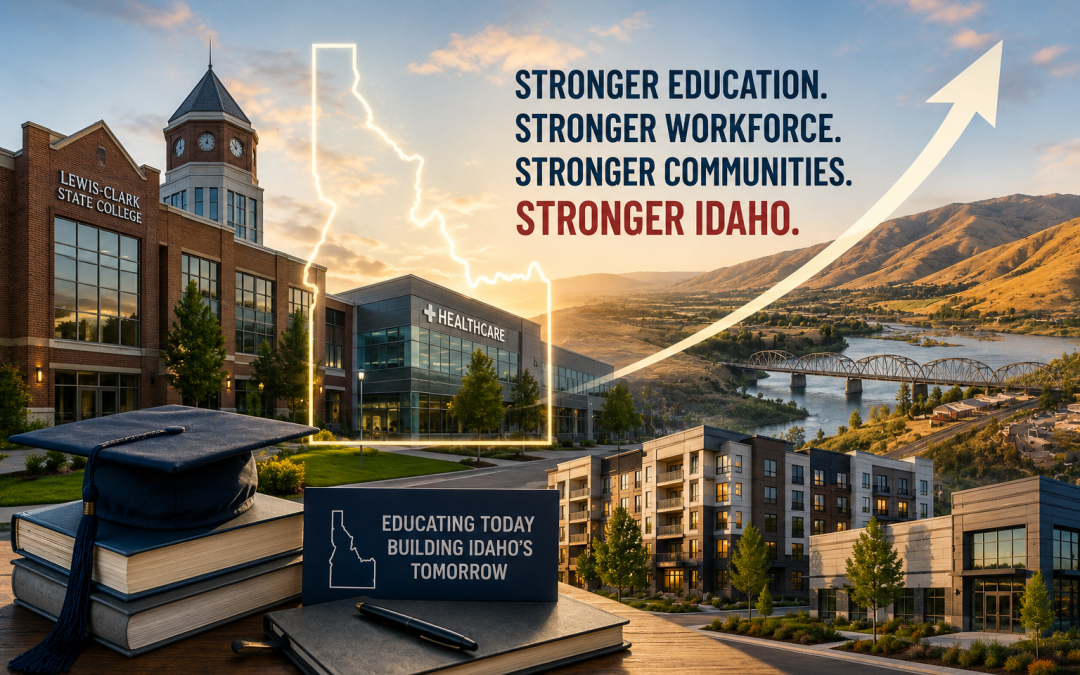
Idaho’s Expanding Higher Education System Could Create Long-Term Commercial Real Estate Growth Opportunities
One of the biggest long-term economic drivers in Idaho is not just population growth.
It is workforce development.
And a recent milestone at Lewis-Clark State College highlights how Idaho’s higher education system is evolving to support the state’s changing economy.
According to reporting by Idaho Business Review staff, Lewis-Clark State College will award its first-ever master’s degree during its May 15 commencement ceremony. You can read the original article here: LC State awards first master’s degree at May 15 commencement in Lewiston
At first glance, this may sound like a simple education story.
But from an Idaho commercial real estate perspective, it reflects a much larger trend happening across the state:
Idaho communities are investing more heavily in specialized workforce education to support long-term economic growth.
Why This Milestone Matters
The school’s first graduate degree will go to Ann Leung, who earned a Master of Science in Nursing Leadership in Healthcare.
That detail is especially important.
Healthcare remains one of the fastest-growing sectors tied to Idaho development, employment expansion, and commercial real estate demand. As Idaho’s population grows, demand continues increasing for:
- Healthcare facilities
- Medical office space
- Workforce housing
- Education partnerships
- Skilled labor pipelines
The graduate program itself reportedly became possible after Idaho lawmakers approved changes in 2020 allowing the college to offer graduate-level programs.
That shift shows how Idaho institutions are adapting to local workforce needs instead of relying entirely on larger metro universities.
Smaller Idaho Markets Are Becoming More Economically Important
One of the more overlooked commercial real estate trends in Idaho is the growing importance of regional cities outside the Boise metro.
Communities like Lewiston are continuing to strengthen their economic infrastructure through:
- Higher education expansion
- Healthcare growth
- Workforce training
- Manufacturing
- Logistics
- Regional business development
As those industries expand, they often create additional demand for:
- Retail leasing
- Multifamily housing
- Office space
- Hospitality development
- Industrial properties
That broader economic diversification helps stabilize regional real estate markets over time.
Idaho’s Workforce Growth Is Reshaping Real Estate Demand
One of the biggest challenges facing Idaho businesses right now is labor availability.
Many companies can find customers.
Finding skilled workers is harder.
That is why workforce-focused education investments increasingly matter to Idaho commercial real estate. Colleges and universities are becoming more connected to regional economic planning, healthcare systems, and employer recruitment strategies.
Programs tied to healthcare, nursing, trades, technology, and leadership development can influence where companies expand and where investors deploy capital.
In many ways, education infrastructure is becoming economic infrastructure.
Key Facts From the Announcement
- Lewis-Clark State College was founded in 1893
- The college will award 966 degrees and certificates this year
- Around 800 students are graduating
- The school’s first graduate degree is in nursing leadership
- Idaho law changed in 2020 to allow graduate programs at the college
- The school is also pursuing a future name change to Lewis-Clark State University
Each of those developments signals continued institutional growth.
And institutional growth often creates long-term commercial real estate ripple effects.
What This Could Mean for Idaho Commercial Real Estate
As Idaho’s educational institutions expand programs tied to workforce demand, several property sectors could benefit:
Healthcare Real Estate
Healthcare education growth often supports demand for clinics, medical office buildings, specialty care facilities, and healthcare-adjacent development.
Housing Demand
Expanding graduate programs can increase demand for student housing, workforce apartments, and long-term residential development near campuses.
Regional Economic Expansion
As smaller Idaho cities become more self-sustaining economically, they may attract additional employers and outside investment.
That can support future retail leasing, hospitality projects, and industrial development.
Local Insight
For years, much of Idaho’s economic attention has centered on Boise.
But long-term statewide growth will likely depend on whether smaller regional markets can continue building stronger employment ecosystems of their own.
Stories like this matter because they show Idaho communities investing in local talent development instead of relying entirely on outside labor migration.
That creates stronger economic durability.
And over time, stronger regional economies usually lead to stronger commercial real estate fundamentals.
Mike Gioioso (joy-OH-so) has for 16+ years been helping companies of all sizes buy, build, and lease perfect places for business in greater Boise, Idaho and beyond.
www.streetsmartidaho.com mike@streetsmartidaho.com 208-209-9166
Tags: #idahocommercialrealestate, #boisecommercialrealestate, #idahodevelopment, #boisedevelopment, #lewisclarkstatecollege, #lewistonidaho, #idahohighereducation, #workforcedevelopment, #healthcareeducation, #medicalofficespace, #idahohealthcare, #economicdevelopment, #commercialrealestate, #idahobusiness, #retailleasingboise