
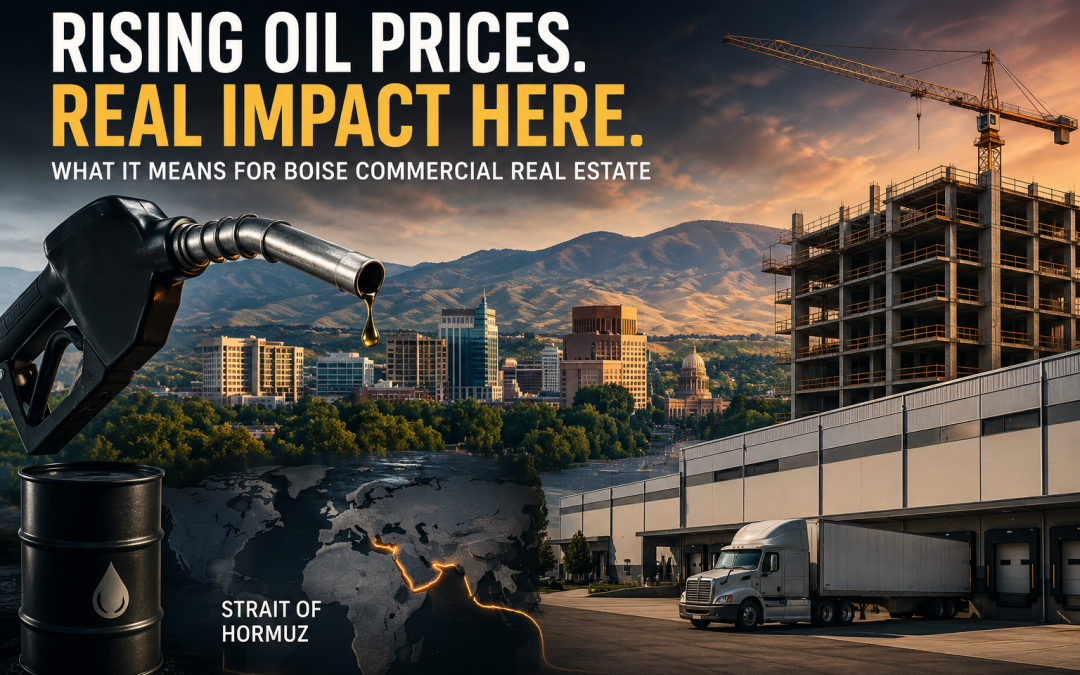
Why Rising Oil Prices Could Quietly Reshape Boise Commercial Real Estate
Most people see rising gas prices as a consumer problem.
But in Boise commercial real estate, higher oil prices can ripple through nearly every part of the market — from construction costs and shipping expenses to tenant demand and development timing.
According to reporting by Reuters and the Idaho Business Review (read the original article here: ), global oil markets remain volatile as tensions escalate around the Strait of Hormuz, one of the world’s most important shipping corridors.
And while oil prices dipped slightly after U.S. military efforts reopened limited shipping access, the broader uncertainty is still pushing fuel prices higher across the United States — including Idaho.
Why This Global Conflict Matters in Idaho
At first glance, conflict in the Middle East may seem far removed from the Treasure Valley.
But energy costs impact almost every layer of the economy.
The Strait of Hormuz handles a major share of the world’s oil and liquefied natural gas shipments. Any disruption there immediately affects transportation costs, manufacturing, freight movement, and construction pricing worldwide.
That matters locally because Boise continues to grow rapidly.
More growth means:
- More construction materials being shipped
- More trucking demand
- More regional logistics activity
- More infrastructure spending
- More commuting across the Treasure Valley
When oil prices jump, those costs move higher too.
Brent crude recently climbed above $111 per barrel before easing slightly, while U.S. oil prices stayed elevated as military conflict between the U.S. and Iran intensified in the Gulf region. Reuters reported that merchant ships experienced explosions and fires, while shipping companies relied on military escorts to navigate the area safely.
Idaho Drivers Are Already Feeling the Pressure
The biggest immediate impact is showing up at the gas pump.
According to AAA Idaho, average gasoline prices in Idaho reached roughly $4.46 per gallon this week — matching the national average.
That’s:
- Higher than last week
- Higher than last month
- More than a dollar above prices from a year ago
While Idaho is no longer among the ten most expensive states for fuel, drivers across the Treasure Valley are still dealing with significantly elevated transportation costs.
And those higher costs can eventually influence:
- Retail spending habits
- Consumer travel patterns
- Restaurant traffic
- Distribution expenses
- Employee commuting decisions
For retailers and restaurant operators, especially those evaluating retail leasing in Boise, fuel-sensitive consumer behavior becomes something worth monitoring closely.
Construction and Development Could Face New Cost Pressures
One of the biggest long-term commercial real estate impacts may come from development costs.
Oil affects:
- Asphalt pricing
- Roofing materials
- Steel production
- Concrete transportation
- Heavy equipment operation
- Freight shipping
That means developers working on projects across Boise, Meridian, Nampa, Caldwell, Star, and Kuna could see tighter construction margins if global instability continues.
In fast-growing markets like the Treasure Valley, timing becomes critical.
Projects that penciled six months ago may suddenly face:
- Higher contractor bids
- Delayed material deliveries
- Increased tenant improvement costs
- Higher operating expenses
For investors, this creates a more selective environment where efficient projects and well-located properties become even more valuable.
Industrial and Logistics Real Estate May Stay Strong
Interestingly, periods of global supply chain stress often reinforce the importance of regional logistics hubs.
That could benefit parts of the Idaho industrial market.
As companies continue diversifying shipping strategies and inventory management, demand for:
- Warehouse space
- Distribution centers
- Flex industrial buildings
- Transportation-oriented sites
could remain strong throughout the Treasure Valley.
Boise’s location along major western transportation corridors still positions the region well for long-term industrial growth — even if short-term volatility creates uncertainty.
My Take: Boise Still Looks Resilient, But Costs Matter
From a local commercial real estate perspective, this story is less about panic and more about pressure.
Boise’s population growth, business migration, and development momentum haven’t disappeared.
But higher energy costs can slow decision-making.
Businesses may become more cautious about expansion timelines. Developers may reevaluate project budgets. Retailers could focus more heavily on high-traffic, efficient locations.
In many ways, this environment rewards smart positioning.
Properties with:
- Strong visibility
- Efficient layouts
- Lower operating costs
- Good regional access
- Established tenant demand
may outperform as companies become more cost-conscious.
For Boise commercial real estate investors, the key is watching how long global instability lasts — and how deeply it affects consumer confidence and development economics here in Idaho.
Mike Gioioso (joy-OH-so) has for 16+ years been helping companies of all sizes buy, build, and lease perfect places for business in greater Boise, Idaho and beyond.
www.streetsmartidaho.com mike@streetsmartidaho.com 208-209-9166
Tags: #boisecommercialrealestate, #boiserealestatetrends, #boisedevelopment, #retailleasingboise, #boiseindustrialmarket, #treasurevalleycommercialrealestate, #idahogasprices, #risingoilprices, #globaloilprices, #boiseinvestmentproperty, #commercialrealestatetrends2026, #boiselogisticsmarket, #industrialrealestateboise, #idahodevelopmenttrends, #boiseretailmarket, #constructioncostsboise, #boisewarehousemarket, #treasurevalleydevelopment, #meridiancommercialrealestate, #nampacommercialrealestate