Idaho Falls’ On-Demand Transit Experiment Offers Lessons for Boise Growth and Commercial Real Estate
What if improving transportation in a growing Idaho city didn’t require adding more full-size buses?
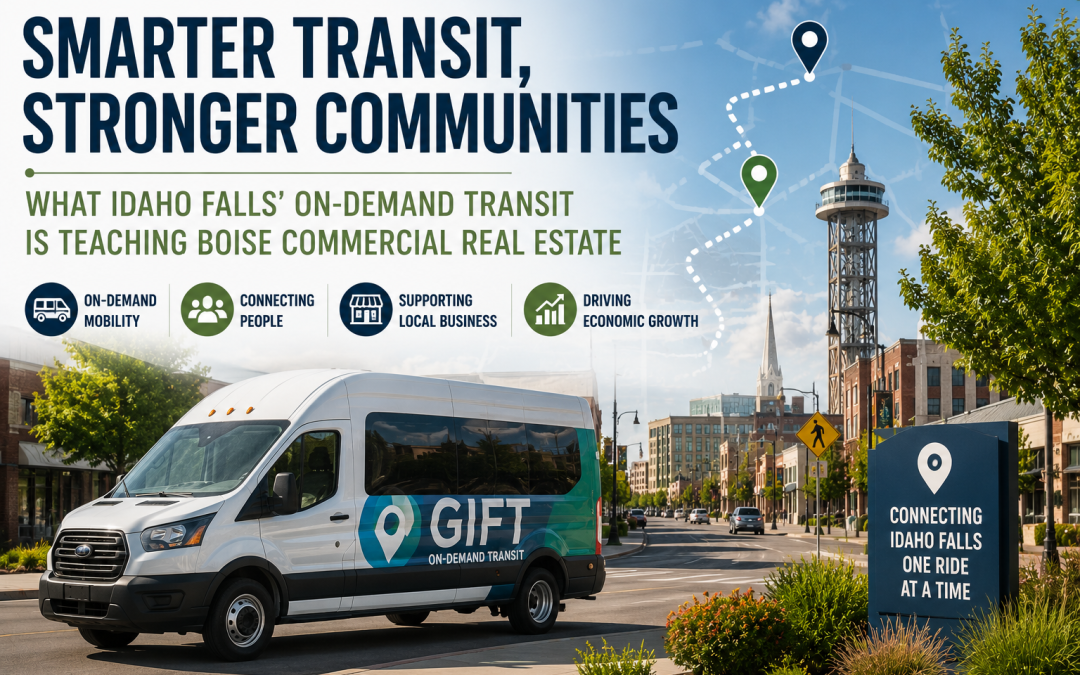
Idaho Falls is testing a very different approach. Instead of rebuilding the traditional bus network it lost several years ago, the city created an on-demand system using a small fleet of minivans.
The result is worth watching from Boise.
According to reporting by Heide Brandes in the Idaho Business Review, Greater Idaho Falls Transit, or GIFT, delivered more than 83,000 rides during 2025 with just eight vehicles. The full story is available from the Idaho Business Review.
This may look like a transportation story, but it is also a commercial real estate and economic development story. How easily people can reach jobs, stores, medical offices, restaurants, and downtown businesses directly affects how those properties perform.
For Boise commercial real estate, the Idaho Falls experiment raises an interesting question: As the Treasure Valley keeps growing, could smaller and more flexible transportation systems help connect people with commercial districts without relying entirely on parking?
Idaho Falls Rebuilt Transit Like a Startup
The story starts with failure.
The Targhee Regional Public Transportation Authority stopped operating in 2019. That left Idaho Falls without public transportation and created real problems for residents who depended on the service to reach jobs, pharmacies, medical appointments, and other destinations.
Rather than recreate the same system, local leaders eventually built something different.
GIFT On-Demand launched in 2022 with the help of a $4.2 million federal CARES Act grant administered through the Idaho Transportation Department.
Instead of operating large buses along fixed routes, passengers request rides through an app or by phone. Smaller vehicles then group trips together and provide door-to-door service throughout the city’s roughly 33-square-mile service area.
The economics are dramatically different from conventional bus transit.
According to the Idaho Business Review, GIFT’s competitively purchased minivans cost around $40,000 each. Drivers don’t need commercial driver’s licenses, and the vehicles can access residential streets that would be difficult for large buses.
The fleet totaled just eight vehicles in 2025.
Yet those vehicles provided 83,768 rides serving 101,237 passengers during the year.
About 62% of trips were shared, and average wait times were approximately 22 minutes.
The previous transit system, by comparison, was estimated to have provided roughly 15,000 to 20,000 annual rides at its peak.
That’s a major productivity difference.
Transportation Is Really About Access to Commercial Real Estate
Commercial real estate professionals spend a lot of time thinking about parking.
How many spaces does a tenant need?
Does a restaurant have enough parking during dinner?
Can employees get to the office?
Will customers avoid downtown because finding a space is difficult?
Those are real questions. But Idaho Falls demonstrates that the solution doesn’t always have to be another parking lot or parking garage.
Transportation can become part of the solution.
GIFT reportedly kept about 12,000 private vehicles out of downtown Idaho Falls during 2025.
That’s meaningful from a commercial real estate perspective.
If fewer customers and employees need to park directly in front of their destinations, the effective capacity of existing parking increases.
That can help downtown districts support more restaurants, retailers, offices, entertainment, and residential development without requiring every property to independently solve its parking problem.
Idaho Falls is even exploring a program that could connect transit directly with downtown spending. Under the concept being discussed with the Idaho Falls Downtown Development Corporation, customers who spend money at participating downtown businesses could potentially receive complimentary transportation.
Think about what that means.
Transportation effectively becomes a retail incentive.
Instead of a business validating a parking ticket, it could validate the customer’s ride.
That is a small change in thinking, but potentially a significant one.
Why Boise Retail and Downtown Property Owners Should Pay Attention
Boise faces many of the same growth pressures Idaho Falls is trying to manage, only on a larger scale.
Downtown Boise has finite land.
Every parcel used for surface parking is land that can’t simultaneously support housing, restaurants, retail, office space, hotels, or other productive uses.
Parking structures can solve part of that problem, but they’re expensive.
That makes transportation increasingly connected to Boise development.
If workers, customers, and residents have more ways to reach commercial districts, developers potentially gain greater flexibility in how land is used.
This matters beyond Downtown Boise.
Think about the growth occurring throughout Meridian, Nampa, Caldwell, Kuna, and Star.
As the Treasure Valley expands geographically, transportation becomes increasingly important to commercial site selection.
Retailers want access to customers.
Employers need access to workers.
Healthcare providers need patients to reliably reach appointments.
Restaurants need both employees and diners.
A property can have excellent demographics and still struggle if customers or employees can’t conveniently reach it.
That makes mobility part of commercial real estate infrastructure, just like roads, utilities, and broadband.
The Rider Data Challenges an Old Assumption
One particularly interesting part of the Idaho Falls experiment is who actually uses it.
It’s easy to assume public transportation in smaller Idaho communities primarily serves seniors or people without other options.
The rider data tells a broader story.
The largest user group is reportedly people between 18 and 34 years old.
That includes students and younger workers who may be saving for a vehicle.
Seniors represent around 30% of approximately 10,000 monthly riders.
GIFT also serves researchers and interns associated with Idaho National Laboratory, including people arriving from larger cities who may not own vehicles or even have driver’s licenses.
That’s important for economic development.
When companies recruit nationally, they’re bringing employees from places where driving everywhere isn’t necessarily normal.
Transportation options can therefore become part of workforce recruitment.
That applies directly to the Treasure Valley.
Boise competes nationally for employers and skilled workers. If someone relocates from Seattle, Portland, San Francisco, Chicago, Boston, or New York, their expectations about transportation may be different from those of a lifelong Idaho resident.
Commercial real estate needs to evolve with those expectations.
Healthcare Shows Another Side of the Real Estate Equation
Transportation also directly affects healthcare real estate.
A medical building doesn’t perform well if patients consistently miss appointments because they can’t get there.
Idaho Falls has created partnerships designed around that problem.
According to the Idaho Business Review, a local clinic pays GIFT so qualifying patients can receive transportation without paying individually.
Eastern Idaho Public Health has also contracted with the transit program to help people reach certain required appointments.
These partnerships demonstrate something commercial property owners sometimes overlook:
Accessibility affects tenant performance.
For medical office landlords, proximity to patients isn’t enough.
Patients need a practical way to reach the building.
The same principle applies to employers. A warehouse might have affordable rent and excellent interstate access, but if workers have difficulty reaching it, labor recruitment becomes harder.
That is why transportation should increasingly be part of site-selection conversations throughout Boise commercial real estate.
Flexible Transit Could Complement Treasure Valley Growth
Boise already has public transportation infrastructure, so the lesson from Idaho Falls isn’t that the Treasure Valley should simply copy GIFT.
The more interesting idea is flexibility.
Traditional fixed-route transit works best when enough people travel along predictable corridors.
But Treasure Valley growth is increasingly spread across a wide geography.
Jobs are in Boise, Meridian, Nampa, Caldwell, and beyond.
Housing is expanding into Kuna, Star, Middleton, and other communities.
Retail follows residential growth.
Industrial development follows transportation corridors and available land.
That makes mobility increasingly complicated.
A smaller on-demand service could potentially complement traditional transportation by connecting areas where fixed routes aren’t practical.
That could be particularly useful for:
- Major employment centers
- Medical campuses
- Downtown districts
- Industrial parks
- Universities and schools
- Senior communities
- Large mixed-use developments
- Entertainment districts
From a developer’s perspective, transportation partnerships could eventually become another amenity.
Imagine a large mixed-use development offering residents or employees access to a shared transportation service.
Or an industrial park helping workers connect from a transit station to individual employers.
Or a shopping district subsidizing rides during major events.
Those aren’t traditional real estate amenities, but they could become more relevant as the Treasure Valley grows.
The Biggest Challenge Is Still Funding
Idaho Falls’ experiment isn’t without challenges.
The original federal funding that helped launch the program has largely been spent.
Idaho provides no state operating funding for transit, according to the Idaho Business Review, so GIFT now relies on a combination of federal and local sources along with fares, contracts, advertising, and partnerships.
The program has tried to diversify its revenue.
Healthcare organizations pay for transportation programs. Businesses and institutions purchase advertising on vehicles. Passenger fares vary depending on the type and timing of the ride.
Even neighboring communities have expressed interest in participating.
That financial creativity may be one of the most important parts of the model.
Instead of expecting one funding source to carry the entire system, GIFT is trying to build a network of users and organizations that benefit from transportation and contribute toward its cost.
Commercial real estate could be one of those beneficiaries.
If transportation increases customer traffic, expands the labor pool, reduces parking pressure, or improves medical appointment attendance, landlords and businesses have an economic reason to care about it.
Local Insight: Mobility Is Becoming a Real Estate Amenity
For years, Boise commercial real estate site selection has focused heavily on three things:
location, visibility, and parking.
Those aren’t going away.
But I think another factor will become increasingly important:
mobility.
How many different ways can someone reach the property?
Can employees get there without owning a car?
Can customers reach the business conveniently?
Can seniors access healthcare?
Can downtown add density without building parking spaces for every new customer, resident, and employee?
Those questions will become more important as Boise and the Treasure Valley continue growing.
The Idaho Falls experiment suggests that solving them doesn’t necessarily require billion-dollar infrastructure.
Sometimes smaller, technology-driven solutions can make existing commercial districts work more efficiently.
My Take
What I find most interesting about GIFT isn’t the minivans.
It’s the mindset.
Idaho Falls lost its old transportation system and didn’t simply recreate what had failed. Local leaders looked at the problem differently and built a smaller model around actual demand.
Commercial real estate investors and developers can learn from that.
We often inherit assumptions about how properties are supposed to work.
Retail needs this much parking.
Office needs that much parking.
Transit needs large buses.
Industrial workers drive themselves.
But markets change.
Technology changes.
Consumer behavior changes.
The strongest Boise development projects over the next decade may be the ones willing to question some of those assumptions.
As land becomes more valuable and the Treasure Valley becomes more populated, using every acre efficiently will matter more.
Transportation won’t replace parking.
But better mobility could help Boise get more economic productivity from the commercial real estate it already has — and create more flexibility for what gets developed next.
Mike Gioioso (joy-OH-so) has for 16+ years been helping companies of all sizes buy, build, and lease perfect places for business in greater Boise, Idaho and beyond.
www.streetsmartidaho.com mike@streetsmartidaho.com 208-209-9166
Tags: #boisecommercialrealestate, #boiserealestate, #boisedevelopment, #boisetransportation, #boisepublictransit, #boisetransit, #boisedowntowndevelopment, #downtownboise, #downtownboisecommercialrealestate, #boiseeconomicdevelopment, #boiseinvestmentproperty, #boiseretailrealestate, #retailleasingboise, #boiseofficerealestate, #boisemedicalrealestate