
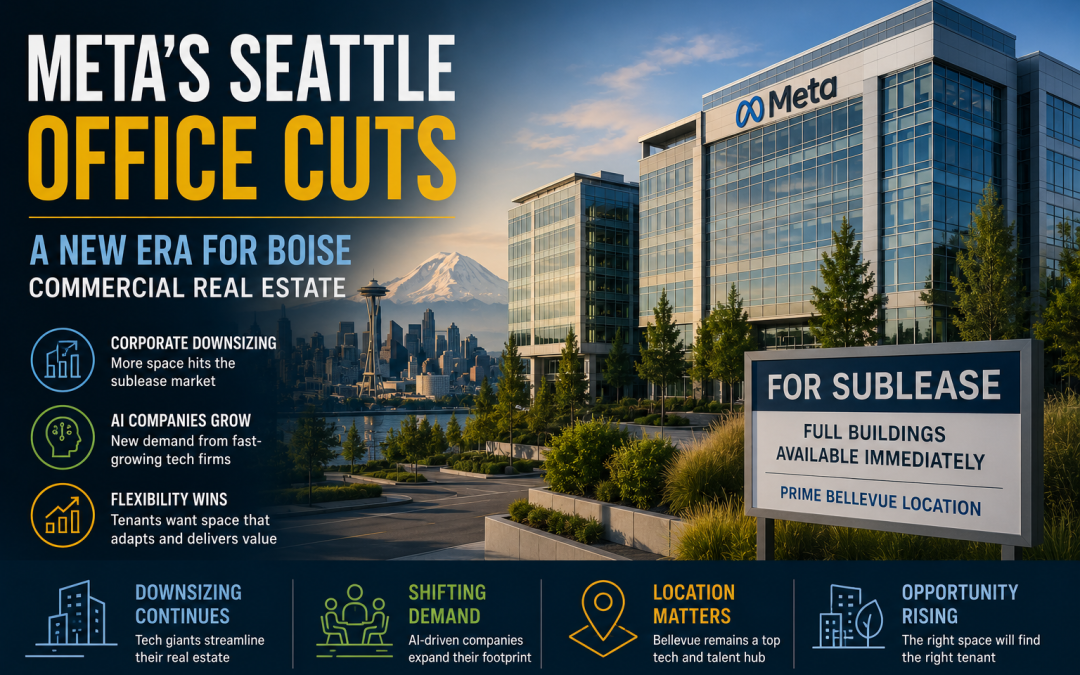
Meta’s Seattle Office Cuts Reveal a Bigger Shift Boise Landlords Should Watch
A company can shrink its office footprint while another company expands into the exact same space.
That may sound contradictory, but it is becoming one of the defining features of today’s office market.
Meta is putting hundreds of thousands of additional square feet on the sublease market around Seattle as it continues reducing its real estate footprint. At the same time, artificial intelligence companies are expanding rapidly in the region and absorbing some of the space left behind by traditional technology companies.
For Boise commercial real estate, that creates an important lesson: office demand isn’t simply disappearing. The companies creating that demand—and what they expect from their offices—are changing.
According to reporting by Katie Burke of CoStar News, Meta is marketing two additional buildings for sublease at the Spring District campus in Bellevue, Washington. The original CoStar News article details the company’s continued Seattle-area downsizing and the emerging demand from AI-related businesses.
The Seattle market is much larger than Boise, but the forces reshaping it can provide clues about where Boise office real estate could be heading.
Corporate Downsizing Is Creating a New Kind of Office Inventory
Meta’s latest move is substantial.
The company is looking to sublease nearly 544,000 square feet across two buildings in Bellevue’s Spring District.
Meta originally committed to the buildings in 2021, when large technology companies were still aggressively securing office space for anticipated growth.
The world changed quickly after that.
Remote work expanded. Technology companies reduced headcounts. Corporate efficiency became a priority. And investment increasingly shifted toward areas such as artificial intelligence.
Meta’s real estate portfolio changed with those priorities.
At its peak, the company controlled roughly 1.8 million square feet through ownership or leases at the Bellevue campus, according to CoStar.
Now, another major portion of that footprint is being offered to other companies.
There is one particularly interesting detail: the newly marketed buildings were never fully built out for Meta.
The available space remains largely unfinished inside, and the sublease runs through 2037.
That creates both a challenge and an opportunity.
A new tenant would need to invest heavily in improvements, but it could also potentially design a large amount of modern space specifically around its needs.
Yesterday’s Expansion Space Can Become Tomorrow’s Opportunity
The Seattle situation illustrates how quickly corporate real estate strategies can change.
Before the pandemic, major technology companies often leased buildings years before construction was complete.
They were planning around rapid hiring.
The risk wasn’t having too much space.
The risk was not having enough.
That mentality produced enormous leases and encouraged developers to build additional office inventory.
Today, companies are approaching real estate differently.
Businesses are asking more questions before committing:
How many employees will actually use the office?
How often will they come in?
How much space do we really need?
Can the office help recruit employees?
Can the space adapt if our company changes?
Those questions are creating a more disciplined office market.
And that has implications for Boise office leasing.
Boise companies may not be leasing half-million-square-foot campuses, but the same decision-making process applies to a 5,000-square-foot office.
Businesses increasingly want flexibility.
AI Companies Are Becoming the New Office Demand Driver
The other half of the Seattle story may be even more important.
While Meta continues reducing space, technology companies tied to artificial intelligence are expanding.
Technology businesses accounted for approximately 42.5% of Seattle-area leasing activity during the second quarter, according to JLL data cited by CoStar.
AI-related companies alone represented more than 21.5% of the region’s leasing activity during the year.
Their combined Seattle-area footprint has grown beyond 855,000 square feet, more than twice what it was two years earlier.
That is significant.
Companies including OpenAI, Anthropic and xAI have established operations in the Seattle region as they compete for technology talent.
And many fast-growing businesses are choosing subleases.
Why?
Speed and flexibility.
A rapidly expanding company may not want to sign a traditional long-term lease and spend a year designing and constructing an office.
It may want space now.
That makes existing offices—particularly high-quality furnished or partially completed space—much more valuable.
What Boise Landlords Can Learn From the Sublease Market
Sublease space is often viewed negatively.
When companies begin dumping offices onto the market, landlords worry about competing inventory.
That’s understandable.
But subleases can also become a bridge between different generations of tenants.
A company that leased too much space several years ago may provide the ready-to-use office needed by today’s growing company.
For Boise commercial real estate landlords, that makes flexibility increasingly valuable.
A tenant looking for 7,500 square feet today may need 12,000 square feet two years from now.
Another business may want only 3,000 square feet but doesn’t want to spend hundreds of thousands of dollars building it out.
Properties that can accommodate changing requirements could outperform rigid office layouts.
This is one reason smaller suites, move-in-ready offices and flexible expansion rights may become more important in Boise office leasing.
The Best Office Space Can Still Find a User
Meta has already demonstrated that unwanted space isn’t necessarily unusable space.
The company previously placed another Spring District building on the sublease market.
Snowflake ultimately leased the entire building.
A similar situation occurred elsewhere in Seattle, where Apple took over a large office building previously committed to Meta.
That’s a valuable reminder.
The original tenant leaving doesn’t determine whether the real estate is good.
Sometimes the tenant’s business strategy changes while the building remains perfectly functional.
That distinction matters for investors.
A vacant or subleased building in a strong location may still have substantial value if the space can attract another growing company.
For Boise investment property, investors should evaluate the real estate separately from the tenant that happens to occupy it today.
Ask:
Would another company want this building?
If the current tenant leaves, how difficult would it be to divide the space?
How much would it cost to renovate?
Does the location attract employees?
Is there enough parking?
Can the property support several smaller tenants?
Those questions reveal the property’s long-term flexibility.
Boise Doesn’t Need Seattle-Sized Tech Companies to Benefit
Boise’s technology sector operates at a different scale.
But that doesn’t mean the trend isn’t relevant.
The Treasure Valley has an established technology ecosystem, anchored by major employers and supported by growing software, semiconductor, engineering and professional-service businesses.
Artificial intelligence will likely create new businesses and reshape existing ones here as well.
Those companies may not need massive campuses.
In fact, many could begin with relatively small teams.
That creates an opportunity for Boise office space in the 2,000- to 15,000-square-foot range, particularly space that is already finished and ready for occupancy.
Downtown Boise could be particularly attractive for companies competing for younger professional talent because of walkability, restaurants, entertainment and proximity to other businesses.
Meridian could appeal to companies prioritizing parking, suburban access and proximity to employees living throughout the Treasure Valley.
Different tenants will prioritize different things.
That’s why flexibility matters.
Office Design Is Becoming Part of Recruiting
There is another reason premium office space can continue performing even when companies reduce overall square footage.
Employers need employees to want to come to the office.
A company that once occupied 20,000 square feet may decide it only needs 12,000.
But it may spend considerably more per square foot making that smaller office better.
That could mean upgraded kitchens, collaboration spaces, natural light, conference rooms, wellness areas and better furniture.
The office becomes less about storing employees and more about creating an environment for collaboration.
For Boise office landlords, that means investing in quality could be more valuable than simply offering cheap rent.
A dated office may be inexpensive.
But if employees don’t want to work there, the savings may not matter to the company making the leasing decision.
Local Insight: Flexibility May Become One of the Most Valuable Amenities
For years, commercial brokers talked about parking, signage and location as the major office amenities.
Those still matter.
But I think flexibility belongs on that list now.
Businesses want the ability to grow, shrink and adapt.
Landlords who can provide that flexibility may have an advantage.
That could mean offering expansion options, creating smaller speculative suites, allowing reasonable assignment and subleasing rights, or designing floor plans that can be divided without major reconstruction.
The easier a building is to adapt, the larger the pool of potential tenants.
That can also reduce risk for investors.
My Take
Meta’s continued Seattle downsizing shouldn’t be interpreted as another sign that office real estate is dead.
I think it shows something more interesting.
The users are changing faster than the buildings.
Meta leased enormous amounts of space based on one vision of its future.
That vision changed.
Now AI companies, cloud businesses and other growing firms are beginning to occupy some of the space that established technology companies no longer need.
Boise will experience its own version of this transition.
Some companies will shrink.
Others will grow.
New industries will emerge.
Businesses that barely exist today could become meaningful office tenants several years from now.
For Boise landlords and investors, the goal shouldn’t be predicting exactly which company will occupy a building ten years from now.
The goal should be owning or creating space that many different companies could use.
That means good locations, functional layouts, modern improvements, reasonable parking and the ability to adapt.
In the next chapter of Boise commercial real estate, flexibility may be just as important as location.
Because the companies occupying our offices will keep changing.
The best buildings will be ready when they do.
Mike Gioioso (joy-OH-so) has for 16+ years been helping companies of all sizes buy, build, and lease perfect places for business in greater Boise, Idaho and beyond.
www.streetsmartidaho.com mike@streetsmartidaho.com 208-209-9166
Tags: #boisecommercialrealestate, #boiserealestate, #boiseofficerealestate, #boiseofficespace, #boiseofficeleasing, #officeleasingboise, #boisecommercialleasing, #boiseofficemarket, #downtownboiseofficespace, #boiseinvestmentproperty, #boiseofficeinvestment, #boisecommercialproperty, #boisedevelopment, #treasurevalleycommercialrealestate, #treasurevalleyofficemarket