
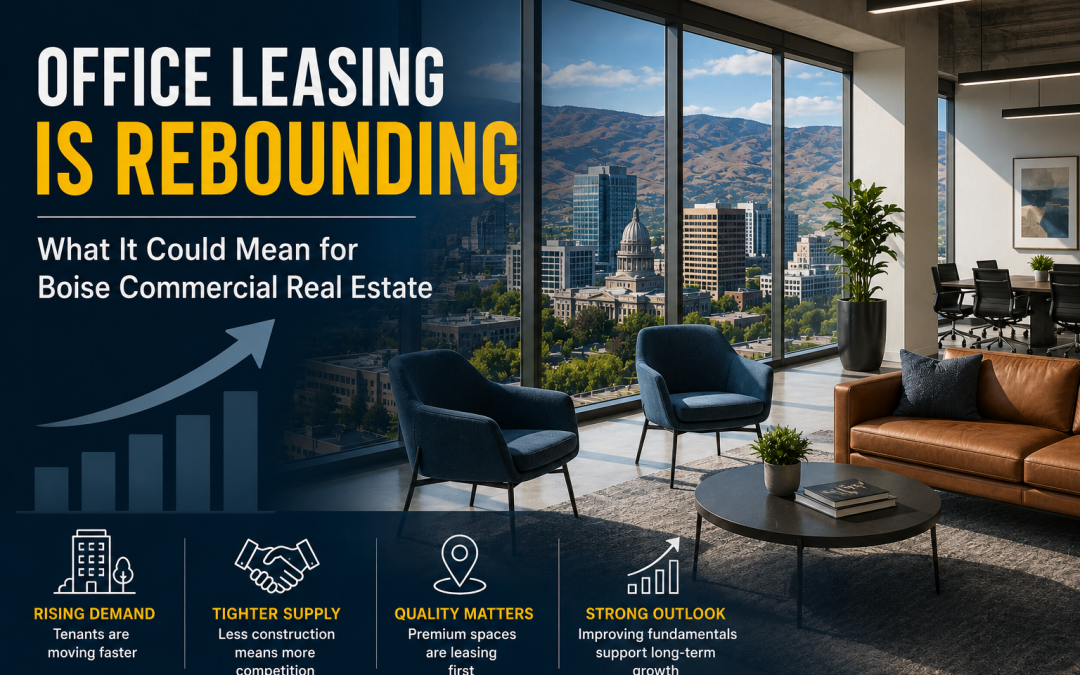
Office Leasing Is Waking Up Again: What the National Rebound Could Mean for Boise
After several difficult years, the office market is starting to show something landlords haven’t seen much of lately: urgency.
Companies in several major West Coast markets are competing for better-quality office space, leasing volume is improving, new construction has slowed dramatically, and vacancy is finally beginning to move in the right direction.
That doesn’t mean every office building is suddenly healthy. Far from it. But it could signal an important change in the balance between tenants and landlords—and there are lessons here for Boise commercial real estate.
According to reporting by Katie Burke of CoStar News, Hudson Pacific Properties is seeing stronger leasing and investment activity across its West Coast office portfolio. The original CoStar News article details how the landlord is responding by increasing leasing activity while selectively selling properties as buyer interest improves.
For Boise owners, investors and businesses, the most important takeaway isn’t what one large REIT is doing. It’s what happens when office demand begins recovering at the same time the supply pipeline dries up.
The Office Market Is Starting to Shift
For years, office tenants had leverage.
Many companies could tour several buildings, negotiate aggressive improvement packages and take months to make a decision. Landlords were competing heavily for a limited pool of tenants.
That dynamic appears to be changing in some markets, particularly for the best buildings.
Hudson Pacific CEO Victor Coleman told analysts that companies considering high-quality offices are making decisions faster because they have fewer attractive alternatives.
The company’s numbers help illustrate the shift.
Hudson completed approximately 1.3 million square feet of new and renewal leasing during the second quarter, although a large portion came from a major government lease in San Francisco.
More important for future demand, the company said it was negotiating another 2.4 million-plus square feet of potential leases.
Roughly 70% of that pipeline represented prospective new leases rather than renewals, and the average transaction was more than 20,000 square feet.
Property tours were also running about 20% higher than a year earlier.
That combination—more tours, more negotiations and faster decisions—is worth watching.
The Supply Side May Be the Bigger Story
Improving demand gets most of the attention, but the lack of new construction may be even more important.
According to CBRE data cited by CoStar, companies nationwide signed more than 62.4 million square feet of office leases over the previous year, representing an increase of roughly 16%.
Meanwhile, only about 2.2 million square feet of new office space was completed during the same period, down approximately 45% from the prior year.
That’s a major imbalance.
When demand improves while developers aren’t adding much new inventory, existing high-quality buildings can become more valuable.
National vacancy is also beginning to reflect that improvement.
CoStar data cited in the article shows the overall office vacancy rate has moved below 14%, while vacancy among premium properties is around 8%.
Those numbers reinforce one of the biggest themes emerging in commercial real estate:
The office recovery isn’t happening equally.
The best buildings are recovering first.
Boise Could See the Same Flight to Quality
That distinction is especially relevant for Boise office real estate.
The question isn’t simply whether companies still need offices.
They do.
The more important question is: What kind of office space do they want?
Businesses have become much more selective since remote and hybrid work changed how companies use space.
An employer may need fewer square feet than it did several years ago, but the space it keeps often needs to work harder.
That means better locations, more natural light, modern finishes, efficient layouts, strong parking, nearby restaurants and amenities, and an environment employees actually want to use.
For Downtown Boise office space, that could benefit buildings near restaurants, coffee shops, entertainment and walkable amenities.
In suburban Boise, Meridian and Eagle, the winners may be buildings offering convenient parking, modern interiors and easy access from growing residential areas.
Older commodity office space without those advantages could continue struggling even while the broader market improves.
Less Construction Could Eventually Tighten Boise Supply
The national construction slowdown also deserves attention locally.
Office development is difficult to finance today.
Construction costs remain high, lenders are cautious and developers generally need significant preleasing before starting a project.
That makes speculative office construction difficult to justify.
If very little new office inventory gets built while existing companies continue expanding and new employers enter the Treasure Valley, the supply-demand balance could gradually tighten.
It won’t happen overnight.
But commercial real estate markets often turn before people realize they’ve turned.
Today’s oversupply can become tomorrow’s shortage when development pipelines remain empty long enough.
For Boise developers, that makes the next several years interesting.
There may eventually be opportunities for well-designed office projects, but they will likely need to be highly targeted rather than generic speculative buildings.
What This Means for Boise Tenants
Tenants shouldn’t interpret improving national statistics as a reason to panic.
Boise businesses still have choices.
But companies looking for the best office space in Boise may want to pay attention to leasing activity within the specific buildings they are considering.
The market can have plenty of vacancy overall while the most desirable properties have very little.
That creates two different office markets at the same time.
Companies primarily focused on price may still find attractive deals in older or less centrally located buildings.
Businesses focused on recruiting, branding, client experience and employee retention may find themselves competing for a much smaller group of premium spaces.
That’s when waiting too long can become expensive.
A tenant may lose its first choice and end up spending more money improving its second choice.
What This Means for Boise Landlords
Landlords should be careful not to interpret improving national office conditions as permission to immediately push rents.
The better opportunity may be to improve the product.
If tenants are increasingly choosing quality over quantity, investing in the building could produce a better return than simply waiting for market rents to rise.
That could mean:
- Modernizing common areas
- Improving building signage
- Updating outdated suites
- Adding shared conference facilities
- Improving outdoor spaces
- Upgrading lighting and finishes
- Making parking easier
- Creating move-in-ready suites
Small improvements can have an outsized effect when companies are comparing several similar options.
This could be particularly useful for smaller office properties where a full redevelopment isn’t necessary.
Investment Sales Could Follow Leasing
Hudson Pacific isn’t just seeing stronger tenant demand.
It is also reporting more interest from buyers.
The company expects to complete more than $200 million in property sales before year-end, according to CoStar’s reporting. Several properties were moving toward closing, and management said pricing had performed better than expected.
That’s significant because investment sales often depend on confidence.
Buyers need confidence that rents can hold.
Lenders need confidence that tenants will remain.
Investors need confidence that vacancy won’t continue rising.
Improving leasing fundamentals can begin restoring that confidence.
For Boise commercial real estate investors, that could eventually translate into a more active office investment market.
There is still plenty of caution around office financing, but properties with strong tenants, manageable lease expirations and good locations could become increasingly attractive as fundamentals stabilize.
Local Insight: Don’t Judge Every Office Building by the Market Average
The biggest mistake investors can make right now may be treating “office” as one single asset class.
It isn’t.
A modern, well-located building with strong parking and amenities is fundamentally different from an outdated building with inefficient floor plates and significant deferred maintenance.
The same applies to Boise.
The overall vacancy rate tells you something about the market.
But it doesn’t tell you whether the specific building you’re buying, leasing or competing against is positioned correctly.
For investors evaluating Boise investment property, I would pay close attention to:
- Tenant retention
- Lease expiration schedules
- Building quality
- Parking
- Location and nearby amenities
- Cost of renovating vacant suites
- Competing available space
- Replacement cost
That last item may become increasingly important.
If construction costs make it extremely expensive to build comparable new office space, existing high-quality buildings may become more valuable as vacancy declines.
My Take
I don’t think the office market is returning to what it was before remote work.
I think something different is happening.
Companies have learned they don’t necessarily need more office space. They need better office space.
That’s an important distinction.
For Boise landlords, this creates an opportunity to reposition older properties rather than simply discounting rent.
For tenants, it means there may still be plenty of office availability overall, but the best options could disappear faster.
For developers, today’s limited construction pipeline could eventually create opportunities if demand continues improving.
And for investors, the next office cycle may reward buyers who can identify buildings that companies actually want to occupy—not simply buildings that happen to have office zoning.
The national recovery described by CoStar is still developing, and Boise won’t necessarily follow San Francisco, Seattle or Los Angeles on the same timeline.
But the underlying trend is worth watching.
Demand is improving. New construction is limited. And the best office space is beginning to separate itself from everything else.
If those conditions continue, the conversation around Boise office real estate could look very different a few years from now.
Mike Gioioso (joy-OH-so) has for 16+ years been helping companies of all sizes buy, build, and lease perfect places for business in greater Boise, Idaho and beyond.
www.streetsmartidaho.com mike@streetsmartidaho.com 208-209-9166
Tags: #boisecommercialrealestate, #boiserealestate, #boiseofficerealestate, #boiseofficespace, #boiseofficeleasing, #officeleasingboise, #boisecommercialleasing, #boiseofficemarket, #downtownboiseofficespace, #downtownboisecommercialrealestate, #boiseinvestmentproperty, #boiseofficeinvestment, #boisecommercialproperty, #boisedevelopment, #boiseofficedevelopment