
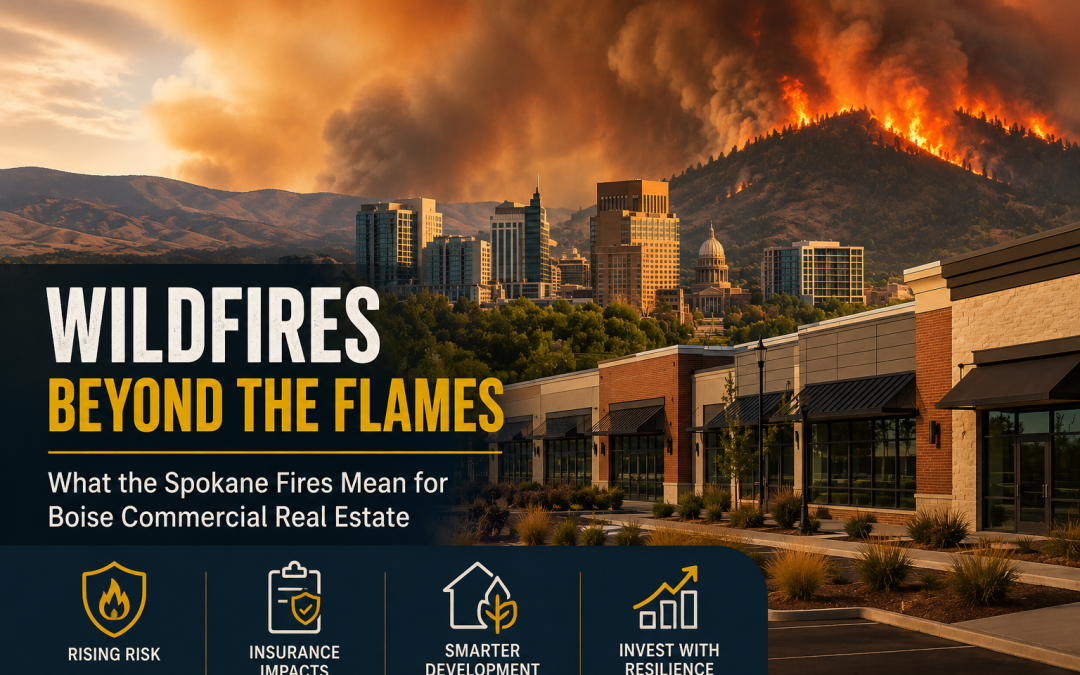
Pacific Northwest Wildfires Highlight a Growing Risk for Boise Commercial Real Estate
Wildfires hundreds of miles away can still affect Boise businesses, property owners and commercial real estate decisions.
The major fires near Spokane are a reminder that wildfire risk in the Northwest isn’t only about burned acreage. Large fires can disrupt transportation, hurt air quality, increase insurance costs, displace communities and influence where—and how—new projects get built.
According to Reuters reporting by Steve Gorman, published by the Idaho Business Review, firefighters made significant progress containing several fires near Spokane after the blazes destroyed hundreds of structures and forced widespread evacuations. The original Idaho Business Review article provides the full account of the firefighting effort and regional conditions.
For Boise commercial real estate, the story deserves attention because Idaho sits in the middle of a Western region facing increasingly complicated wildfire exposure.
A Regional Problem With Local Consequences
The scale of wildfire activity across the West is significant.
At the time of the report, 94 major wildfires were burning across 13 states, with more than half of those fires located in Oregon and Washington.
The National Interagency Fire Center, headquartered in Boise, reported more than 45,000 wildfires nationwide during the year through early August, burning nearly 5.5 million acres.
The Spokane area illustrates how quickly the risk can move from open land into populated communities.
The three fires discussed in the report burned more than 10,000 acres near the city’s northern edge. At the peak of the emergency, as many as 64,000 people were under evacuation orders.
At least 700 structures were destroyed, with preliminary assessments indicating hundreds more may have suffered major damage.
Fortunately, no deaths had been reported at the time of the article.
Firefighters benefited from cooler temperatures and calmer winds, but another period of hot, dry weather was expected to test containment efforts.
That combination—heat, low humidity, dry vegetation and wind—is something communities throughout the Northwest increasingly have to consider.
Why Wildfire Risk Matters to Boise Real Estate
The connection to Boise commercial real estate may not be obvious until you look beyond the fire line.
One of the biggest issues is insurance.
Properties near the wildland-urban interface can face greater scrutiny from insurance carriers. Higher premiums, larger deductibles or reduced coverage availability can change the economics of owning or developing a property.
For an investor, insurance isn’t a minor operating expense. A major increase can affect net operating income and, ultimately, property value.
For developers, wildfire exposure can also influence site planning.
Projects near foothills, open land or areas with significant vegetation may require additional attention to access, landscaping, emergency routes, water availability and building materials.
These considerations can increase development costs before construction even begins.
And the issue isn’t limited to properties sitting next to open land.
Smoke can travel hundreds of miles.
Poor air quality can reduce outdoor activity, affect construction schedules and temporarily hurt businesses that depend on outdoor dining, recreation or foot traffic.
That makes wildfire activity a regional economic issue—not simply a rural land issue.
Boise Development Is Moving Toward the Wildland Edge
This is particularly relevant as the Treasure Valley continues expanding.
Growth throughout Boise, Meridian, Eagle, Star, Kuna, Nampa and Caldwell continues pushing development farther into previously undeveloped areas.
In many cases, those locations offer exactly what developers want: available land, growing household counts and proximity to expanding residential neighborhoods.
But expansion can also bring commercial and residential projects closer to grasslands, foothills and other areas with greater fire exposure.
That creates another layer of due diligence.
Developers evaluating land for Boise development should increasingly think about more than zoning, utilities, traffic counts and demographics. Wildfire exposure, emergency access and insurance availability can also influence whether a site works financially.
For commercial land investors, this becomes especially important when holding property for several years before development.
A parcel that looks inexpensive based on price per acre may become less attractive if future development requires expensive mitigation measures or carries unusually high insurance costs.
Insurance Could Become Part of the Investment Conversation
Commercial property underwriting traditionally focuses on familiar numbers:
Purchase price, rents, vacancy, operating expenses, financing costs and cap rates.
Insurance deserves a larger place in that discussion.
If insurance premiums rise faster than rents, property-level returns can be squeezed.
For triple-net properties, landlords may be able to pass insurance expenses through to tenants. But that doesn’t eliminate the problem.
The tenant still has to pay the bill.
Higher insurance, taxes and common-area expenses increase total occupancy costs. Eventually, those expenses can affect leasing decisions and the rent a business can afford.
For retail leasing in Boise, this is particularly important because tenants typically evaluate their total monthly occupancy expense rather than base rent alone.
A property with an attractive asking rent but unusually high operating expenses may struggle against competing locations with lower overall occupancy costs.
Wildfires Can Affect Construction and Supply Chains
There is another commercial real estate impact that gets less attention: construction.
Large wildfire events can temporarily disrupt highways, utilities and regional supply routes. They can also create labor challenges when workers are displaced or emergency resources are redirected.
Smoke and poor air quality may also interfere with outdoor construction activity.
One isolated event isn’t likely to derail Boise commercial development, but repeated disruptions across the Northwest can create another source of uncertainty for construction schedules and budgets.
Developers already dealing with labor costs, financing expenses and material pricing don’t need many additional variables before a project’s feasibility begins to change.
That makes resilience increasingly valuable.
Local Insight: Risk Should Be Priced Before the Deal
The lesson for Boise investors and developers isn’t to avoid properties near open land.
It’s to understand the risk before committing capital.
A strong development site can still be an excellent investment even when wildfire exposure exists. But the price paid for that property should reflect the true cost of developing and operating it.
For land and commercial acquisitions, I would increasingly want answers to several questions:
- What does commercial insurance actually cost for this location?
- Has the property’s risk classification changed?
- Are there adequate emergency access routes?
- Are additional landscaping or fire-mitigation improvements required?
- Could wildfire exposure affect future financing or insurance availability?
- What happens to the project’s economics if insurance expenses increase substantially?
Those questions belong alongside traffic counts, demographics, zoning and utility availability.
My Take
Wildfire risk probably isn’t going to stop growth in the Treasure Valley.
But it could change the economics of where and how we build.
Boise’s continued expansion means more residential and commercial development will occur near areas that were once farmland, grassland or undeveloped open space. That makes fire resilience increasingly relevant to Boise real estate investment and development.
For investors, the biggest takeaway may be simple: don’t underwrite yesterday’s insurance costs into tomorrow’s investment.
For developers, think about wildfire exposure during site selection—not after the plans are finished.
For landlords, pay attention to how insurance increases affect tenant occupancy costs.
And for tenants comparing locations, look beyond the advertised rental rate. Insurance and other pass-through expenses can make two seemingly similar properties very different financially.
The Spokane fires are first and foremost a serious emergency for the communities directly affected. But they also offer a broader lesson for commercial real estate throughout the Northwest.
As Boise and the Treasure Valley continue to grow, resilience, insurance and risk management are likely to become increasingly important parts of the real estate equation.
Mike Gioioso (joy-OH-so) has for 16+ years been helping companies of all sizes buy, build, and lease perfect places for business in greater Boise, Idaho and beyond.
www.streetsmartidaho.com mike@streetsmartidaho.com 208-209-9166
Tags: #boisecommercialrealestate, #boiserealestate, #boisedevelopment, #boisecommercialdevelopment, #boiseinvestmentproperty, #boisecommercialproperty, #idahocommercialrealestate, #treasurevalleycommercialrealestate, #treasurevalleydevelopment, #boiselanddevelopment, #boiselandinvestment, #boiserealestateinvestment, #boisepropertyinsurance, #commercialpropertyinsurance