
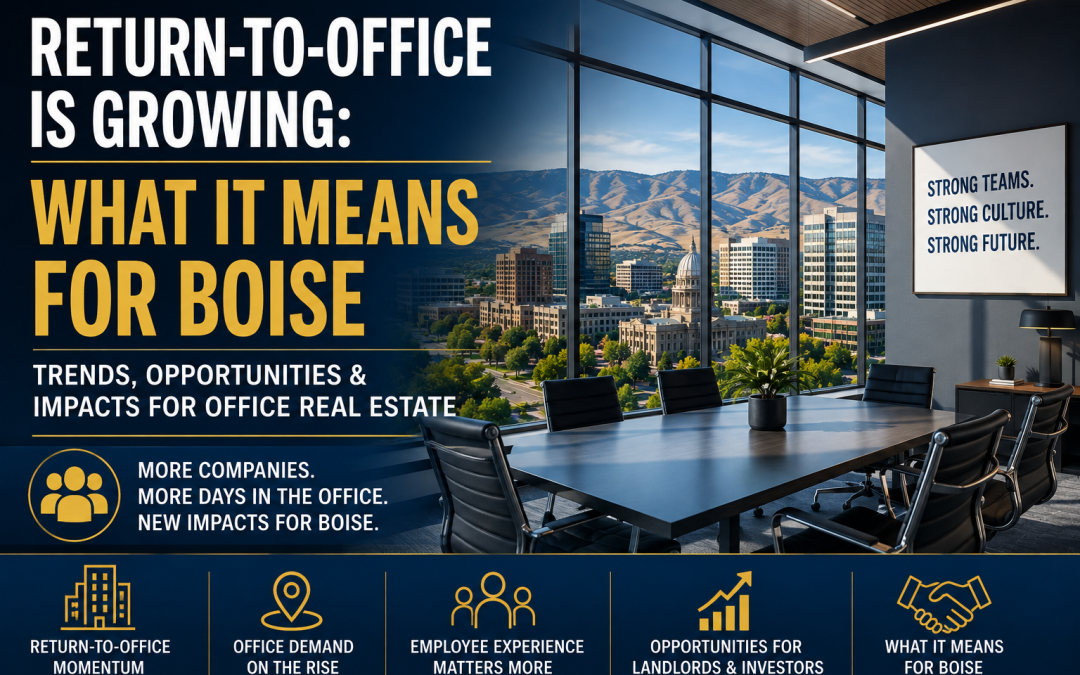
Return-to-Office Mandates Are Growing: What It Could Mean for Boise Commercial Real Estate
For several years, the biggest question hanging over office real estate was whether employees would ever come back.
That question may be changing.
Instead of asking whether offices still matter, more large employers are deciding how many days employees must actually be there.
TikTok is the latest major company moving toward a traditional five-day office schedule. While one company’s policy won’t determine the future of Boise office real estate, the broader return-to-office movement deserves attention from landlords, investors, developers and businesses throughout the Treasure Valley.
According to reporting by Katie Burke of CoStar News, TikTok plans to require its U.S. workforce to report to physical offices five days per week. The change follows similar moves by other major employers and comes as companies continue adjusting their real estate and workplace strategies.
The original CoStar News article provides additional reporting on TikTok’s decision and the national return-to-office trend.
For Boise commercial real estate, the important story isn’t TikTok itself.
It’s what happens if more employers decide the office is once again a required part of the workweek.
Companies Are Getting More Serious About the Office
TikTok’s move comes after years when hybrid schedules became common across corporate America.
The company’s new policy is expected to put employees across its U.S. operations on the same five-day attendance schedule.
TikTok isn’t alone.
Other large technology companies have also increased expectations for employees to spend more time working in person.
CoStar cited survey data showing how dramatically executive attitudes have changed.
A KPMG survey found that the share of CEOs expecting a return to a five-day office week increased from approximately 64% in 2023 to about 85%.
JLL research cited by CoStar also showed a significant decline in hybrid policies, while fully remote arrangements represented only a very small portion of companies surveyed.
Those numbers don’t necessarily mean every American office worker will soon be back at a desk five days a week.
Small businesses, professional firms and regional employers may make very different decisions from multinational corporations.
But the direction is worth watching.
Large companies appear increasingly willing to tell employees that being physically present is part of the job.
That could eventually change the conversation around office real estate.
More Office Days Could Change How Boise Tenants Choose Space
A company using its office twice a week may tolerate things employees don’t love.
A company requiring workers to show up five days a week has a different problem.
The office needs to be somewhere employees actually want to spend time.
That makes location and building quality increasingly important.
For Boise office leasing, properties that offer a strong employee experience could have an advantage.
That might include:
- Convenient parking
- Easy commuting access
- Nearby restaurants and coffee shops
- Natural light
- Attractive common areas
- Outdoor spaces
- Modern conference rooms
- Updated HVAC systems
- Reliable technology infrastructure
- Walkable amenities
Downtown Boise has obvious strengths when it comes to restaurants, entertainment and walkability.
Suburban office locations in Meridian, Eagle and other Treasure Valley communities can compete differently through parking, freeway access, shorter commutes for suburban employees and proximity to growing residential areas.
The winning office isn’t necessarily going to be downtown or suburban.
It will be the building that best matches what a particular employer and its workers need.
Return-to-Office Doesn’t Automatically Mean More Square Feet
This is where commercial real estate investors need to be careful.
Five days in the office sounds bullish for office demand.
But it doesn’t automatically mean companies will lease the same amount of space they occupied before the pandemic.
Businesses have spent years learning how efficiently they can use offices.
Some have reduced private offices.
Others have adopted shared workstations, smaller individual workspaces and more collaborative areas.
A company could bring employees back five days per week and still occupy fewer square feet than it did several years ago.
That means the important metric isn’t simply attendance.
It’s square feet per employee.
For Boise office landlords, the best outcome would be a combination of increasing attendance, employment growth and companies needing additional physical capacity.
That could gradually create stronger leasing demand.
But a return-to-office mandate by itself doesn’t guarantee it.
Corporate Real Estate Is Still Being Restructured
TikTok’s situation illustrates another important point.
The company is requiring more employees to work from offices while simultaneously consolidating parts of its real estate footprint.
According to CoStar, TikTok recently closed its Nashville office, which totaled more than 143,000 square feet, while eliminating roughly 250 positions associated with that location.
That might initially sound contradictory.
It isn’t.
Companies can simultaneously become more committed to office work and more selective about which offices they keep.
That may be one of the biggest commercial real estate themes of the next several years.
Instead of maintaining numerous locations with inconsistent attendance, businesses may consolidate employees into fewer, better-utilized offices.
For landlords, that creates both winners and losers.
Buildings that survive corporate consolidation could become busier.
Properties that lose major tenants may face significant backfill challenges.
The same principle can apply to Boise.
A regional company with several smaller offices might eventually decide that bringing employees together in one better location makes more sense than maintaining multiple partially occupied spaces.
That creates opportunities for some buildings while creating vacancy in others.
Local Insight: Office Demand May Recover Differently Than Expected
From a Boise commercial real estate perspective, I don’t think the office recovery will simply be a return to 2019.
Too much has changed.
Businesses understand workplace flexibility differently. Employees have different expectations. Companies have learned to operate with less space.
But that doesn’t mean office real estate is becoming irrelevant.
The next phase may actually make good office space more important.
If employers require workers to come in more frequently, they have a stronger incentive to provide an environment that helps recruit and retain those employees.
That reinforces the flight-to-quality trend already appearing in many office markets.
For Boise landlords, this could mean investing in improvements instead of simply waiting for demand to return.
For tenants, today’s market can offer an opportunity to secure higher-quality space and negotiate favorable economics before conditions potentially tighten.
For investors, the opportunity may be less about buying “office” as a category and more about identifying individual properties that can remain competitive for the next decade.
And for developers, caution is still appropriate.
A stronger return-to-office trend doesn’t necessarily justify a wave of speculative Boise office construction. Construction costs, financing, achievable rents and existing vacancy still have to support the project.
The bigger takeaway is simpler.
Companies appear to be reconsidering what they expect from employees—and that will eventually influence what they expect from their real estate.
If five-day office schedules continue spreading, the Boise office market could receive a meaningful demand boost.
But the benefits probably won’t be distributed evenly.
The buildings with the right location, amenities, parking, design and economics are likely to capture the greatest share of that demand.
The office isn’t necessarily coming back exactly as it was.
It may be coming back more selectively.
And for Boise commercial real estate owners, tenants and investors, that distinction matters.
Mike Gioioso (joy-OH-so) has for 16+ years been helping companies of all sizes buy, build, and lease perfect places for business in greater Boise, Idaho and beyond.
www.streetsmartidaho.com mike@streetsmartidaho.com 208-209-9166
Tags: #boisecommercialrealestate, #boiserealestate, #boiseofficemarket, #boiseofficerealestate, #boiseofficespace, #boiseofficeleasing, #commercialofficeboise, #idahocommercialrealestate, #idahoofficemarket, #treasurevalleycommercialrealestate, #treasurevalleyofficemarket, #returntooffice, #returntoofficemandate, #fivedayofficeweek, #officeattendance