
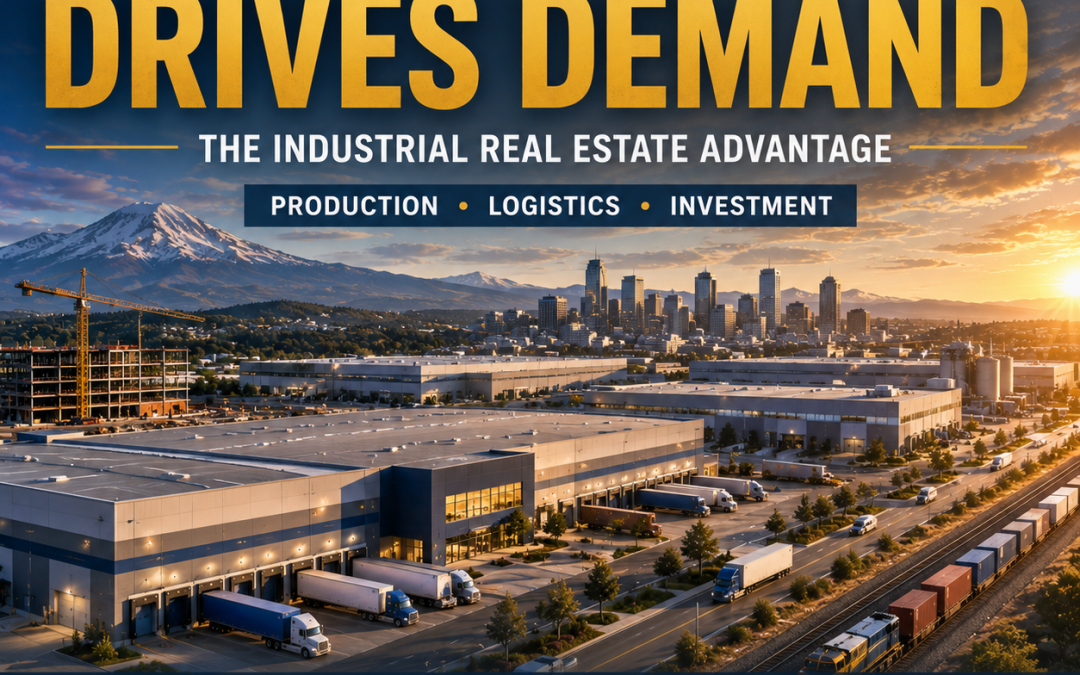
What Boeing’s Industrial Expansion Reveals About the Growing Importance of Manufacturing Real Estate
Some of the biggest commercial real estate trends start with a company expanding production.
Not a new office tower.
Not a retail development.
A factory.
A recent industrial property sale in the Seattle region highlights how manufacturing growth can influence warehouse demand, investment activity, and commercial real estate values across an entire market. While the transaction occurred in Washington, the broader lessons may be highly relevant for Boise commercial real estate professionals watching Idaho’s growing industrial sector.
According to reporting by Randyl Drummer of CoStar News, Realty Income recently acquired a three-building logistics campus in Kent, Washington, for approximately $98 million. The development includes a large warehouse leased by Boeing as the aircraft manufacturer continues increasing production capacity. The original CoStar article can be found here: https://product.costar.com/home/news/2117578463
The sale was one of the Seattle area’s largest industrial transactions of 2026 and reflects growing investor confidence in properties connected to manufacturing and supply chain activity.
Manufacturing Growth Creates Real Estate Demand
One of the most important takeaways from the transaction is that industrial real estate often follows production growth.
As Boeing increases aircraft manufacturing, the company requires additional facilities to support inventory management, logistics operations, parts distribution, and production activities.
According to CoStar’s reporting:
- Realty Income purchased a three-building industrial campus in Kent for approximately $98 million.
- Boeing leases the property’s largest warehouse building.
- Boeing is increasing aircraft production as demand improves.
- Industrial sales activity in the Seattle market continues recovering.
- Investors remain highly interested in logistics facilities connected to major employers.
The connection between manufacturing growth and industrial real estate demand is straightforward.
When production rises, companies frequently need more warehouse space, distribution capacity, and supporting infrastructure.
Why Investors Continue Chasing Industrial Assets
Industrial real estate has remained one of the strongest commercial property sectors over the past several years.
While office markets continue adjusting to changing workplace trends, warehouses and logistics facilities remain critical components of modern supply chains.
Properties leased to major corporate users often attract significant investor interest because they can provide:
- Long-term occupancy stability
- Strong tenant credit
- Predictable cash flow
- Lower management intensity
- Institutional investment appeal
The Kent transaction demonstrates how investors continue targeting industrial properties tied to essential manufacturing operations.
For many buyers, the quality of the tenant is just as important as the quality of the building.
What This Means for Boise Commercial Real Estate
Boise may not have an aerospace manufacturing footprint comparable to Seattle, but Idaho is experiencing its own industrial growth story.
Large employers continue investing throughout the Treasure Valley and surrounding regions. Manufacturing, technology, food production, distribution, and semiconductor-related industries are creating demand for industrial space across multiple Idaho markets.
The expansion of companies such as Micron and other advanced manufacturing operations highlights an important trend.
Industrial demand is increasingly being driven by production, not just distribution.
As employers expand operations, they often require:
- Warehouse facilities
- Flex industrial space
- Manufacturing buildings
- Logistics centers
- Contractor yards
- Supplier locations
These requirements create opportunities for developers, investors, and property owners throughout the Boise market.
Industrial Investment Is Following Employment Growth
One reason industrial real estate remains attractive is its close relationship to job creation.
When employers add workers and expand production, real estate needs typically follow.
Seattle’s recent industrial transactions demonstrate how investor capital often moves toward markets with strong employment anchors and long-term growth potential.
The same principle applies in Idaho.
As Boise development continues and employment growth remains strong, industrial properties positioned near major transportation routes and employment centers may continue attracting tenant demand and investor interest.
Local Insight
One of the most interesting aspects of this transaction is that the warehouse itself may not be the biggest story.
The bigger story is what the warehouse represents.
It represents confidence in future production.
It represents confidence in future employment.
And it represents confidence in future demand for industrial real estate.
For Boise commercial real estate professionals, that lesson matters.
Whether the growth comes from aerospace, semiconductors, food processing, logistics, or advanced manufacturing, the pattern is often the same: business expansion drives industrial demand, and industrial demand drives real estate investment.
The markets that attract and retain major employers are often the markets that see the strongest long-term industrial real estate performance.
Mike Gioioso (joy-OH-so) has for 16+ years been helping companies of all sizes buy, build, and lease perfect places for business in greater Boise, Idaho and beyond. www.streetsmartidaho.com mike@streetsmartidaho.com 208-209-9166
Tags: #boisecommercialrealestate, #industrialrealestate, #boiseindustrialmarket, #industrialdevelopment, #warehousespace, #logisticsrealestate, #boisedevelopment, #manufacturingrealestate, #commercialrealestateinvestment, #industrialproperty, #distributioncenters, #warehouseinvestment, #logisticsfacilities, #micronboise, #industrialleasing