
Why Semiconductor Logistics Growth Could Become the Next Big Opportunity for Boise Commercial Real Estate
When most people think about the semiconductor industry, they picture chip factories.
But behind every semiconductor plant is an enormous supply chain that requires warehouses, logistics providers, transportation companies, and specialized industrial facilities.
As semiconductor manufacturing continues expanding across the Pacific Northwest, those supporting businesses are growing alongside it. That trend could eventually create significant opportunities for Boise commercial real estate.
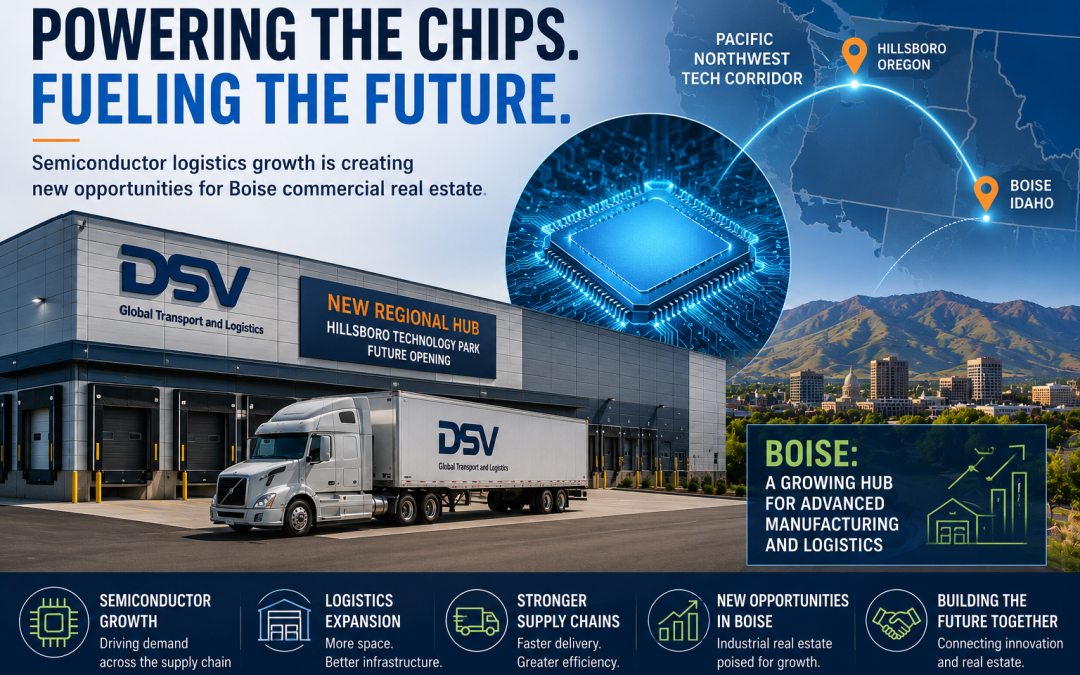
According to reporting by Randyl Drummer in CoStar News, global logistics company DSV Global Transport and Logistics is developing a major regional distribution hub in Hillsboro, Oregon, to better serve the area’s growing semiconductor industry. You can read the original CoStar News article here: https://product.costar.com/home/news/1870750250. This article is based on that reporting while exploring what this logistics expansion could mean for Boise commercial real estate, industrial development, and the region’s growing semiconductor supply chain.
The Semiconductor Industry Is Expanding Beyond Manufacturing
Modern semiconductor production depends on much more than fabrication plants.
Chip manufacturers rely on highly coordinated logistics networks to move sensitive materials, precision equipment, replacement parts, and finished products quickly and securely.
To support that demand, DSV is constructing a new 750,000-square-foot logistics facility in Hillsboro Technology Park near Portland.
Once completed, the regional hub will consolidate three existing Oregon locations into one significantly larger operation.
The new facility is expected to include:
- Approximately 750,000 square feet of warehouse space.
- Forty-foot clear ceiling heights for efficient storage.
- More than 50 loading docks.
- Specialized storage areas designed for semiconductor materials.
- Artificial intelligence-powered inventory tracking systems.
Construction is underway, with operations expected to begin in 2027.
Why This Matters for Boise Commercial Real Estate
Boise’s commercial real estate market is already benefiting from semiconductor investment.
Micron’s historic manufacturing expansion has attracted suppliers, engineering firms, equipment manufacturers, and construction companies to the Treasure Valley.
As semiconductor production increases, demand doesn’t stop at the factory gates.
Additional warehouse space, distribution centers, transportation providers, equipment maintenance companies, packaging firms, and specialized industrial users all become part of the larger ecosystem.
That creates new opportunities for industrial developers, landlords, investors, and businesses serving advanced manufacturing.
In many ways, logistics facilities become just as important as manufacturing plants themselves.
Regional Supply Chains Are Becoming More Connected
The Pacific Northwest is increasingly functioning as one integrated technology corridor.
Oregon has long been home to a large concentration of semiconductor companies, while Idaho continues expanding its manufacturing footprint through Micron and related investment.
As businesses grow throughout both states, many suppliers operate across multiple markets instead of serving only one city.
A larger logistics network benefits manufacturers by improving delivery speed, reducing inventory delays, and supporting increasingly complex production schedules.
That regional connectivity can also increase demand for warehouse space throughout Idaho as suppliers seek strategic locations closer to customers.
Industrial Real Estate Continues to Evolve
Today’s logistics buildings are very different from warehouses built twenty years ago.
Many now feature taller clear heights, automation systems, sophisticated inventory software, robotics, and specialized environmental controls.
Facilities supporting semiconductor manufacturing often require even higher standards because many materials are highly specialized and sensitive to handling conditions.
As Boise industrial real estate continues evolving, developers may increasingly design buildings capable of serving advanced manufacturing users rather than traditional warehouse tenants alone.
That shift could create higher-value industrial product throughout the Treasure Valley.
My Take
One of the biggest commercial real estate stories over the next decade won’t simply be where semiconductor plants are built.
It will be where the companies supporting those plants decide to locate.
Every major manufacturing investment creates ripple effects throughout the supply chain.
Warehousing.
Transportation.
Engineering.
Equipment servicing.
Technology.
Distribution.
Those businesses all require commercial real estate.
Boise is already becoming one of the country’s most important semiconductor markets, and the supporting industrial ecosystem is still developing.
Projects like DSV’s regional logistics hub demonstrate how quickly supply chains expand around advanced manufacturing. I expect Boise development will continue seeing increased demand for industrial buildings, flex space, logistics facilities, and supplier locations as the semiconductor industry grows throughout the Northwest.
Mike Gioioso (joy-OH-so) has for 16+ years been helping companies of all sizes buy, build, and lease perfect places for business in greater Boise, Idaho and beyond. www.streetsmartidaho.com mike@streetsmartidaho.com 208-209-9166
Tags: #boisecommercialrealestate, #boisedevelopment, #industrialrealestate, #semiconductorindustry, #micron, #logistics, #supplychain, #warehousedevelopment, #dsv, #industrialleasing, #manufacturing, #distributioncenters, #treasurevalley, #commercialrealestate, #economicdevelopment