
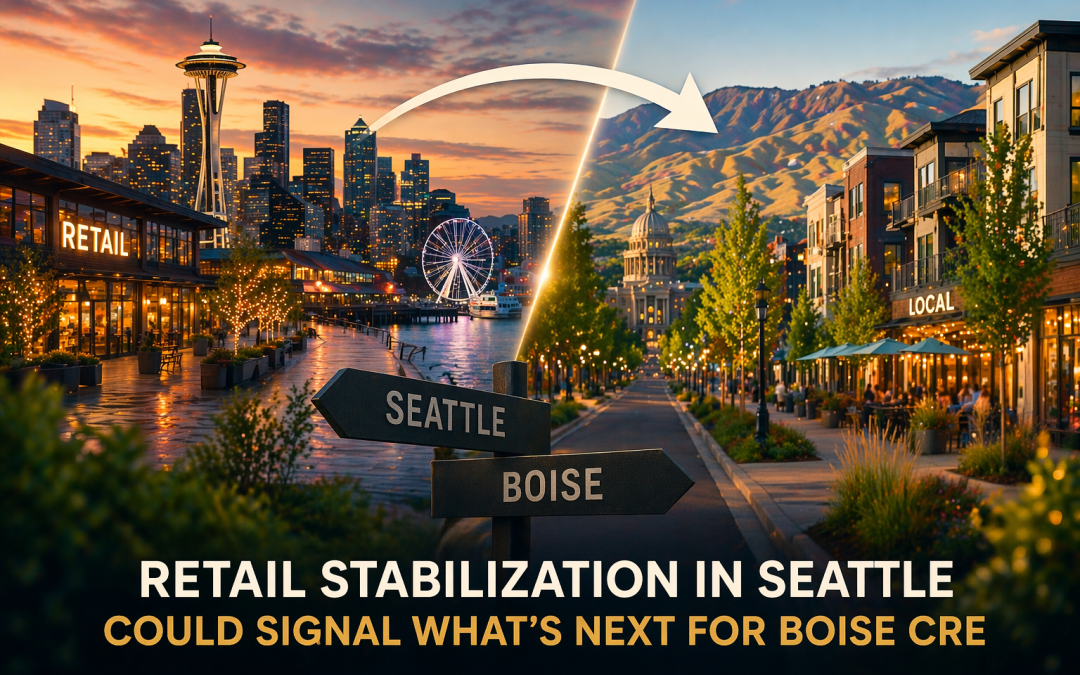
Retail Stabilization in Seattle Could Signal What’s Next for Boise Commercial Real Estate
Retail doesn’t usually turn on a dime.
It shifts slowly—often in ways that are easy to miss if you’re only watching headline numbers.
That’s exactly what’s happening right now in the Pacific Northwest.
According to reporting by Elliott Krivenko of CoStar Analytics (read the original article here: https://product.costar.com/home/news/899873210), the Seattle retail market is showing early signs of stabilization after several years of decline.
For anyone focused on Boise commercial real estate, this isn’t just a Seattle story.
It’s a preview of what could be coming next.
What’s Actually Changing in Retail Right Now
The headline sounds simple: retail demand is ticking up.
But the underlying story is more nuanced—and more important.
Here’s what the data shows:
- Retail absorption turned slightly positive in early 2026
- Overall occupancy remains essentially flat
- The gain is modest compared to the size of the market
- Leasing activity is steady—not surging
In short, this isn’t a comeback.
It’s a pause in a long-term reset.
And that reset has been driven less by weak demand—and more by changing supply.
The Real Story: Retail Isn’t Shrinking—It’s Being Rebuilt
One of the biggest takeaways from the Seattle data is this:
Retail space hasn’t just been vacated—it’s been removed and repurposed.
Over the past several years:
- Millions of square feet of retail space have disappeared
- Older shopping centers have been demolished
- Standalone retail has been replaced with mixed-use development
That means:
- Less traditional retail inventory
- More integrated retail within residential or urban projects
- A shift in where tenants choose to locate
For Boise, this trend should feel familiar.
Why This Matters for Boise Commercial Real Estate
Boise tends to follow larger West Coast markets—but with a delay.
What happens in Seattle often shows up in the Treasure Valley a few years later, adjusted for scale.
1. Retail Demand Is Still There—Just Redirected
The Seattle story confirms something many Boise brokers are already seeing:
Retail demand hasn’t disappeared—it’s just moving.
Tenants are increasingly choosing:
- Mixed-use environments
- Walkable developments
- High-traffic, experience-driven locations
That means older strip centers or isolated retail sites may struggle, even as overall demand holds steady.
2. Supply Reduction Can Stabilize the Market
One of the reasons Seattle is seeing stabilization is simple:
There’s less retail space to fill.
As obsolete properties are redeveloped:
- Vacancy pressure decreases
- Remaining centers perform better
- Land values shift toward higher-density uses
For Boise, this suggests:
- Redevelopment opportunities will continue to grow
- Underperforming retail could become future mixed-use sites
- Investors should evaluate land value as much as income
3. Mixed-Use Is Winning the Next Cycle
A key insight from the data is where leasing demand is going:
Not into traditional retail centers—but into mixed-use projects.
That has big implications for:
- Developers planning new projects
- Landlords repositioning assets
- Cities guiding growth patterns
In Boise, we’re already seeing this play out in:
- Downtown Boise
- Meridian’s evolving urban core
- Suburban nodes shifting toward higher density
Retail is no longer the anchor.
It’s part of a broader ecosystem.
The Bigger Trend: Stabilization Before the Next Evolution
Seattle’s slight positive absorption isn’t a signal that retail is “back.”
It’s a signal that the market may be:
- Finding its new balance
- Adjusting to a different footprint
- Preparing for the next phase of growth
That phase likely looks like:
- Smaller, more efficient retail spaces
- Higher-quality locations outperforming
- More integration with residential and office uses
Local Market Impact
For those active in Boise commercial real estate, here’s how to interpret this:
- Retail isn’t dying—it’s evolving
- Location and experience matter more than ever
- Older assets may need repositioning to stay competitive
If Seattle is stabilizing after years of contraction, Boise may:
- Continue seeing steady demand
- Avoid extreme overbuilding
- Benefit from learning what worked—and what didn’t—in larger markets
My Take: Watch the Direction of Demand, Not Just the Numbers
It’s easy to look at absorption and occupancy and try to call a turning point.
But the smarter move is to watch where tenants are going.
Right now, they’re choosing:
- Walkability
- Visibility
- Integration with daily life
That’s where the next wave of Boise development will focus.
And for investors, landlords, and developers, that’s the real opportunity.
Not chasing the past version of retail—but building for what it’s becoming.
Mike Gioioso (joy-OH-so) has for 16+ years been helping companies of all sizes buy, build, and lease perfect places for business in greater Boise, Idaho and beyond.
www.streetsmartidaho.com mike@streetsmartidaho.com 208-209-9166
Tags: #boisecommercialrealestate, #boiserealestate, #retailleasingboise, #boisedevelopment, #mixedusedevelopmentboise, #boiseretailmarket, #commercialrealestatetrendsboise, #investmentpropertyboise, #treasurevalleydevelopment, #retailtrends2026, #seattleretailmarket, #retailabsorptiontrends, #retailredevelopment, #commercialrealestateinvestmentboise, #boisegrowthtrends