
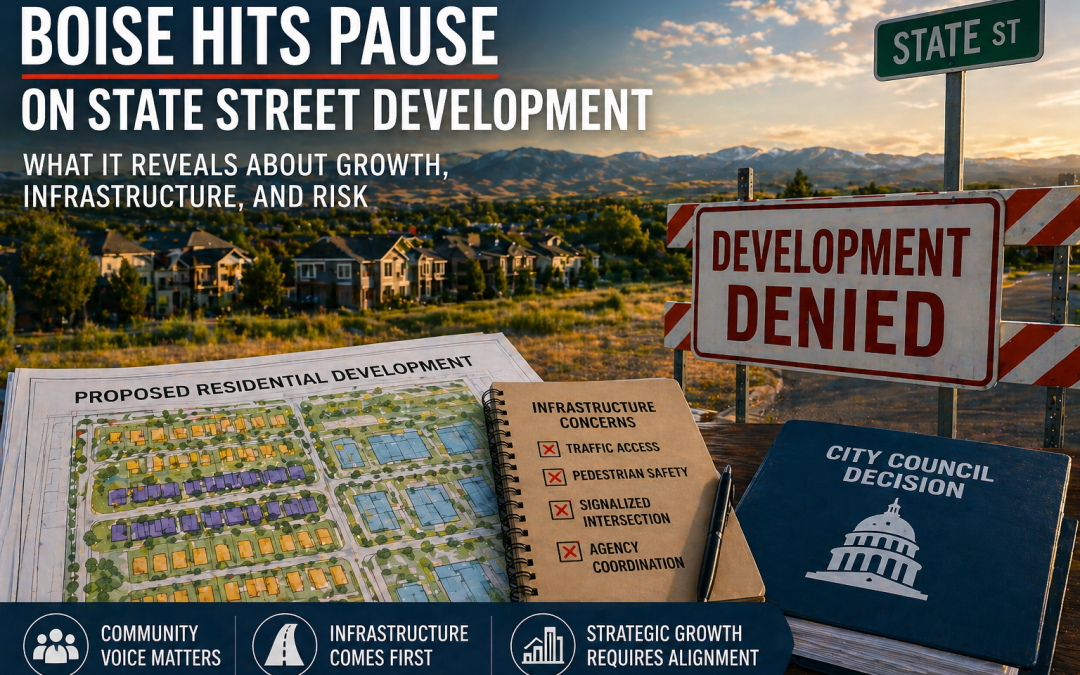
Boise Hits Pause on State Street Development — What It Reveals About Growth, Infrastructure, and Risk
Not every well-designed project gets built.
In Boise commercial real estate, some of the most important signals come from the deals that don’t move forward—and why.
A recent City Council decision in northwest Boise is a perfect example of how growth, infrastructure, and community expectations are starting to collide.
A Denied Project With Big Implications
According to reporting by Haadiya Tariq in the Idaho Press (read the original article here: https://www.idahopress.com/news/boise-denies-state-street-development/article_569a4f01-dc69-40fd-8f20-189277d3393a.html), a proposed residential development along State Street was denied after failing to resolve key infrastructure concerns.
The project, planned for nearly 19 acres, would have included a mix of:
- Single-family homes
- Townhomes
- Apartment units
From a planning standpoint, it checked a lot of boxes—density, infill, and housing diversity.
So why did it get denied?
👉 Traffic and infrastructure concerns ultimately stopped the deal.
What’s Changing: Infrastructure Is Now the Gatekeeper
This decision highlights a shift happening across Boise development.
1. Traffic Access Is No Longer a Secondary Issue
The biggest challenge? Lack of direct access to State Street.
- Traffic would have been pushed onto nearby neighborhood roads
- Concerns around congestion and safety increased
- Proposed solutions required coordination with multiple agencies
👉 Translation: if access isn’t clear and executable, projects stall—no matter how strong they look on paper.
2. Conditions of Approval Are Getting Tougher
The city didn’t outright reject the idea of development—but the conditions attached created friction.
- Initial requirement tied to a future signalized intersection
- Revised condition required coordination with multiple agencies
- Developers argued the requirements were unclear and outside their control
👉 This is becoming more common:
- Cities want infrastructure solved upfront
- Developers want clarity and control
When those don’t align, deals fall apart.
Why This Matters for Boise Commercial Real Estate
This isn’t just a housing story—it directly impacts land, development strategy, and investment risk.
1. Entitlement Risk Is Rising
Even projects that align with Boise’s comprehensive plan can face rejection.
👉 For investors and developers:
- Entitlements are no longer a formality
- Infrastructure feasibility must be validated early
- Timeline risk is increasing
2. Infill Development Is Getting More Complex
Boise continues to push for infill housing—but sites like this show the challenges.
- Existing neighborhoods lack modern road networks
- No consistent grid system in some areas
- Pedestrian infrastructure is often incomplete
👉 That means:
- More upfront planning
- More collaboration with agencies like ACHD
- Higher development costs
3. Community Influence Is Stronger Than Ever
Neighborhood feedback played a major role here.
Concerns included:
- Pedestrian safety
- Traffic congestion
- Lack of infrastructure improvements
👉 For Boise developers:
- Community engagement isn’t optional
- It’s a critical path item in getting projects approved
Local Market Impact: What to Watch Next
This decision sends a clear message to the market:
- Projects without clear traffic solutions face uphill battles
- Infrastructure improvements may be required before approval, not after
- Sites near major corridors like State Street will face higher scrutiny
- Developers may need to scale or redesign projects to move forward
And importantly:
👉 This project isn’t dead—it may come back in a revised form.
My Take: This Is a Reality Check for Boise’s Growth Cycle
From a boots-on-the-ground Boise commercial real estate perspective, this is a turning point.
For years, growth has been:
- Fast
- Developer-driven
- Demand-heavy
Now, we’re entering a phase where:
👉 Infrastructure is catching up—and slowing things down.
The opportunities are still there—but they require:
- Better planning
- Stronger alignment with city and regional agencies
- Realistic expectations around timing and cost
The big takeaway?
👉 In today’s Boise market, getting a project approved may be harder than finding the deal itself.
And that’s a shift every investor and developer needs to understand.
Mike Gioioso (joy-OH-so) has for 16+ years been helping companies of all sizes buy, build, and lease perfect places for business in greater Boise, Idaho and beyond.
www.streetsmartidaho.com mike@streetsmartidaho.com 208-209-9166
Tags: #boisecommercialrealestate, #boisedevelopment, #statestreetboise, #boisehousingdevelopment, #boisezoningissues, #entitlementriskrealestate, #boiseinfilldevelopment, #treasurevalleydevelopment, #boiselanddevelopment, #idahorealestatetrends, #boiseplanningandzoning, #achdtrafficissues, #boiseinfrastructurechallenges