
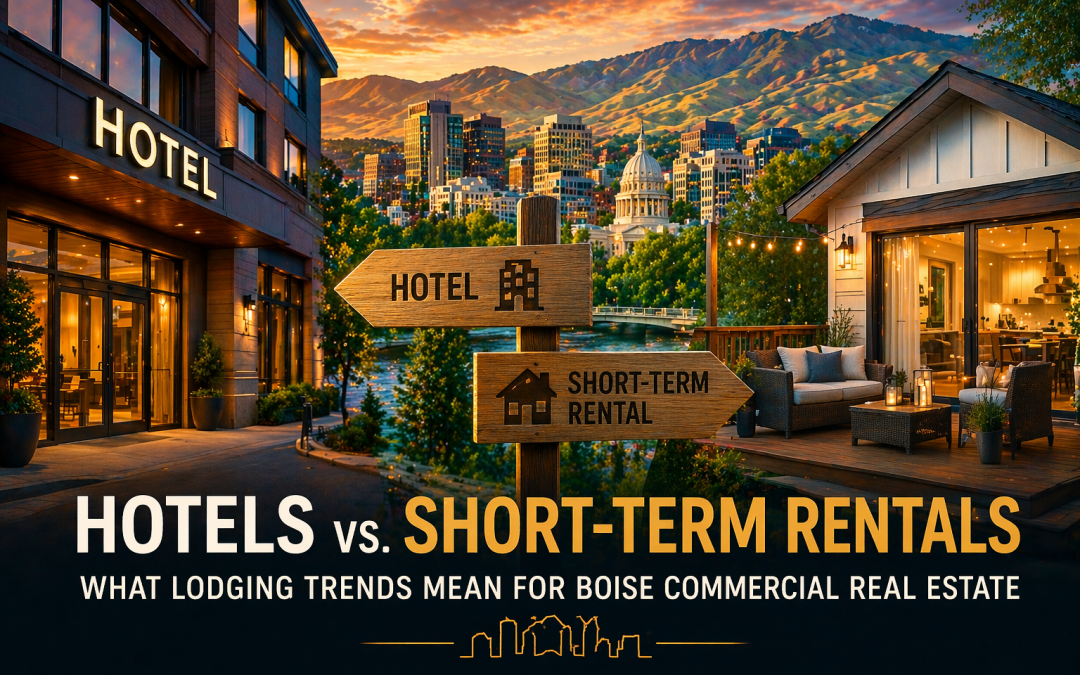
Hotels vs. Short-Term Rentals — What Lodging Trends Mean for Boise Commercial Real Estate
Travel demand is strong again—but where people stay (and how much they pay) is changing in a big way.
That shift isn’t just impacting hotels and vacation rentals.
It’s influencing Boise commercial real estate, especially in hospitality, mixed-use development, and even retail corridors tied to tourism.
According to analysis by Michael Stathokostopoulos of CoStar Analytics (read the original article here: https://product.costar.com/home/news/1415817839), hotels and short-term rentals are both performing well—but in very different ways.
And that difference matters.
What’s Really Happening in the Lodging Market
At a high level, both hotels and short-term rentals (STRs) are capturing demand—but they’re doing it differently.
Here’s the breakdown:
- Hotels lead in occupancy — they consistently fill more rooms
- Short-term rentals lead in pricing — they command higher nightly rates
- Revenue per unit often favors STRs despite lower occupancy
- Performance varies widely by market and travel type
This isn’t a battle where one is winning and the other is losing.
It’s a split market, with each product serving a different type of traveler.
Why This Matters for Boise Commercial Real Estate
Boise sits in a unique position.
It’s not a pure business travel market—but it’s not purely leisure either.
That makes it especially sensitive to how these two lodging models evolve.
1. Hotels Still Anchor Consistent Demand
Hotels continue to dominate when it comes to:
- Business travel
- Group bookings
- Conferences and events
- Short, repeat stays
That consistency is critical.
For Boise, that means:
- Hotels remain a key driver of downtown activity
- Convention-related demand still supports surrounding retail and restaurants
- Institutional travel keeps occupancy stable even during slower seasons
From a Boise development standpoint, hotels still play a foundational role in the market.
2. Short-Term Rentals Are Capturing Premium Demand
Where STRs are winning is pricing.
Travelers are paying more for:
- Extra space
- Privacy
- Flexibility
That trend is strongest in lifestyle-driven markets—but Boise is increasingly fitting that profile.
As more people visit Boise for:
- Outdoor recreation
- Relocation scouting
- Extended stays
STRs become more competitive.
That creates ripple effects:
- Pressure on hotel pricing strategies
- Increased demand for residential-style units
- More investor interest in flexible-use properties
3. Segmentation Is the Real Story
The biggest takeaway isn’t competition—it’s segmentation.
Hotels and STRs are not fighting for the exact same customer.
Instead:
- Hotels capture repeat, structured demand
- STRs capture discretionary, experience-driven demand
For Boise, that means both can grow at the same time—but in different ways.
The Bigger Trend: Blurring Lines Between Hospitality and Residential
One of the most important long-term implications is how these models are starting to overlap.
We’re seeing:
- Hotels adding extended-stay and apartment-style units
- Developers designing mixed-use projects with flexible lodging components
- Investors evaluating properties based on multiple income strategies
In Boise, this could show up as:
- More hybrid hospitality projects
- Increased interest in downtown and walkable areas
- Retail and restaurant growth tied to visitor traffic
This is where retail leasing Boise connects directly to lodging trends.
More visitors = more spending = stronger retail performance.
Local Market Impact
For investors, landlords, and developers watching Boise real estate, here’s what to focus on:
- Hotels provide stability and predictable demand
- STRs provide upside and pricing flexibility
- The strongest opportunities may combine elements of both
Location will matter more than ever:
- Walkable districts
- Lifestyle-oriented neighborhoods
- Proximity to amenities and experiences
Boise is already moving in that direction.
My Take: This Isn’t a Competition—It’s a Blueprint
It’s easy to frame this as hotels vs. short-term rentals.
But that misses the point.
The real takeaway is this:
Travel demand is diversifying—and real estate needs to adapt.
The markets that win will be the ones that:
- Offer multiple ways to stay
- Create experiences, not just places to sleep
- Integrate hospitality into broader development strategies
Boise is well positioned for that.
It has:
- A growing tourism base
- Strong population growth
- Increasing national visibility
The opportunity now is to build for how people actually travel today—not how they traveled ten years ago.
Mike Gioioso (joy-OH-so) has for 16+ years been helping companies of all sizes buy, build, and lease perfect places for business in greater Boise, Idaho and beyond.
www.streetsmartidaho.com mike@streetsmartidaho.com 208-209-9166
Tags: #boisecommercialrealestate, #boiserealestate, #boisedevelopment, #boisehospitalitymarket, #shorttermrentalsboise, #strmarketboise, #boisehotels, #hotelinvestmentboise, #commercialrealestatetrendsboise, #tourismboiseidaho, #investmentpropertyboise, #mixedusedevelopmentboise, #retailleasingboise, #boisegrowthtrends, #hospitalityrealestatetrends