
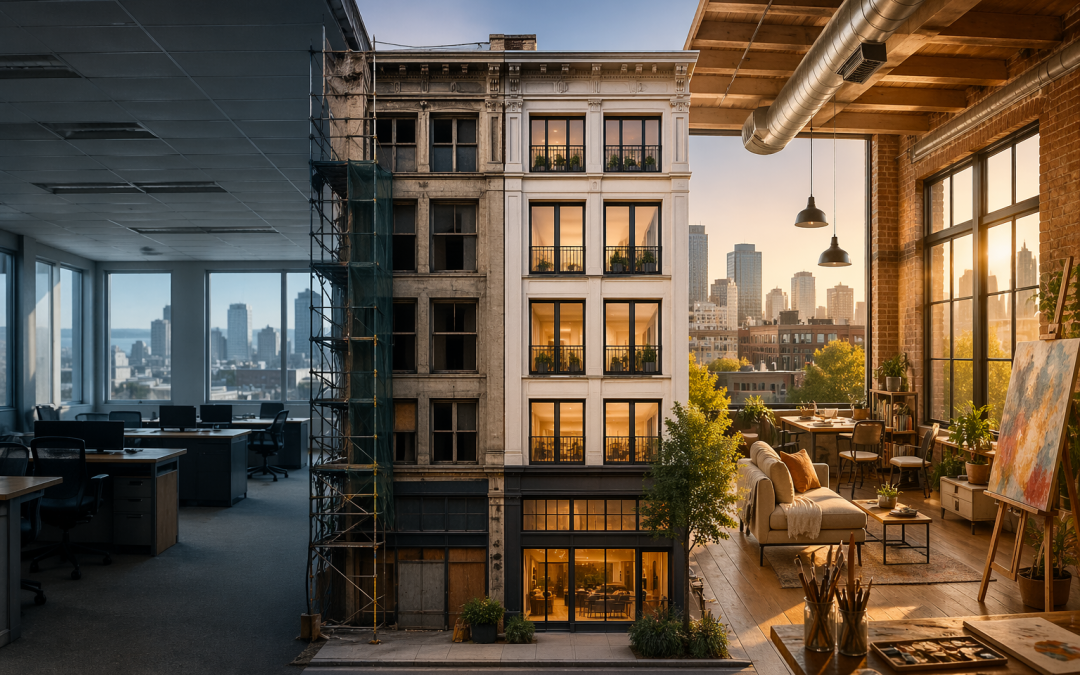
Office-to-Housing Conversions Gain Momentum — What Seattle’s Artist Lofts Signal for Boise Commercial Real Estate
Downtown office buildings across the country are facing a new reality.
Some are struggling to stay full.
Others are being reimagined entirely.
And one project out of Seattle is showing how creative thinking—and a little risk—can turn an aging office tower into something much more relevant for today’s market.
A Creative Reuse Model Takes Shape
According to reporting by Madeleine D’Angelo in CoStar News (read the original article here: https://product.costar.com/home/news/1210483357), a Seattle-based nonprofit is working to convert a historic office building into affordable housing designed specifically for artists.
The project centers on a tower built in 1910 in downtown Seattle. Instead of trying to reposition it as traditional office space, the plan is to:
- Keep the ground floor as retail
- Turn the second floor into shared community space
- Convert upper floors into deed-restricted housing for artists
- Include live-work studio space within residential units
- Blend affordable and market-rate housing on upper levels
The goal? Create attainable housing for people earning below the area median income—while bringing energy back into the downtown core.
What’s Driving the Office Conversion Trend
This isn’t just a one-off idea.
Across the U.S., office-to-residential conversions are gaining traction—and fast.
Here’s why:
- Office vacancy remains elevated in many downtowns
- Remote and hybrid work continue to reshape demand
- Housing shortages persist, especially in urban cores
- Older office buildings often struggle to compete with newer product
Seattle is a clear example. Reports suggest a meaningful portion of its office inventory could be converted into housing. At the same time, the city is actively encouraging these projects through tax incentives and policy support.
The economics are also telling.
The building in this case sold for a steep discount compared to its prior value—highlighting how distressed office assets are becoming opportunities for adaptive reuse.
Why This Matters for Boise Commercial Real Estate
You might be thinking—“That’s Seattle. What does it have to do with Boise?”
More than you think.
Boise commercial real estate is not immune to the same pressures:
- Office demand has shifted
- Tenants are using space differently
- Some older buildings are becoming less competitive
- Housing affordability continues to be a major issue
While Boise doesn’t have the same level of office distress as larger metros, the trend lines are similar—just earlier in the cycle.
This creates opportunity.
Potential implications for Boise:
- Selective office conversions could emerge, especially in older downtown or fringe assets
- Mixed-use repositioning may become more common (office → residential + retail)
- Public-private partnerships could play a role if housing pressure intensifies
- Creative user groups (artists, startups, makers) may become part of redevelopment strategies
And here’s the key: Boise doesn’t need a crisis to act.
Markets that adapt early often win.
The Bigger Shift: From Static Buildings to Flexible Use
This project isn’t just about housing.
It’s about how we think about real estate.
Instead of viewing buildings as fixed-use assets, developers and cities are starting to ask:
- What does this building need to become to stay relevant?
- Who is being underserved in this market?
- How can we activate underutilized space today—not five years from now?
In Seattle’s case, the answer was artists.
In Boise, it could be:
- Workforce housing
- Small business incubators
- Flexible live-work environments
- Hybrid retail/experience spaces
That’s where Boise development is heading—toward flexibility, creativity, and mixed-use thinking.
My Take: Boise Should Be Watching This Closely
From a boots-on-the-ground perspective in Boise commercial real estate, this is the kind of story that matters.
Not because we’ll copy it exactly.
But because it signals where the industry is going.
Office-to-residential conversions aren’t a silver bullet—they’re complex, expensive, and highly dependent on building layout, zoning, and financing.
But they are becoming a real tool in the toolbox.
And in a market like Boise, where:
- Land is getting more expensive
- Housing supply is tight
- Downtown vibrancy matters more than ever
…adaptive reuse could quietly become one of the most important strategies in the next cycle.
The takeaway?
Watch the buildings that aren’t leasing.
They might not stay office forever.
Mike Gioioso (joy-OH-so) has for 16+ years been helping companies of all sizes buy, build, and lease perfect places for business in greater Boise, Idaho and beyond.
www.streetsmartidaho.com mike@streetsmartidaho.com 208-209-9166
Tags: #boisecommercialrealestate, #boisedevelopment, #officetoresidentialconversion, #adaptivereuserealestate, #boiseofficemarket, #officevacancytrends, #housingshortageboise, #boisehousingdevelopment, #mixedusedevelopmentboise, #downtownboisedevelopment, #commercialrealestatetrends, #realestateinvestmentboise, #multifamilydevelopmentboise, #boiseofficespace, #retailleasingboise