
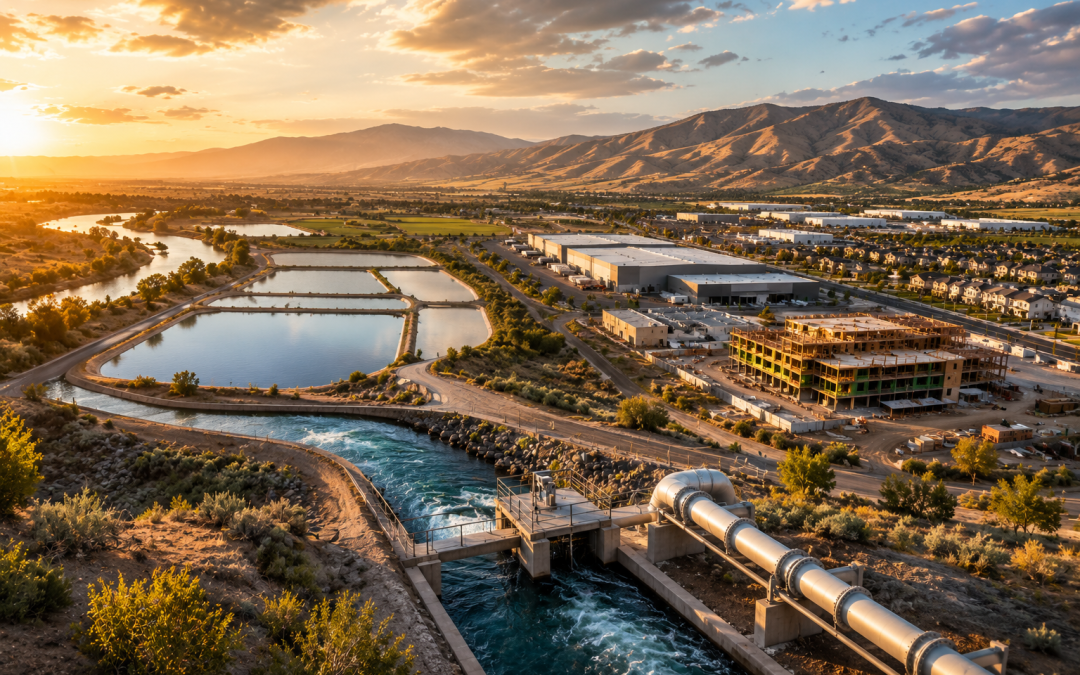
Idaho’s New Water Investment Could Shape the Next Phase of Growth Near Mountain Home and Boise
Water has always been one of the most important long-term issues in Idaho growth planning — but now the state is putting serious money behind one of its biggest regional water challenges.
A new commitment from the Idaho Water Resource Board could eventually influence agriculture, development patterns, industrial expansion, and long-term investment activity across the broader Boise region.
According to reporting by Idaho Business Review staff in this article — “Idaho water resource board commits $8 million to Mountain Home water sustainability” — the state approved an $8 million funding commitment tied to long-term aquifer stabilization efforts in the Mountain Home area.
While the story centers on water infrastructure, the implications stretch much further into Idaho commercial real estate, Boise development, agriculture, logistics growth, and long-range land planning.
Why Water Infrastructure Matters More Than Ever in Idaho
Growth across southwest Idaho continues accelerating.
More residents, businesses, industrial users, and agricultural operations all increase pressure on the region’s water systems. In many parts of the West, water availability is increasingly becoming a major economic development issue — not just an environmental concern.
The Idaho Water Resource Board approved the new Mountain Home Plateau Regional Water Sustainability Program to help address long-term groundwater depletion in Elmore County.
Key facts from the report include:
- $8 million approved for the new sustainability initiative
- The Mountain Home aquifer reportedly faces a deficit of roughly 30,000 acre-feet annually
- Local wells have faced pressure for decades
- Elmore County is pursuing infrastructure tied to both the South Fork Boise River and the Snake River
- Full implementation could ultimately require tens of millions of dollars beyond the initial state funding
The long-term goal is to reduce dependence on groundwater by bringing more surface water into the region.
That may sound highly technical, but from a Boise commercial real estate perspective, it is a major growth and stability issue.
Water Availability Is Becoming a Development Issue
Across the western United States, water access increasingly affects:
- housing growth
- industrial expansion
- data center development
- agricultural production
- manufacturing recruitment
- long-term land values
Communities with stronger long-term infrastructure planning often become more attractive to investors and employers.
Mountain Home occupies an increasingly strategic position along the Interstate 84 corridor between Boise and eastern Idaho. As the Treasure Valley continues expanding outward, nearby communities may see growing pressure for residential, industrial, and logistics-related development.
Reliable water systems become critical when regions begin absorbing long-term population and business growth.
For developers and investors, infrastructure conversations like this one are becoming just as important as road access, power capacity, or zoning policy.
Why This Could Matter for Boise Commercial Real Estate
The Boise metro area is still viewed nationally as a high-growth western market.
But sustaining that growth over the next 10 to 20 years will require major infrastructure investments across multiple categories:
- water
- transportation
- energy
- utility capacity
- workforce housing
The Mountain Home water initiative reflects a broader shift happening across the West:
states are starting to address infrastructure stress before reaching full crisis levels.
That proactive approach may help Idaho remain competitive compared to other western growth markets facing stricter water constraints.
There may also be future implications for:
- agricultural land values
- industrial development corridors
- warehouse and logistics expansion
- military-related growth near Mountain Home Air Force Base
- long-term residential expansion east of Boise
If regional water stability improves over time, it could support additional investment confidence throughout parts of Elmore County and the broader Interstate 84 corridor.
Local Insight
One thing that often gets overlooked in Boise development conversations is how closely infrastructure and commercial real estate are connected.
Water projects may not create the same headlines as a new mixed-use development or corporate lease announcement, but they can have an even bigger long-term impact on growth patterns.
Institutional investors, major employers, and large-scale developers increasingly evaluate long-term infrastructure reliability before committing capital.
In many ways, water may become one of the defining growth constraints — or growth advantages — for western markets over the next several decades.
Idaho appears to be recognizing that reality earlier than some competing states.
Mike Gioioso (joy-OH-so) has for 16+ years been helping companies of all sizes buy, build, and lease perfect places for business in greater Boise, Idaho and beyond.
www.streetsmartidaho.com mike@streetsmartidaho.com 208-209-9166
Tags: #boisecommercialrealestate, #boisedevelopment, #idahocommercialrealestate, #mountainhomeidaho, #elmorecounty, #waterinfrastructure, #watersustainability, #aquiferrecharge, #economicdevelopment, #industrialdevelopment, #treasurevalleyrealestate, #boiserealestate, #infrastructureinvestment, #commercialdevelopment, #industrialrealestate