
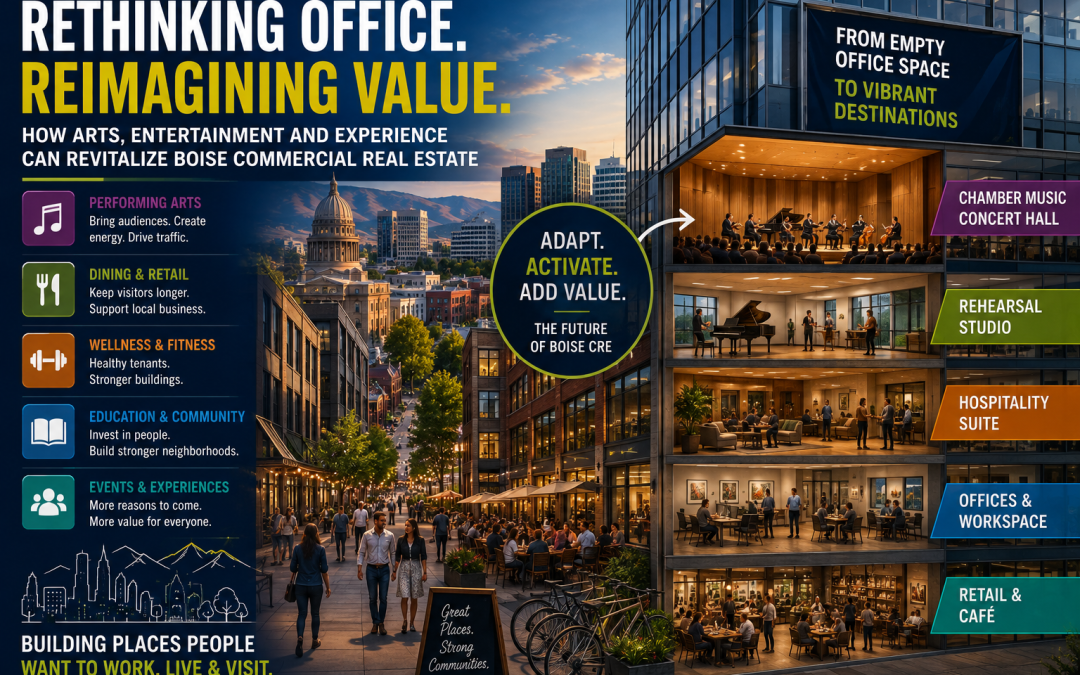
Could Arts and Entertainment Help Reinvent Boise Commercial Real Estate?
What happens when a downtown office building has more space than traditional companies want to lease?
One answer may be to stop looking only for traditional office tenants.
Seattle is providing an interesting example. A major downtown office tower is preparing to add a purpose-built chamber music venue, bringing concerts, rehearsals, offices and hospitality space into a property originally associated primarily with corporate users.
For Boise commercial real estate, the lesson goes beyond music.
As office markets evolve, landlords may need to think much more broadly about who can occupy commercial buildings—and what types of tenants can create value beyond simply paying rent.
According to reporting by Randyl Drummer of CoStar News, the Seattle Chamber Music Society has leased 16,620 square feet inside the U.S. Bank Center in downtown Seattle.
The organization plans to create a 271-seat performance venue along with rehearsal areas, offices and hospitality space. The facility is expected to open in early 2028.
You can read the original CoStar News article here:
https://product.costar.com/home/news/2061795576
The deal offers an interesting look at how struggling office districts could evolve as landlords search for new sources of demand.
Office Buildings May Need a Much Broader Tenant Mix
Seattle’s office market faces a challenge shared by many cities.
There is simply more traditional office space available than companies currently want.
CoStar reported downtown Seattle office vacancy above 31%.
That kind of vacancy changes the leasing equation.
When a market has abundant available space, landlords can’t always wait for another law firm, technology company or corporate headquarters to appear.
They may need to expand the definition of an office tenant.
Seattle is already seeing some of that experimentation.
Arts organizations have taken space in traditional office properties. Another arts operation opened in a former big-box retail location downtown.
Now the Seattle Chamber Music Society is preparing to turn part of an office tower into a dedicated performance destination.
That’s significant.
Instead of simply filling desks, the tenant could bring audiences into the property.
Those visitors may eat nearby.
They may visit bars before or after performances.
They may use parking.
They may shop.
They may return repeatedly throughout the year.
That means the economic value of the tenant can potentially extend beyond its leased square footage.
For Downtown Boise commercial real estate, that’s worth thinking about.
The Next Office Tenant May Not Look Like an Office Tenant
The traditional office leasing model is fairly predictable.
Employees arrive in the morning.
They work.
They leave in the afternoon.
That traffic helps support surrounding restaurants, coffee shops and retailers.
Hybrid work weakened that pattern in many cities.
Fewer workers downtown five days per week means less predictable daytime traffic.
That creates a reason to pursue tenants that generate different kinds of activity.
Think about the possibilities:
- Performing arts organizations
- Fitness and wellness concepts
- Education and training facilities
- Medical services
- Private clubs
- Event venues
- Galleries
- Museums
- Entertainment concepts
- Community organizations
- Culinary experiences
Not every office building can accommodate these uses.
Zoning matters.
Parking matters.
Ceiling heights matter.
Building systems matter.
Access matters.
Construction costs matter.
But when those pieces work, unconventional tenants can potentially turn underused commercial space into something productive.
That could become increasingly relevant to Boise office leasing.
Experience-Based Tenants Can Help the Entire Property
There’s another reason landlords should pay attention to this trend.
An entertainment or cultural tenant can function almost like an amenity for the rest of the building.
Imagine an office property with restaurants downstairs and a performance venue inside.
Employees have something to do after work.
Visitors have another reason to enter the property.
Restaurants gain evening traffic.
The building develops an identity beyond simply being an office address.
That can potentially improve the experience for other tenants.
This is similar to what has happened in retail.
Shopping centers learned that restaurants, gyms, entertainment and experiential concepts could generate traffic that traditional stores alone could not.
Office owners may increasingly borrow from that playbook.
The goal becomes creating a destination, not simply leasing suites.
For Boise commercial real estate landlords, that shift could become important as businesses become more selective about where they locate.
Adaptive Reuse Doesn’t Always Mean Apartments
When people hear about struggling office buildings, one solution gets discussed constantly:
Convert them into housing.
Sometimes that makes sense.
But office-to-residential conversion can be extremely difficult.
Floor plates may be too deep.
Windows may be poorly positioned.
Plumbing systems may require extensive reconstruction.
Building codes can create challenges.
Conversion costs can become enormous.
That means some buildings need another solution.
The Seattle deal provides one example.
Instead of converting an entire office tower into apartments, owners can rethink individual floors, common areas or portions of the property.
A former office suite might become medical space.
A large floor could become education space.
A lobby-level area might become retail.
Another section could become entertainment.
That’s a different kind of adaptive reuse.
Rather than changing the entire building, landlords gradually diversify what happens inside it.
For Boise, that approach may prove more realistic for some properties.
Why This Matters for Downtown Boise
Downtown Boise does not face the same office conditions as Seattle, and the scale of the two markets is very different.
But the broader trend matters.
Office demand has changed.
Companies increasingly evaluate space based on how frequently employees actually use it.
Businesses may need fewer square feet.
Others may want higher-quality space with better amenities.
That means older or less competitive buildings may eventually need to reposition themselves.
One strategy could be finding users that traditionally weren’t considered part of the office tenant pool.
Downtown Boise has several advantages for those concepts.
Restaurants are nearby.
Hotels are nearby.
Parking infrastructure exists.
The district is walkable.
There are residents, workers, visitors and tourists.
Those ingredients can support businesses and organizations that depend on people physically showing up.
And that’s an important distinction.
A technology company can let employees work remotely.
A concert cannot.
A fitness class cannot.
A medical appointment cannot.
A restaurant cannot.
An art exhibition cannot.
Those uses create physical demand for real estate.
Local Insight: Look for Tenants That Create Traffic
When evaluating unconventional tenants, I wouldn’t focus only on whether they can occupy the available space.
I’d ask another question:
What happens to the rest of the property when they move in?
Some tenants simply consume space.
Others create activity.
A performance venue can generate evening traffic.
A gym can generate morning and afternoon traffic.
A medical tenant can create steady weekday visits.
A restaurant can bring customers throughout the day.
An educational facility can create predictable schedules and repeat visits.
That traffic can benefit neighboring tenants.
For Boise retail leasing, this becomes especially important in mixed-use projects where office, retail, restaurants and services depend on one another.
The right tenant mix can make the whole property stronger.
Boise Office Owners May Need To Think Like Retail Landlords
Retail landlords have spent decades thinking about tenant mix.
They ask which businesses generate traffic.
They consider which tenants complement one another.
They try to avoid having too many businesses competing for the same customer.
Office landlords historically didn’t need to think this way as much.
A law firm could lease one floor.
An accounting company could lease another.
A technology company could take another.
Each tenant largely operated independently.
That model may be changing.
As office properties become more mixed-use and experience-oriented, landlords may increasingly need to think about how tenants interact.
Could a restaurant benefit from a nearby entertainment venue?
Could a fitness tenant make an office building more attractive to employers?
Could medical services generate customers for ground-floor retail?
Could an event venue support hotel demand?
These relationships can create value that doesn’t appear when looking at each lease individually.
For Boise commercial real estate investors, that could become an important part of evaluating office properties.
The Opportunity Is To Make Buildings Useful Again
Seattle’s chamber music deal is ultimately about more than filling 16,620 square feet.
It demonstrates how landlords can rethink commercial space when traditional demand changes.
That’s something every commercial real estate market should watch.
Buildings don’t become obsolete simply because the original tenant profile changes.
Sometimes the use needs to evolve.
For Boise commercial real estate, the next generation of successful office properties may include far more than offices.
They could combine workspaces with healthcare, entertainment, education, fitness, restaurants, retail and community uses.
That doesn’t mean every office tower should become a concert hall.
It means landlords should be willing to ask a broader question:
Who needs physical space, and what can they bring to the property besides rent?
The owners who answer that question creatively may have a major advantage as commercial real estate continues to evolve.
Mike Gioioso (joy-OH-so) has for 16+ years been helping companies of all sizes buy, build, and lease perfect places for business in greater Boise, Idaho and beyond.
www.streetsmartidaho.com mike@streetsmartidaho.com 208-209-9166
Tags: #boisecommercialrealestate, #boiseofficerealestate, #boiseofficemarket, #boiseofficeleasing, #downtownboisecommercialrealestate, #downtownboiseoffice, #idahocommercialrealestate, #treasurevalleycommercialrealestate, #boiseadaptivereuse, #officeadaptivereuse, #officeredevelopment, #boiseredevelopment, #downtownboisedevelopment, #boisedevelopment, #commercialrealestateadaptivereuse