
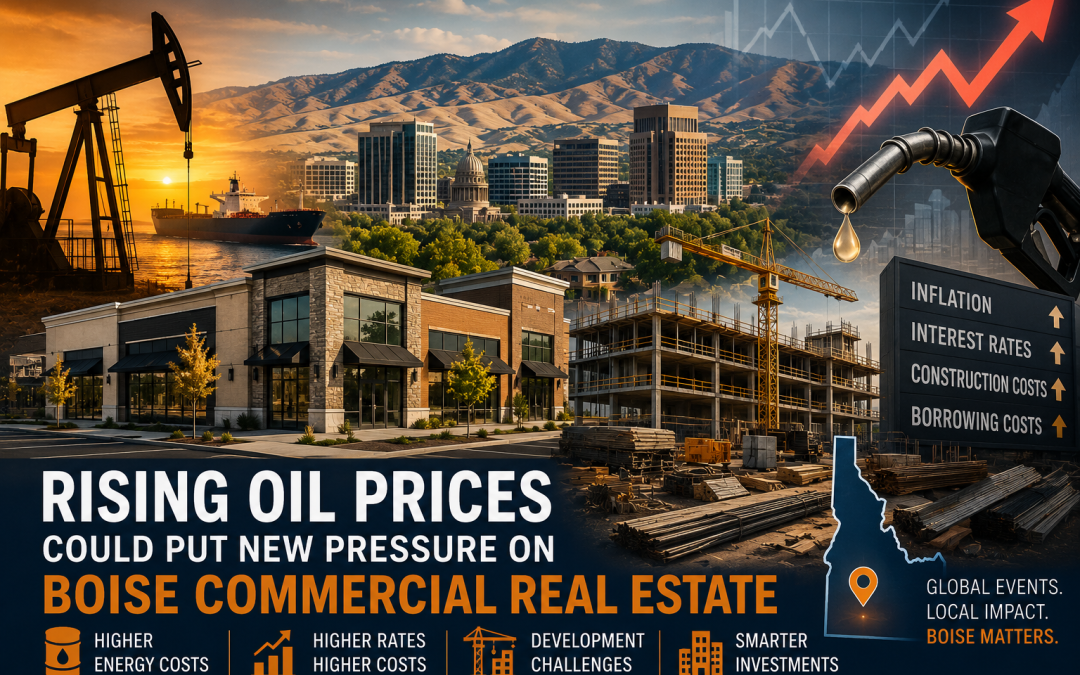
Rising Oil Prices Could Put New Pressure on Boise Commercial Real Estate
Commercial real estate investors have spent the past few years waiting for one thing: more predictable borrowing costs.
A new surge in oil prices could make that harder.
Crude oil climbed above $95 per barrel as renewed Middle East tensions raised concerns about global energy supplies. While that immediately affects financial markets, the bigger issue for Boise commercial real estate is what could happen next.
Higher energy prices can contribute to inflation. Inflation can keep interest rates elevated. Higher rates can make commercial development, investment property purchases and business expansion more expensive.
According to reporting by Gregor Stuart Hunter and Johann M. Cherian of Reuters, published by the Idaho Business Review, oil markets and geopolitical concerns were creating fresh uncertainty for investors as technology companies prepared to report earnings.
You can read the original Idaho Business Review article here:
https://idahobusinessreview.com/2026/07/22/rising-oil-prices-us-futures-big-tech-earnings/
The story is global, but the potential effects can reach all the way to Boise.
Energy Prices Could Complicate the Interest Rate Picture
Oil prices jumped about 4% and reached their highest level in roughly six weeks as concerns grew about potential supply disruptions.
That matters because energy touches almost everything in the economy.
Fuel moves construction materials.
Trucks deliver products to stores.
Contractors operate equipment.
Employees commute to work.
Manufacturers use energy to produce goods.
Restaurants, retailers and service businesses depend on supply chains that can become more expensive when transportation costs increase.
If oil remains expensive, businesses may eventually face higher operating costs. Some of those increases can be passed along to customers, adding another source of inflation.
For commercial real estate, inflation matters largely because of what it can mean for interest rates.
The Federal Reserve was expected to keep borrowing costs unchanged at its upcoming meeting, according to the Reuters report. At the same time, markets were pricing in the possibility of higher rates later in the year.
The 10-year U.S. Treasury yield was around 4.64%.
For Boise commercial real estate investors, that number matters.
Treasury yields influence the broader cost of capital. When borrowing costs stay high, buyers generally need stronger property income or lower acquisition prices to make deals work.
That can widen the gap between what sellers want and what buyers are willing to pay.
Boise Development Could Feel the Pressure From Several Directions
Higher oil prices are not simply a gas station story.
They can become a Boise development story.
Consider a commercial project under construction.
Steel, lumber, roofing materials, HVAC equipment, concrete components, fixtures and other products often travel significant distances before reaching a Treasure Valley jobsite.
If transportation and manufacturing costs increase, construction budgets can face additional pressure.
Developers may then have to make difficult decisions.
Do they absorb the additional cost?
Increase rents?
Reduce the project’s scope?
Delay construction?
Or wait until financing and material costs become more predictable?
That uncertainty can be especially important for projects where development economics are already tight.
Retail is a good example.
A new shopping center may require rents high enough to support land costs, construction, financing, tenant improvements and developer returns.
But tenants can only afford so much rent.
If development costs rise faster than the rents businesses can reasonably pay, fewer projects pencil.
That could affect retail leasing in Boise, particularly in rapidly growing Treasure Valley areas where new commercial construction is needed to serve expanding residential neighborhoods.
Tenants Could Face a Double Squeeze
Businesses leasing commercial space can also feel the effects.
A restaurant may pay more for food deliveries.
A retailer could face higher shipping costs.
A contractor may spend more fueling vehicles.
A distribution company could see transportation expenses increase.
At the same time, businesses using credit to purchase equipment, open locations or finance operations may continue dealing with expensive borrowing.
That creates a potential double squeeze:
higher operating expenses and higher capital costs.
Landlords should pay attention to this.
Tenant health ultimately supports property health.
A landlord may want higher rent, but rent is only one part of a tenant’s occupancy equation. Labor, insurance, utilities, inventory, financing and transportation expenses all compete for the same revenue.
Understanding those pressures can become increasingly important during lease negotiations and renewals.
AI Adds Another Layer for Commercial Real Estate
There is another interesting piece of the Reuters report.
Technology stocks were under pressure as investors waited for major earnings announcements and questioned whether enormous spending on artificial intelligence infrastructure would produce adequate returns.
That may sound disconnected from Idaho real estate.
It isn’t.
AI development requires enormous amounts of physical infrastructure.
Data centers need land.
They need buildings.
They need power.
They require cooling systems, transmission infrastructure, construction labor and specialized equipment.
Idaho has increasingly become part of the national conversation around semiconductor manufacturing, data centers, energy infrastructure and technology investment.
That means the relationship between energy availability and commercial development could become even more important.
An economy building massive amounts of digital infrastructure still depends on very physical resources.
Land, electricity, construction materials and capital all matter.
Local Insight: Watch the Cost of Capital More Than the Stock Market
For Boise investors and property owners, I wouldn’t focus too heavily on whether the Nasdaq rises or falls on any particular day.
I would watch what happens to inflation expectations, Treasury yields and commercial lending rates.
Those factors can have a much more direct effect on commercial property.
If oil prices retreat and inflation continues cooling, financing conditions could eventually become more favorable.
If energy prices stay elevated, however, the Federal Reserve may have less room to lower rates.
That could keep commercial real estate financing expensive for longer.
For investors, that means underwriting conservatively.
For developers, it means leaving room for unexpected construction and financing costs.
For landlords, it means understanding what tenants are experiencing beyond rent.
And for tenants looking for Boise commercial space, it may make sense to evaluate locations based on total occupancy costs rather than asking only about the quoted rental rate.
The bigger lesson is simple:
Commercial real estate does not operate in isolation.
A tanker changing direction thousands of miles away can eventually influence fuel costs, inflation expectations, interest rates and construction budgets here in Idaho.
That’s why watching global economic trends can be useful when making local Boise commercial real estate decisions.
Mike Gioioso (joy-OH-so) has for 16+ years been helping companies of all sizes buy, build, and lease perfect places for business in greater Boise, Idaho and beyond.
www.streetsmartidaho.com mike@streetsmartidaho.com 208-209-9166
Tags: #boisecommercialrealestate, #idahocommercialrealestate, #treasurevalleycommercialrealestate, #boisedevelopment, #treasurevalleydevelopment, #boiseinvestmentproperty, #commercialrealestateinvesting, #boiseretailrealestate, #retailleasingboise, #boiseindustrialrealestate, #commercialrealestateinterestrates, #oilprices, #inflation, #commerciallending, #boiseconstructioncosts