
Why Dumpling Time’s Boise Expansion Signals Continued Momentum for Downtown Boise Retail
Downtown Boise keeps attracting new restaurant concepts from outside Idaho — and that trend says a lot about where Boise commercial real estate may be headed next.
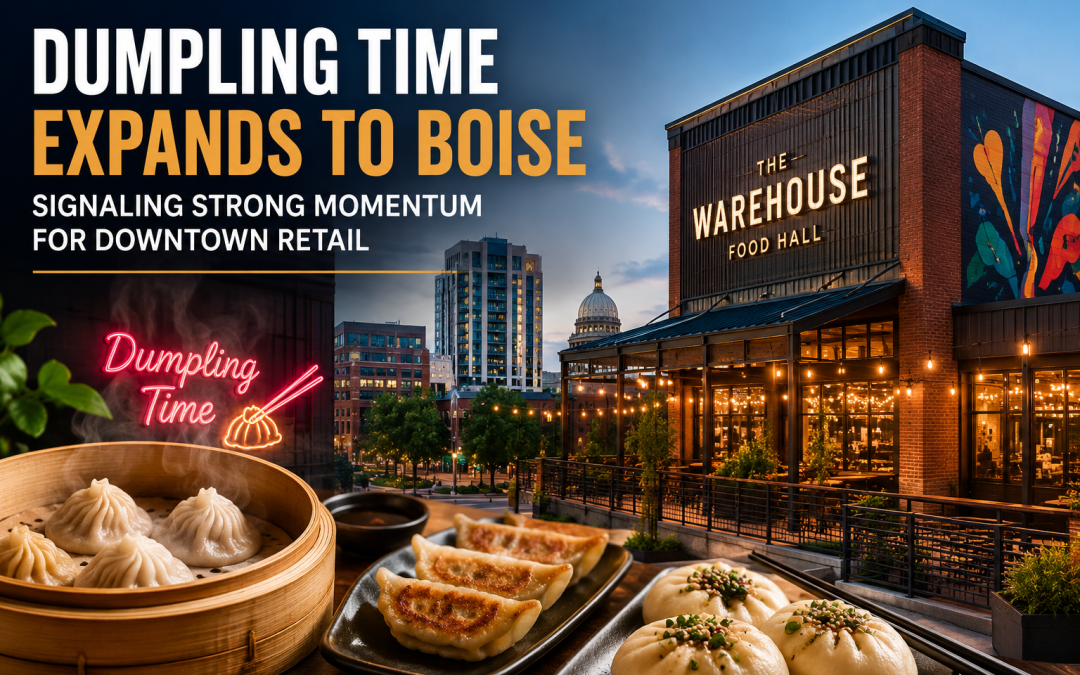
According to reporting by Idaho Business Review staff in this article — “Dumpling restaurant makes time to open first Idaho location in Boise” — California-based Dumpling Time plans to open its first Idaho location this fall inside The Warehouse Food Hall in downtown Boise’s BoDo district.
The expansion is notable because it represents the company’s first move outside California. For Boise commercial real estate professionals, that matters far beyond one restaurant opening.
It highlights how national and regional operators increasingly view downtown Boise as a market capable of supporting higher-end, experience-driven food concepts.
Boise Continues Attracting Out-of-State Restaurant Brands
Dumpling Time was originally founded in the Bay Area in 2017 by Kash Feng as part of the Omakase Restaurant Group portfolio.
The Boise location will reportedly be operated through a partnership between Feng and local operator Jon Bergscheider. The restaurant will join the growing lineup inside The Warehouse Food Hall, becoming the development’s 14th food vendor.
The concept focuses heavily on handmade Asian dishes including:
- Xiao long bao soup dumplings
- Crispy gyoza
- Pan-seared bao
- Hand-cut noodles
- Seafood and pork dumplings
- Beer, wine, and sake offerings
But from a Boise development perspective, the bigger story may be what this says about downtown tenant demand.
National and regional restaurant operators rarely expand into smaller secondary markets unless they believe:
- population growth is sustainable,
- disposable income is increasing,
- tourism and convention activity are strengthening,
- and downtown foot traffic can support premium dining concepts.
Boise increasingly checks all of those boxes.
Food Halls Are Becoming Retail Anchors in Downtown Boise
One of the more important commercial real estate trends tied to this announcement is the continued evolution of food halls as mixed-use traffic generators.
The Warehouse has steadily positioned itself as more than just a collection of restaurants. Developments like this often function as modern experiential retail anchors that help activate downtown districts and support surrounding office, residential, hotel, and entertainment uses.
That matters for Boise retail leasing.
Restaurants that create energy and repeat visitation can help:
- increase nearby retail demand,
- improve pedestrian traffic,
- support apartment absorption,
- and strengthen downtown investment appeal.
In many growing western cities, food halls have become part of broader placemaking strategies designed to keep urban districts active beyond standard office hours.
Boise appears to be moving further in that direction.
Why International Cuisine Growth Matters for Boise Commercial Real Estate
Another interesting takeaway is the continued diversification of Boise’s restaurant scene.
The article notes that Dumpling Time’s interior design will draw inspiration from Asian night markets and street-food culture, featuring murals, neon elements, and a more immersive dining atmosphere.
That style of experience-focused restaurant concept has become increasingly popular in larger West Coast markets.
As Boise grows, developers and landlords are paying closer attention to tenants that create social experiences rather than simply selling products or meals.
For retail landlords, these concepts can:
- generate stronger evening traffic,
- encourage longer customer visits,
- create social media visibility,
- and help projects differentiate themselves from traditional shopping centers.
This is especially important in urban Boise retail corridors competing for entertainment-oriented consumers.
Local Market Impact
The Boise metro continues evolving from a smaller regional city into a more nationally recognized growth market.
Openings like Dumpling Time may seem small individually, but collectively they signal several broader Boise real estate trends:
- More out-of-state brands entering Idaho
- Continued confidence in downtown Boise retail
- Rising demand for experiential dining
- Stronger consumer support for international cuisine
- Increased competition for quality restaurant space
For landlords, this can support rent growth and tenant demand in well-positioned retail environments.
For developers, it reinforces the value of mixed-use projects with entertainment and food-driven components.
For investors, it may signal continued long-term strength in downtown Boise commercial real estate despite broader national uncertainty in some retail sectors.
My Take
One of the biggest shifts happening in Boise development right now is that restaurant concepts are no longer treating Boise like a “test market.”
They are increasingly designing locations specifically for Boise because they believe the city now has enough population density, tourism, income growth, and lifestyle demand to support more sophisticated dining experiences.
That is a meaningful evolution for the Treasure Valley.
The types of restaurants entering a market often tell you a lot about where commercial real estate demand is headed next.
And right now, Boise continues moving toward a more experience-driven urban economy.
Mike Gioioso (joy-OH-so) has for 16+ years been helping companies of all sizes buy, build, and lease perfect places for business in greater Boise, Idaho and beyond.
www.streetsmartidaho.com mike@streetsmartidaho.com 208-209-9166
Tags: #boisecommercialrealestate, #boisedevelopment, #downtownboise, #boiseretail, #retailleasingboise, #boiserestaurants, #bododistrict, #thewarehouseboise, #boiserealestate, #idahocommercialrealestate, #treasurevalleyrealestate, #mixedusedevelopment, #experientialretail, #restaurantrealestate, #retaildevelopment