
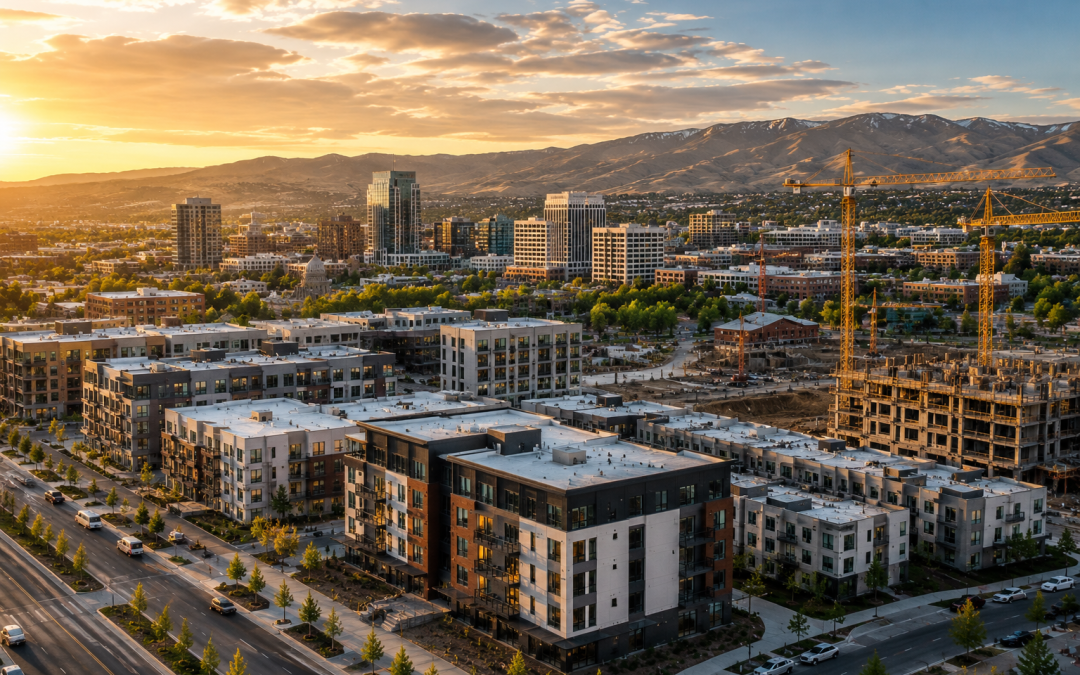
Why New Financing Trends Could Create More Multifamily Development Opportunities in Boise
Access to capital often determines which real estate projects move forward and which remain on the drawing board.
That is why a recent series of developments in commercial real estate finance may be worth watching for anyone involved in Boise commercial real estate, multifamily development, or investment property ownership.
According to reporting by Mark Heschmeyer in CoStar News, government-backed multifamily financing is gaining momentum, commercial mortgage-backed securities (CMBS) performance is improving, and investors are increasingly paying attention to long-term office occupancy risks.
While these stories originate from national markets, they offer important clues about where capital may flow next and what opportunities could emerge across the Treasure Valley.
You can read the original CoStar News article here:
https://product.costar.com/home/news/826220204
Capital Is Becoming More Available for Multifamily Housing
One of the most significant developments involves financing backed by the U.S. Department of Housing and Urban Development (HUD).
Historically, many institutional investors viewed HUD financing as a niche option. That perception appears to be changing.
According to CoStar News, HUD-insured multifamily and senior housing loan securitizations reached approximately $6.36 billion through April, a substantial increase from the same period a year earlier.
Several factors are driving the growth:
- Faster loan processing
- More predictable approvals
- Higher leverage opportunities
- Long-term fixed-rate financing
- Proposed underwriting flexibility
- Expanded support for workforce housing
Perhaps most important for growing markets like Boise is HUD’s increasing willingness to support housing serving households earning up to 120% of area median income.
That places significant attention on workforce housing, one of the fastest-growing needs throughout the Treasure Valley.
Why Workforce Housing Matters in Boise
Housing affordability remains one of the biggest long-term economic challenges facing the Boise region.
Many workers who support healthcare systems, schools, local governments, retail businesses, and service industries fall into the workforce housing category.
Developers have often struggled to make these projects financially feasible due to rising land costs, construction expenses, insurance premiums, and financing challenges.
If HUD financing becomes more accessible and attractive to institutional investors, it could unlock additional multifamily development opportunities throughout Boise, Meridian, Nampa, Caldwell, and surrounding communities.
That matters because housing supply continues to influence:
- Workforce recruitment
- Business expansion
- Retail spending
- Economic development
- Long-term population growth
For Boise development professionals, capital availability may become just as important as land availability over the next several years.
Office Markets Continue Sending Mixed Signals
Another interesting theme from the CoStar report involves changing perceptions around major corporate headquarters.
Recent discussion surrounding Starbucks’ expansion into Nashville has raised questions among some investors about long-term office occupancy commitments, even among historically stable corporate tenants.
Although Starbucks has stated it remains committed to Seattle and continues maintaining its large headquarters presence, the situation highlights a broader trend.
Corporate location decisions are becoming increasingly dynamic.
For decades, investors often viewed major headquarters properties as among the safest office investments available.
Today, many investors are reevaluating assumptions about tenant permanence, especially as companies continue adapting to hybrid work models, geographic expansion strategies, and changing workforce preferences.
For Boise commercial real estate professionals, this trend reinforces the value of diversified tenant bases rather than relying heavily on a single large occupier.
Commercial Real Estate Debt Markets Are Showing Improvement
The report also highlighted encouraging news within the CMBS market.
National delinquency rates declined during April as several large troubled loans were resolved or brought current.
While office properties continue experiencing the highest levels of distress among major property types, overall performance improved across many sectors.
Key takeaways include:
- Overall CMBS delinquency rates declined.
- Retail loan performance improved modestly.
- Multifamily loan performance strengthened.
- Hotel distress decreased.
- Workout activity increased.
- New delinquency volume fell significantly.
These developments suggest that lenders, borrowers, and investors are gradually working through many of the challenges created by higher interest rates and changing property values.
While risks certainly remain, the data points toward a healthier capital markets environment than many anticipated a year ago.
What Boise Investors Should Watch
The biggest lesson from these national trends is simple: capital is becoming more selective, but it is still available for the right projects.
Properties and developments that align with long-term demographic trends are likely to attract the greatest lender interest.
In Boise, that may include:
Workforce Housing
Demand remains strong while supply remains constrained.
Mixed-Use Development
Projects that combine housing, retail, and community amenities continue attracting investor attention.
Necessity-Based Retail
Retail centers serving growing residential neighborhoods remain attractive to lenders and investors.
Healthcare-Related Real Estate
Population growth continues creating demand for healthcare facilities and services.
My Take
The most important story here is not declining delinquency rates or individual office leases.
It is the growing willingness of capital providers to support workforce-oriented housing projects.
Boise’s long-term success depends heavily on maintaining housing options for teachers, healthcare workers, first responders, service employees, and countless others who keep the local economy functioning.
If financing programs continue evolving to support those projects, the Treasure Valley could benefit from additional housing supply at a time when affordability remains one of the region’s most pressing challenges.
For investors, developers, and lenders, that may be one of the most important commercial real estate trends to watch over the next several years.
Mike Gioioso (joy-OH-so) has for 16+ years been helping companies of all sizes buy, build, and lease perfect places for business in greater Boise, Idaho and beyond.
208-209-9166
Tags: #boisecommercialrealestate, #boisedevelopment, #boiserealestate, #multifamilyhousing, #workforcehousing, #commercialrealestate, #realestatefinance, #hudfinancing, #investmentproperty, #treasurevalleyrealestate, #apartmentdevelopment, #boiseinvestors, #commercialmortgage, #cmbs, #multifamilyinvestment