
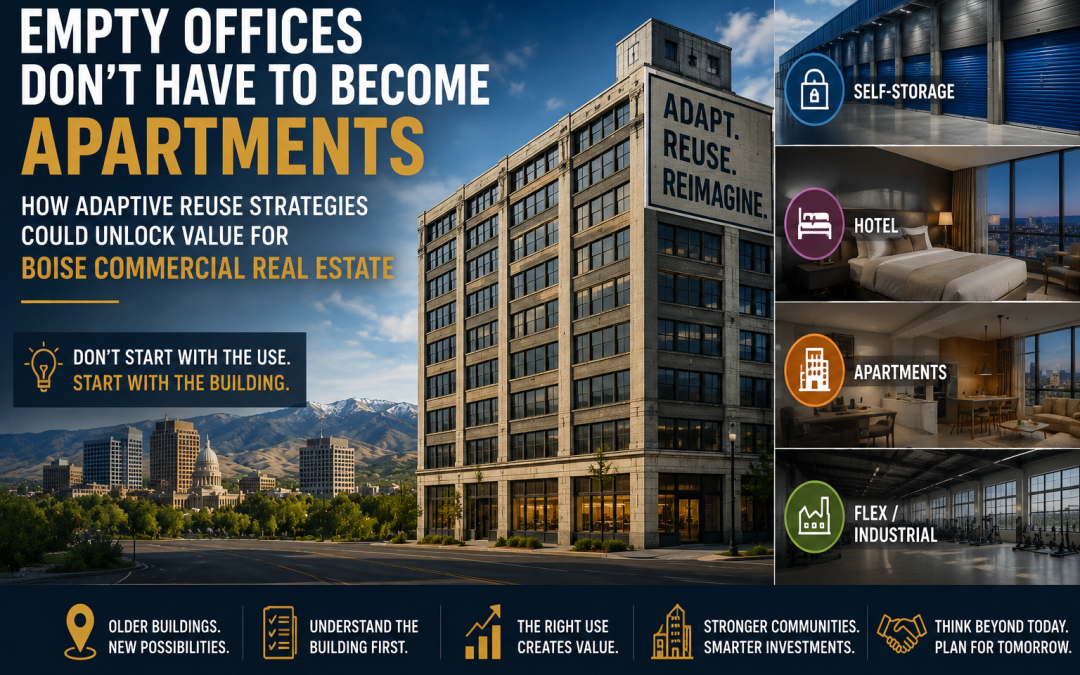
Empty Offices Don’t Have to Become Apartments—and That Could Matter for Boise Commercial Real Estate
When people talk about fixing struggling office buildings, one solution usually gets most of the attention:
Turn them into apartments.
It sounds simple.
Cities need housing. Some cities have too much office space. Why not convert one into the other?
The problem is that buildings don’t always cooperate.
A Seattle-based developer’s experience shows why successful adaptive reuse requires more than finding an empty office building. It requires finding a new use that actually fits the building.
That’s an important lesson for Boise commercial real estate, particularly as owners, investors, and developers consider the future of older office properties.
According to reporting by Randyl Drummer of CoStar News, Ben Wong and Jonas Sylvester founded Tourbineau Real Estate Partners in 2024 with plans to pursue office-to-residential conversions. After analyzing potential projects, they discovered that many office buildings simply didn’t work financially or physically as apartments.
Instead of abandoning the conversion strategy, they changed the end use.
You can read the original CoStar News article here: https://product.costar.com/home/news/1763270924
Their experience offers a useful lesson for Boise:
Don’t start with what you want an old building to become. Start with what the building is already capable of becoming.
Why Turning Offices Into Apartments Is Harder Than It Looks
The basic office conversion argument makes sense.
Suppose an older office building has high vacancy and declining demand.
At the same time, the surrounding market needs housing.
Turning the offices into apartments appears to solve two problems at once.
But commercial buildings weren’t designed as homes.
Apartment residents need windows, bathrooms, kitchens, ventilation, plumbing, parking, elevators, emergency access, and floorplans that make sense for daily living.
An office building can create problems with almost every one of those requirements.
Consider floor depth.
Many office buildings have large floorplates designed to fit rows of desks and interior workspaces.
That works because employees don’t necessarily need a window next to every desk.
Apartments are different.
Units generally need access to natural light, which can make deep office floorplates difficult to divide efficiently.
Then there’s plumbing.
An office building may have restrooms concentrated around the building core.
An apartment conversion suddenly needs kitchens and bathrooms spread throughout every residential floor.
That can mean extensive structural and mechanical work.
Parking creates another challenge.
So do ceiling heights, elevators, heating and cooling systems, building codes, zoning, and fire requirements.
By the time everything is added together, a building that looked inexpensive to acquire can become extremely expensive to convert.
Tourbineau encountered exactly that problem.
According to CoStar, Wong concluded that successful office-to-apartment conversions require an unusually favorable combination of building characteristics and economics.
That pushed the company toward another strategy.
The Better Question May Be: What Use Fits the Building?
Instead of trying to force apartments into properties that weren’t designed for residential use, Tourbineau began looking at the physical characteristics of the buildings themselves.
Some had originally been warehouses before being converted into offices.
That history mattered.
Warehouses can offer attributes such as heavy floor-load capacity, taller ceilings, and relatively straightforward interior layouts.
Those characteristics may not make them ideal apartments.
But they can work well for another property type:
Self-storage.
That realization changed Tourbineau’s investment strategy.
Rather than primarily looking for traditional residential conversions, the company began targeting underused buildings in dense urban locations that could be repositioned as storage facilities.
The company acquired nine properties during its first two years, with most planned for self-storage.
Projects have already opened in Oklahoma City and Raleigh, North Carolina.
Another conversion is opening in Seattle inside an older building that began life as a warehouse before later becoming office space.
Tourbineau is also pursuing storage conversions in several other major U.S. markets.
The important lesson isn’t that every obsolete office building should become self-storage.
It’s that adaptive reuse doesn’t have to mean residential conversion.
That’s a much more useful way to think about aging commercial properties.
Boise Could Eventually Face the Same Adaptive-Reuse Question
Boise doesn’t have the same office vacancy problem as San Francisco or Seattle.
But the forces reshaping office demand are national.
Hybrid work changed how companies use space.
Artificial intelligence could change employment patterns.
Companies are becoming more selective about office quality.
Tenants increasingly prefer newer buildings, stronger amenities, better locations, and more efficient layouts.
That can create a widening gap between the best office buildings and everything else.
In Boise commercial real estate, that means some older office properties could eventually face a difficult question:
What happens if traditional office demand no longer supports the building?
Selling it to another office investor doesn’t solve the underlying problem.
Lowering rent may help temporarily.
Renovating can work if the location and building fundamentals remain strong.
But some properties may ultimately need a completely different use.
That’s where adaptive reuse becomes interesting.
Depending on the building, possible alternatives could include:
- Apartments
- Self-storage
- Hotels
- Medical space
- Education
- Fitness facilities
- Research facilities
- Light manufacturing
- Creative industrial
- Flex space
- Mixed-use redevelopment
The right answer depends on the property.
And that is exactly the point.
Building History Could Become an Investment Advantage
One particularly interesting aspect of Tourbineau’s strategy is its focus on buildings that have already changed uses.
A warehouse that became an office might be easier to convert into storage than a traditional purpose-built office tower.
That suggests investors should look beyond a property’s current use.
They should understand its original design.
Was it originally industrial?
Does it have unusually strong floors?
What are the ceiling heights?
Where are the columns?
How deep is the floorplate?
How many elevators exist?
Where are utilities located?
Can vehicles access the building?
How much parking exists?
What zoning applies?
Those questions can uncover opportunities that aren’t obvious from a listing brochure.
This could become particularly relevant for Boise redevelopment.
The Treasure Valley contains older warehouses, former industrial properties, aging offices, retail boxes, and other buildings constructed for uses that may no longer represent their highest value.
Some of those properties may have better bones than their current appearance suggests.
Understanding the physical building can therefore become part of identifying its future value.
Conversion Economics Start With the Purchase Price
There’s another lesson commercial real estate investors shouldn’t overlook.
Adaptive reuse doesn’t magically make bad economics disappear.
An investor still needs to acquire the property at a price that leaves enough room for conversion costs.
That’s particularly important with struggling office buildings.
An owner may think:
“My building was worth $15 million several years ago.”
A conversion investor may look at the same property and say:
“After demolition, structural work, new mechanical systems, permitting, financing, and construction, I can only afford to pay $7 million.”
That gap can prevent deals from happening.
Sometimes the biggest obstacle to adaptive reuse isn’t zoning.
It’s the existing owner’s basis.
This is why distressed pricing can eventually create redevelopment opportunities.
When property values reset enough to reflect the cost of repositioning a building, new uses can suddenly become financially possible.
That’s something Boise commercial real estate investors should keep in mind if portions of the office market continue changing.
Office Conversions Can Go Far Beyond Storage
Tourbineau’s strategy also shows that adaptive reuse doesn’t require committing to one property type.
While much of the company’s current pipeline involves storage, it is pursuing other conversions as well.
CoStar reported that Tourbineau plans to transform a downtown Nashville office property into a 330-room Hyatt hotel.
In San Mateo, California, the company plans to convert a 12-story property into 144 apartments.
That reinforces an important point.
The strategy isn’t:
“Buy offices and turn them into storage.”
The strategy is:
Buy underused real estate and determine the highest-value feasible use.
That’s a much more flexible investment thesis.
Local Insight: Boise Should Think About Buildings Before They Become Problems
Adaptive reuse often becomes a major topic only after vacancy becomes severe.
By then, owners may already be under financial pressure.
I think the smarter approach is to evaluate buildings earlier.
If an older Boise office property is consistently losing tenants to newer buildings, owners should ask why.
Is it rent?
Parking?
Amenities?
Location?
Floorplan?
Mechanical systems?
Energy efficiency?
Or has the building simply reached a point where another use could produce greater long-term value?
Not every older building is obsolete.
In fact, many can remain competitive with thoughtful renovations and aggressive leasing.
But owners should understand their alternatives before they’re forced to use them.
That applies to investors, too.
The next interesting Boise commercial real estate investment might not be a brand-new building.
It could be an older building purchased at the right basis with physical characteristics that allow an entirely different use.
What This Could Mean for Boise Commercial Real Estate
The national office market is teaching investors an important lesson.
Buildings aren’t necessarily permanently tied to the use printed on the original plans.
Offices can become apartments.
Warehouses can become offices.
Offices can become storage.
Office towers can become hotels.
Retail properties can become medical facilities.
Industrial buildings can become entertainment venues.
Real estate changes because cities change.
For Boise landlords and developers, that means the value of a property may increasingly depend on its optionality.
A building capable of supporting several future uses may carry advantages over one that can only function as a single property type.
For investors, that makes physical due diligence even more important.
Don’t just ask:
“How much rent can this building generate today?”
Also ask:
“What else could this building become tomorrow?”
That question could become increasingly important as office demand evolves across the Treasure Valley.
The developers who solve the next generation of obsolete-building problems may not be the ones who follow the most popular conversion trend.
They may be the ones willing to look at an old building differently—and find the use the building was already capable of supporting.
Mike Gioioso (joy-OH-so) has for 16+ years been helping companies of all sizes buy, build, and lease perfect places for business in greater Boise, Idaho and beyond.
www.streetsmartidaho.com mike@streetsmartidaho.com 208-209-9166
Tags: #boisecommercialrealestate, #boiseofficemarket, #boiseofficespace, #boiseofficeleasing, #officeconversion, #officetoresidentialconversion, #adaptivereuseboise, #boiseredevelopment, #boisedevelopment, #downtownboisedevelopment, #boisecommercialpropertyinvestment, #treasurevalleycommercialrealestate, #officevacancy, #boiseselfstorage, #commercialpropertyconversion