
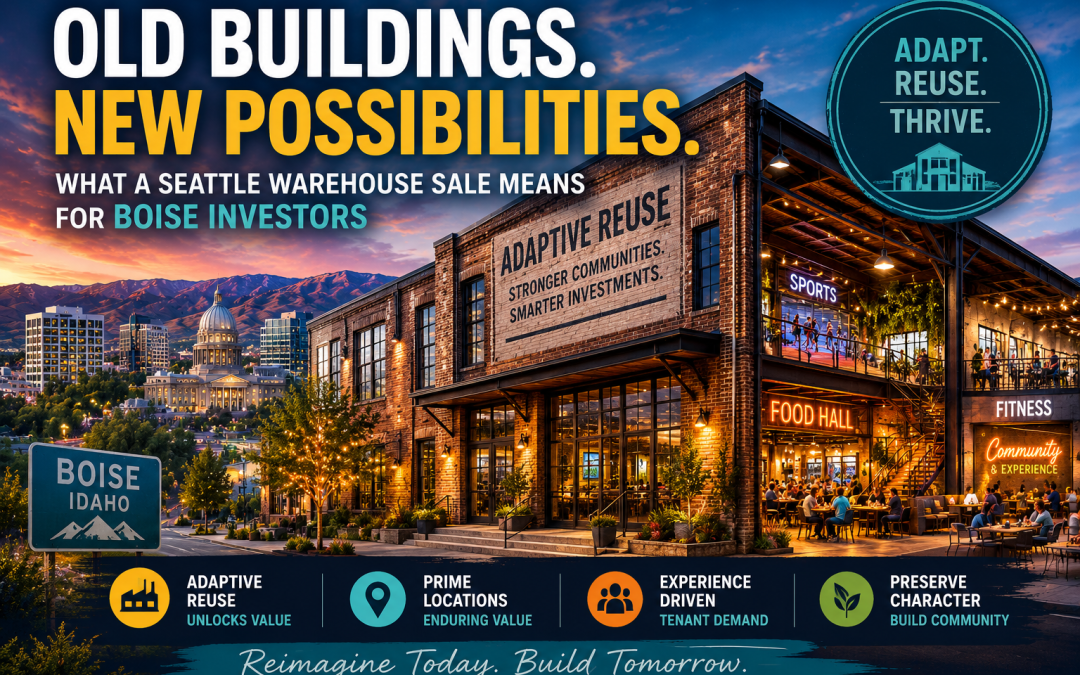
What a Seattle Warehouse Sale Could Teach Boise Commercial Real Estate Investors About Adaptive Reuse
Some of the most valuable commercial real estate opportunities aren’t found on vacant land.
They’re hiding inside older industrial buildings that no longer serve their original purpose.
A recent transaction in Seattle highlights a trend that is becoming increasingly important in commercial real estate markets across the country—and it may offer valuable lessons for Boise commercial real estate investors, developers, and property owners.
According to reporting by Joseph Garcia with CoStar Research, Horikoshi Enterprises recently acquired a historic warehouse property in Seattle’s Capitol Hill neighborhood for approximately $10.1 million. The building, originally constructed in 1920, has long been occupied by family-owned Auto Accessories and sits within one of the area’s remaining historic auto-oriented corridors.
The original CoStar News article can be found here:
https://product.costar.com/home/news/2134471634
While future plans have not been publicly announced, reports indicate the buyer may be exploring recreational or sports-related uses while preserving the building’s exterior character.
For Boise investors, the bigger story isn’t the sale itself.
It’s what the transaction says about changing demand for older commercial properties.
Industrial Buildings Are Finding New Life
Across the country, older warehouses are increasingly being repositioned rather than demolished.
In many urban markets, historic industrial buildings occupy locations that have become far more valuable than they were when originally developed.
As neighborhoods evolve, these structures often become candidates for:
- Entertainment venues
- Sports facilities
- Fitness centers
- Food halls
- Creative office space
- Event venues
- Mixed-use developments
- Specialty retail concepts
Rather than tearing down a building and starting over, developers frequently look for ways to preserve character while adapting the property for modern users.
That appears to be the direction being considered in Seattle.
Why This Matters for Boise Development
The Treasure Valley is younger than many major coastal markets, but Boise is beginning to see similar trends emerge.
As Boise continues growing, some older industrial and commercial properties are finding themselves surrounded by new residential development, mixed-use projects, and higher-density urban growth.
In these situations, property owners often face an important question:
Is the highest and best use still industrial?
Sometimes the answer is yes.
Other times, the property’s value may be unlocked through adaptive reuse.
Areas near downtown Boise, the Boise Bench, Garden City, and portions of older industrial corridors could eventually see increased interest from investors looking to transform existing buildings into more modern uses.
The Growing Value of Location
One reason adaptive reuse projects continue gaining popularity is because land has become increasingly difficult and expensive to replace.
An older building in a prime location may offer advantages that cannot be replicated through new construction.
These advantages often include:
- Established infrastructure
- Existing utility capacity
- Strong transportation access
- Walkable surroundings
- Historic character
- Central urban locations
As Boise development continues expanding, these factors may become increasingly valuable.
Developers are often willing to invest significant capital into renovations when the underlying location remains highly desirable.
Experience Is Becoming a Major Real Estate Driver
One of the more interesting details from the Seattle transaction is the possibility of recreational or sporting uses.
That reflects a broader trend occurring throughout commercial real estate.
Consumers are increasingly spending money on experiences rather than products.
This shift has fueled demand for:
- Indoor sports facilities
- Pickleball venues
- Entertainment concepts
- Golf simulators
- Fitness facilities
- Family activity centers
- Experiential retail
For those involved in retail leasing Boise, these categories continue generating significant interest as landlords seek tenants that drive consistent customer traffic.
Many of these concepts require large open spaces, making older warehouses attractive candidates.
What Boise Investors Should Watch
The Seattle warehouse transaction highlights several trends that may eventually create opportunities throughout Idaho.
Key Takeaways
- Older industrial buildings are increasingly being repurposed rather than demolished.
- Adaptive reuse continues gaining popularity in urban growth markets.
- Experience-based tenants are creating demand for large industrial-style spaces.
- Prime locations often become more valuable than the buildings occupying them.
- Historic structures can provide unique redevelopment opportunities that new construction cannot easily replicate.
My Take
One of the most overlooked opportunities in Boise commercial real estate may be the inventory that’s already built.
As the Treasure Valley matures, I expect more investors to evaluate existing warehouses, industrial buildings, and older commercial properties through a different lens.
The next great development opportunity may not involve building something entirely new.
It may involve reimagining a property that has been sitting in plain sight for decades.
The Seattle transaction serves as a reminder that location, flexibility, and creativity often create some of the strongest long-term investment opportunities in commercial real estate.
Mike Gioioso (joy-OH-so) has for 16+ years been helping companies of all sizes buy, build, and lease perfect places for business in greater Boise, Idaho and beyond.
www.streetsmartidaho.com mike@streetsmartidaho.com 208-209-9166
Tags: #boisecommercialrealestate, #adaptivereuse, #industrialrealestate, #boisedevelopment, #commercialdevelopment, #industrialdevelopment, #retailleasingboise, #mixedusedevelopment, #urbandevelopment, #commercialrealestate, #treasurevalleyrealestate, #investmentproperty, #realestateinvesting, #warehouseconversion, #economicdevelopment