
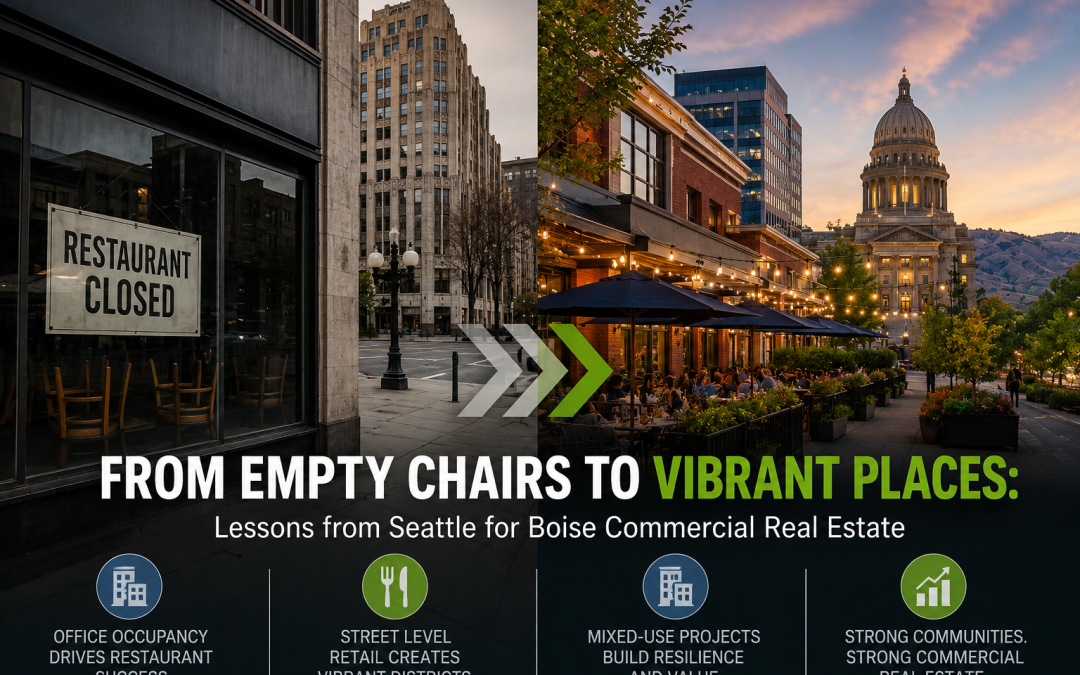
What Seattle’s Downtown Restaurant Closures Could Mean for Boise Commercial Real Estate
Restaurants often tell the story of a city’s commercial real estate market before office vacancy numbers do.
When office workers disappear, restaurants usually feel the impact first. Fewer daily customers mean lower sales, and eventually even well-known operators may decide it no longer makes financial sense to stay open.
According to reporting by Nazifa Rahman of CoStar Research, Chef Brendan McGill has permanently closed both Cafe Hitchcock and the Oyster Cellar inside Seattle’s historic Exchange Building. You can read the original CoStar News article here: https://product.costar.com/home/news/116563596. This article is based on that reporting while exploring what these downtown restaurant closures could signal for Boise commercial real estate, office leasing, retail demand, and future mixed-use development.
Restaurants Often Reflect the Health of Office Buildings
The closures were more than the loss of two dining destinations.
Both restaurants occupied ground-floor retail space within Seattle’s Exchange Building, a historic office tower that has already faced significant leasing challenges in recent years. After the building lost a major office tenant in 2023, additional upper-floor vacancies reduced the daily population that many downtown restaurants rely on.
Chef Brendan McGill will continue operating several restaurants on Bainbridge Island, but his departure from downtown Seattle highlights how closely restaurants and office occupancy remain connected.
Key Facts
- Two restaurants closed inside Seattle’s Exchange Building.
- The closures became effective at the end of May.
- The building has experienced office vacancy following the departure of a major tenant.
- Street-level retail continues adjusting as fewer office workers return to downtown.
Why This Matters Beyond Seattle
Commercial real estate functions as an ecosystem.
Office tenants support restaurants. Restaurants create amenities that attract employers. Retail activity increases foot traffic, helping other businesses nearby. When one part weakens, the effects often spread throughout an entire downtown district.
This is why investors pay close attention to restaurant openings and closures. They often provide an early indication of changing demand within a commercial market.
The challenges facing older downtown office buildings are no longer limited to leasing office suites. Owners are also working to maintain vibrant retail environments that encourage people to spend time in the neighborhood.
What Boise Commercial Real Estate Can Learn
Fortunately, downtown Boise remains in a different position than many larger West Coast cities.
Boise continues benefiting from population growth, business expansion, and a healthier balance between office users, residents, visitors, and government employment. Those factors help support restaurants throughout downtown even as office utilization evolves.
Still, Seattle provides an important reminder.
For Boise commercial real estate, filling office space is about more than increasing rent rolls. Every additional employee working downtown helps restaurants, coffee shops, retail stores, and service businesses that depend on weekday traffic.
As employers evaluate hybrid work models, landlords increasingly recognize that successful office buildings need active ground-floor retail to create an attractive workplace experience.
Mixed-Use Projects May Hold a Competitive Advantage
Developers across the country continue shifting toward mixed-use environments that combine office, residential, retail, and entertainment.
That diversification creates multiple customer bases instead of relying almost entirely on office workers.
For future Boise development, projects that include apartments, restaurants, neighborhood retail, outdoor gathering areas, and flexible office space may prove more resilient during changing economic conditions.
Instead of depending on one type of tenant, these developments benefit from activity throughout the day and evening.
My Take
Seattle’s restaurant closures should not be viewed simply as isolated business decisions.
They reflect the ongoing evolution of downtown commercial real estate. Office occupancy continues influencing restaurant success, retail leasing, and building performance across many major cities.
For Boise, the lesson is encouraging rather than alarming. As long as the Treasure Valley continues attracting employers, residents, and investment, downtown restaurants should remain an important part of creating vibrant commercial districts. Investors, landlords, and developers who understand the relationship between office occupancy and retail vitality will likely be better positioned for long-term success.
Mike Gioioso (joy-OH-so) has for 16+ years been helping companies of all sizes buy, build, and lease perfect places for business in greater Boise, Idaho and beyond. www.streetsmartidaho.com mike@streetsmartidaho.com 208-209-9166
Tags: #boisecommercialrealestate, #boiserealestate, #downtownboise, #boisedevelopment, #retailleasingboise, #restaurantrealestate, #restaurantclosures, #officemarket, #officeleasing, #mixedusedevelopment, #downtownrevitalization, #commercialproperty, #commercialrealestateinvestment, #retailrealestate, #officevacancy