
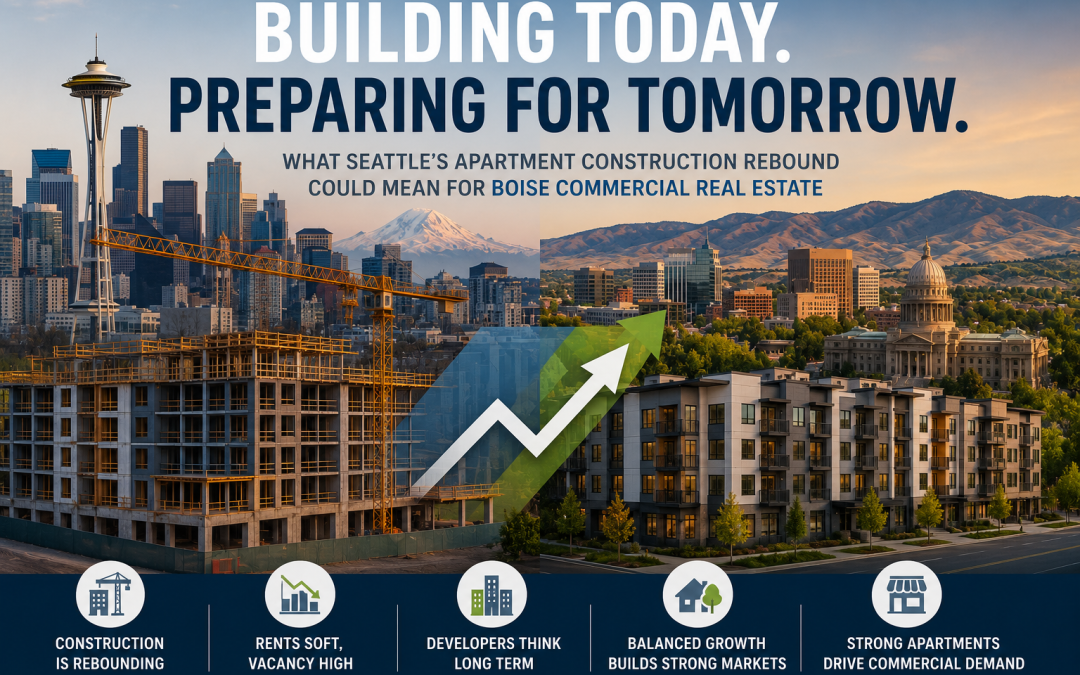
Why Seattle’s Apartment Construction Rebound Could Offer Clues for Boise Commercial Real Estate
Apartment development doesn’t stop simply because rents cool down.
Developers often make decisions years before residents move into a building. That means today’s construction activity is usually based on where investors believe the market will be several years from now—not where it stands today.
According to reporting by Elliott Krivenko of CoStar Analytics, apartment construction in the Seattle metro area is beginning to increase again after a significant slowdown, even as landlords continue dealing with slower rent growth, elevated vacancy, and ongoing lease-up challenges. You can read the original CoStar News article here: https://product.costar.com/home/news/713329186. This article is based on that reporting while exploring what these development trends could mean for Boise commercial real estate, multifamily investment, future development, and long-term housing demand across the Treasure Valley.
Developers Are Looking Beyond Today’s Market
Seattle’s apartment market is sending an interesting signal.
While operating conditions remain challenging for many owners, developers are beginning to launch new projects again. The number of apartment units under construction has started growing after declining sharply from its 2023 peak.
Although construction activity remains below historic highs, the recent increase suggests many builders believe the current slowdown will eventually give way to stronger market conditions.
Instead of reacting only to today’s rents, developers appear to be planning for future population growth and housing demand.
Key Market Highlights
- Apartment construction is increasing after a prolonged slowdown.
- Rent growth remains weaker than normal.
- Vacancy is still elevated across much of the market.
- Many newly completed apartment communities continue leasing units.
- Developers are moving forward with projects expected to deliver several years from now.
Why This Matters for Boise Commercial Real Estate
Commercial real estate is always forward-looking.
Financing, permitting, and construction often take multiple years before a project is complete. Developers who begin construction today are making a long-term investment rather than betting on current market conditions.
For Boise commercial real estate, Seattle demonstrates how experienced investors often continue building during slower periods if they believe long-term fundamentals remain strong.
Treasure Valley continues benefiting from population growth, business expansion, and employer relocation. Those trends support long-term housing demand even if short-term market conditions fluctuate.
Supply and Demand Must Stay Balanced
One lesson from Seattle is that timing matters.
A large wave of apartment deliveries can temporarily outpace renter demand. When that happens, landlords often compete through concessions, reduced rent growth, and higher vacancy.
That doesn’t necessarily mean a market is unhealthy.
Instead, it often represents a normal adjustment after an aggressive development cycle.
For Boise development, maintaining a healthy balance between new apartment construction and population growth will be important for preserving stable occupancy and sustainable rental rates.
Developers who carefully phase projects may reduce the risk of oversupplying individual neighborhoods.
What Investors Should Be Watching
Apartment performance affects much more than housing.
New residential communities generate demand for grocery stores, restaurants, medical offices, fitness centers, childcare providers, and neighborhood retail. They also influence future office development, infrastructure planning, and mixed-use investment.
As more residents move into an area, surrounding commercial properties often benefit from increased customer traffic.
For investors evaluating multifamily investment, retail leasing Boise, or mixed-use development opportunities, housing trends remain one of the strongest indicators of future commercial growth.
My Take
Seattle’s apartment market illustrates an important principle that applies to nearly every commercial real estate cycle.
Strong developers rarely make decisions based solely on today’s rents. They focus on where demographics, employment, and housing demand are likely to be several years into the future.
Boise continues to benefit from many of those long-term growth drivers. While every market experiences periods of slower leasing or rising vacancy, carefully planned development supported by steady population growth can create healthier commercial real estate markets over time. Investors who understand both today’s operating conditions and tomorrow’s demand may be best positioned for long-term success.
Mike Gioioso (joy-OH-so) has for 16+ years been helping companies of all sizes buy, build, and lease perfect places for business in greater Boise, Idaho and beyond. www.streetsmartidaho.com mike@streetsmartidaho.com 208-209-9166
Tags: #boisecommercialrealestate, #boiserealestate, #boisedevelopment, #multifamilydevelopment, #multifamilyinvestment, #apartmentdevelopment, #apartmentconstruction, #boiseapartments, #treasurevalleyrealestate, #commercialrealestateinvestment, #retailleasingboise, #mixedusedevelopment, #residentialdevelopment, #housingmarket, #commercialproperty