
How Adaptive Reuse Is Creating New Opportunities for Boise Commercial Real Estate
Sometimes the best development opportunity isn’t building something new—it’s giving an older property a second life.
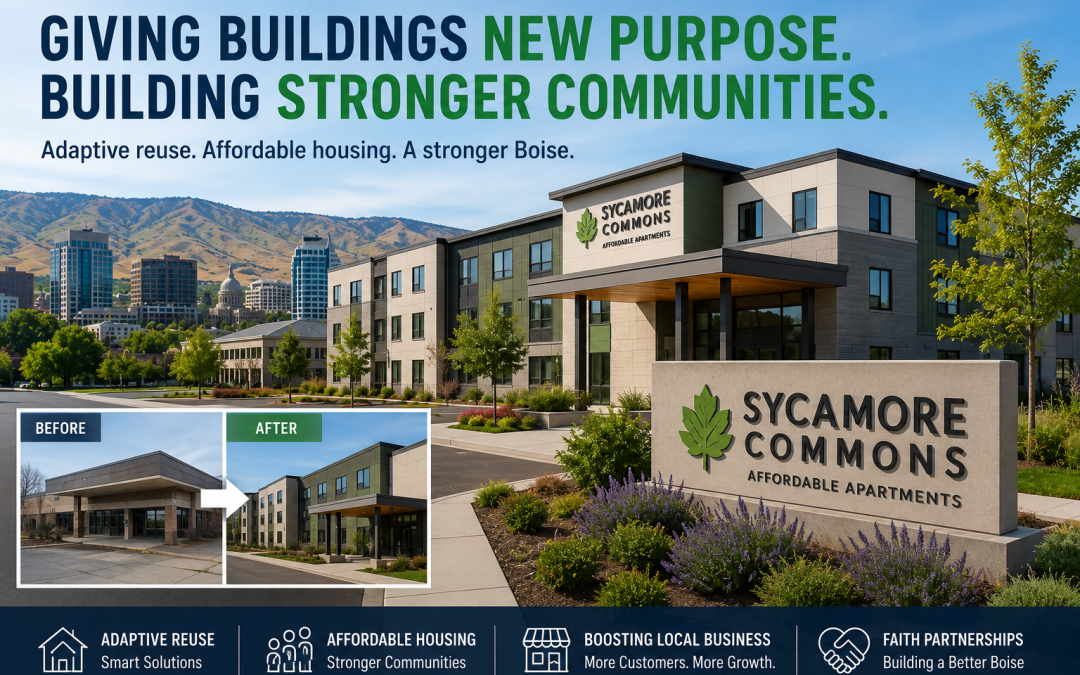
Across the country, developers are finding creative ways to convert vacant buildings into housing, offices, and mixed-use projects. Boise is seeing that trend firsthand with the opening of Sycamore Commons, a new affordable housing community created from a former skilled nursing facility.
According to reporting by Brooke Strickland in the Idaho Business Review, LEAP Housing recently celebrated the opening of the first phase of Sycamore Commons after transforming a long-vacant healthcare property into affordable apartments. You can read the original Idaho Business Review article here: https://idahobusinessreview.com/2026/07/02/sycamore-commons-opens-53-affordable-apartments-boise/. This article is based on that reporting while exploring what this project could mean for Boise commercial real estate, adaptive reuse, and future housing development.
Vacant Properties Can Become Community Assets
For years, the former nursing facility on North Sycamore Drive sat unused after closing during the pandemic.
Instead of remaining an empty building, the property has been reimagined as Sycamore Commons, bringing much-needed affordable housing to Boise’s Collister neighborhood.
Phase one includes 53 studio and one-bedroom apartments designed for residents seeking quality housing at an affordable cost.
The location also offers several advantages beyond the apartments themselves.
Residents have access to nearby shopping, public transportation, bike storage, community gathering areas, laundry facilities, a library, and a computer lab, making the property well connected to everyday services.
Even more housing is already planned.
LEAP Housing expects a second phase to add another 30 apartments, with construction anticipated through 2027 once project funding is finalized.
Key Facts
- A former skilled nursing facility was converted into affordable housing.
- Phase one adds 53 new apartments.
- Phase two is expected to add 30 additional units.
- The project sits next to the Collister Shopping Center and public transit.
- Multiple public and private financing partners helped make redevelopment possible.
Why Affordable Housing Matters to Boise Commercial Real Estate
Housing and commercial real estate are closely connected.
When workers can afford to live near their jobs, employers have an easier time hiring and retaining employees. Businesses also benefit from having more customers living nearby.
Affordable housing supports restaurants, neighborhood retail centers, healthcare providers, grocery stores, and local service businesses by creating stable residential communities.
Projects like Sycamore Commons don’t just help individual residents—they also strengthen surrounding commercial corridors.
For landlords, retailers, and investors, that often means healthier neighborhoods with more consistent consumer activity over the long term.
Faith Partnerships Are Opening New Development Opportunities
One of the more interesting aspects of the Sycamore Commons project is how it was made possible through collaboration.
According to LEAP Housing, the organization has partnered with churches and faith-based organizations on multiple affordable housing projects throughout the Treasure Valley.
The organization believes many faith communities own underutilized land that could help address Idaho’s housing shortage.
Rather than asking churches to become housing developers, LEAP provides the development, financing, and construction expertise while partnering with organizations already committed to serving their communities.
If additional partnerships move forward, they could unlock more redevelopment opportunities without requiring large greenfield developments.
Adaptive Reuse Continues to Gain Momentum
Redeveloping existing buildings has become an increasingly attractive strategy in today’s market.
Older healthcare facilities, offices, schools, hotels, and other underutilized properties often already have infrastructure, utilities, and established locations that make redevelopment more practical than starting from scratch.
For developers, adaptive reuse can reduce waste, preserve valuable real estate, and bring dormant properties back into productive use.
As Boise continues to grow, these types of projects may become an increasingly important part of meeting both housing and commercial real estate needs.
My Take
One of the biggest challenges facing Boise today is balancing growth with affordability.
Every new employer that comes to the Treasure Valley creates additional demand for housing, retail, healthcare, and infrastructure.
Projects like Sycamore Commons demonstrate that solving housing shortages doesn’t always require expanding outward. Sometimes the answer is finding new uses for properties that have already served the community for decades.
From a Boise commercial real estate perspective, adaptive reuse represents an exciting opportunity.
Vacant buildings can become productive assets again, neighborhoods gain new residents, nearby businesses benefit from increased activity, and developers create value while addressing important community needs.
I expect we’ll continue seeing more creative redevelopment projects like this as Boise development evolves over the coming years.
Mike Gioioso (joy-OH-so) has for 16+ years been helping companies of all sizes buy, build, and lease perfect places for business in greater Boise, Idaho and beyond. www.streetsmartidaho.com mike@streetsmartidaho.com 208-209-9166
Tags: #boisecommercialrealestate, #boisedevelopment, #affordablehousing, #adaptivereuse, #sycamorecommons, #leaphousing, #collister, #boisehousing, #mixedusedevelopment, #retailleasingboise, #commercialrealestate, #treasurevalley, #economicdevelopment, #communitydevelopment, #housingdevelopment