
Why Private Real Estate Lending Could Create New Opportunities for Boise Commercial Real Estate
When banks become more cautious about lending, commercial real estate doesn’t necessarily stop growing. Instead, new sources of capital often step in to keep projects moving.
That appears to be happening across the country today.
According to reporting by Mark Heschmeyer in CoStar News, global investment manager Invesco has priced a $1.2 billion commercial real estate collateralized loan obligation (CRE CLO) as part of its rapidly expanding private real estate lending platform. You can read the original CoStar News article here: https://product.costar.com/home/news/722649469.
This article is based on that reporting while exploring what the rapid growth of private real estate lending could mean for Boise commercial real estate, future development, and financing opportunities throughout the Treasure Valley.
Private Capital Is Filling the Lending Gap
For years, banks were the primary source of financing for many commercial real estate projects.
Today, that’s changing.
As many traditional lenders continue tightening underwriting standards, private credit firms, mortgage REITs, and institutional investment managers are taking on a larger role in financing commercial properties.
Invesco’s lending platform illustrates just how quickly this shift is happening.
Its commercial real estate loan portfolio grew from approximately $3.55 billion to $6 billion in just one year—an increase of roughly 70%.
That kind of growth signals that borrowers continue looking beyond traditional banks to fund acquisitions, refinancing, and new development.
Investors Are Backing Property Types With Strong Fundamentals
Another important takeaway isn’t simply who is making the loans—it’s where the money is going.
The portfolio supporting Invesco’s latest debt offering is heavily concentrated in sectors that continue showing long-term demand.
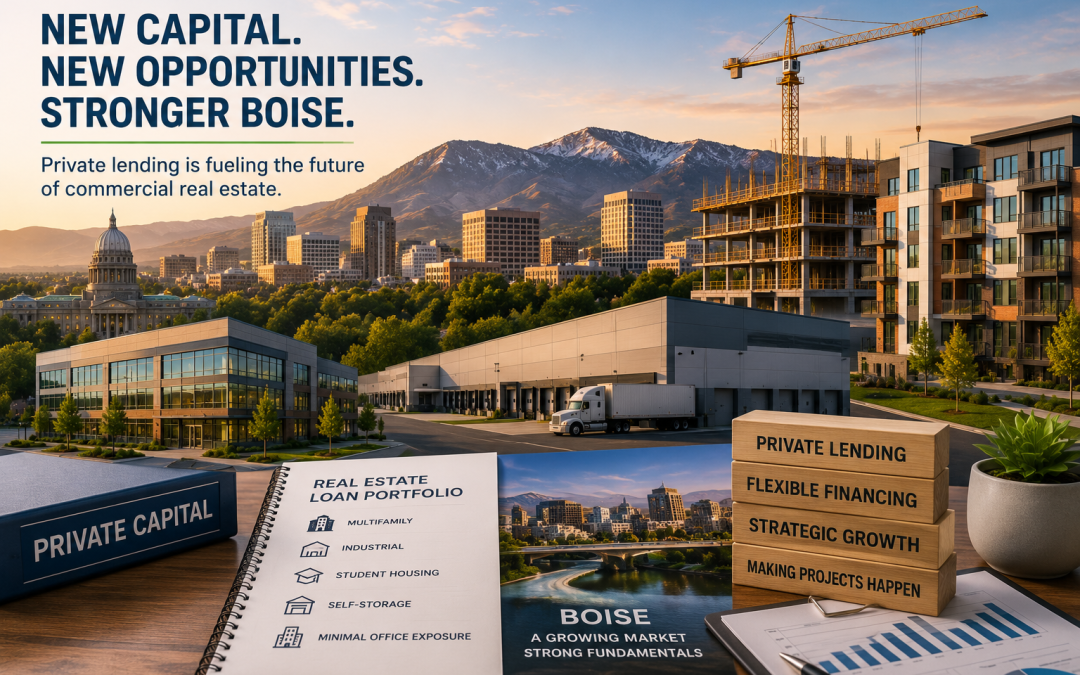
The underlying loan pool includes financing for:
- Apartment communities
- Industrial properties
- Student housing
- Limited self-storage
- Minimal office exposure
Rather than spreading risk evenly across every commercial property type, institutional lenders are increasingly focusing on sectors supported by population growth, logistics, and housing demand.
That strategy reflects broader market trends that many investors are following nationwide.
Why This Matters for Boise Commercial Real Estate
Financing availability often determines which projects get built.
When traditional lenders become more conservative, developers need alternative capital sources to keep projects moving forward.
Private lenders can help finance:
- Multifamily developments
- Industrial buildings
- Mixed-use projects
- Student housing
- Commercial acquisitions
- Property renovations and repositioning
For Boise development, additional lending options may become increasingly important as the region continues expanding.
The Treasure Valley remains one of the faster-growing areas in the Mountain West, creating ongoing demand for housing, industrial space, healthcare facilities, and neighborhood retail.
Projects that align with these long-term growth trends may become more attractive to private lenders seeking stable opportunities.
Institutional Capital Is Becoming More Selective
The composition of Invesco’s loan portfolio tells another important story.
Office properties account for only a small portion of the loans backing the securitization, while apartments and industrial assets dominate the portfolio.
This mirrors a broader shift occurring across commercial real estate.
Many institutional lenders are placing greater emphasis on property types supported by demographic trends and everyday economic activity rather than sectors facing structural uncertainty.
For developers and investors, understanding where lenders want to deploy capital can become just as important as identifying where tenants want to lease space.
Key Takeaways
- Invesco priced a $1.2 billion commercial real estate debt offering backed by private real estate loans.
- The company’s commercial real estate loan portfolio expanded approximately 70% over the past year.
- Private credit firms continue increasing their role as banks reduce commercial real estate lending.
- Apartments and industrial properties represent the largest share of the underlying loan portfolio.
- Institutional lenders continue emphasizing property sectors with durable long-term demand.
My Take
Access to capital has always been one of the biggest drivers of commercial real estate.
What’s changing today isn’t necessarily the amount of capital available—it’s where that capital comes from.
Private lenders have become an increasingly important financing source for commercial real estate across the country, particularly for projects that fit today’s strongest investment themes.
For Boise commercial real estate, this could create meaningful opportunities.
The Treasure Valley continues experiencing population growth, industrial expansion, healthcare investment, and strong multifamily demand. Those are exactly the types of property sectors many institutional lenders appear eager to finance.
Developers who understand how private capital is evolving may find themselves better positioned to move projects forward even as traditional bank lending remains more selective. As Boise continues growing, access to alternative financing could become an increasingly important competitive advantage.
Mike Gioioso (joy-OH-so) has for 16+ years been helping companies of all sizes buy, build, and lease perfect places for business in greater Boise, Idaho and beyond. www.streetsmartidaho.com mike@streetsmartidaho.com 208-209-9166
Tags: #boisecommercialrealestate, #boisedevelopment, #commercialrealestatefinance, #privatecredit, #privaterealestatelending, #commercialrealestateloans, #crelending, #commercialmortgage, #mortgagereit, #institutionalrealestate, #commercialrealestateinvestment, #multifamilyinvestment, #industrialrealestate, #boiseindustrialmarket, #boisemultifamily, #mixedusedevelopment