
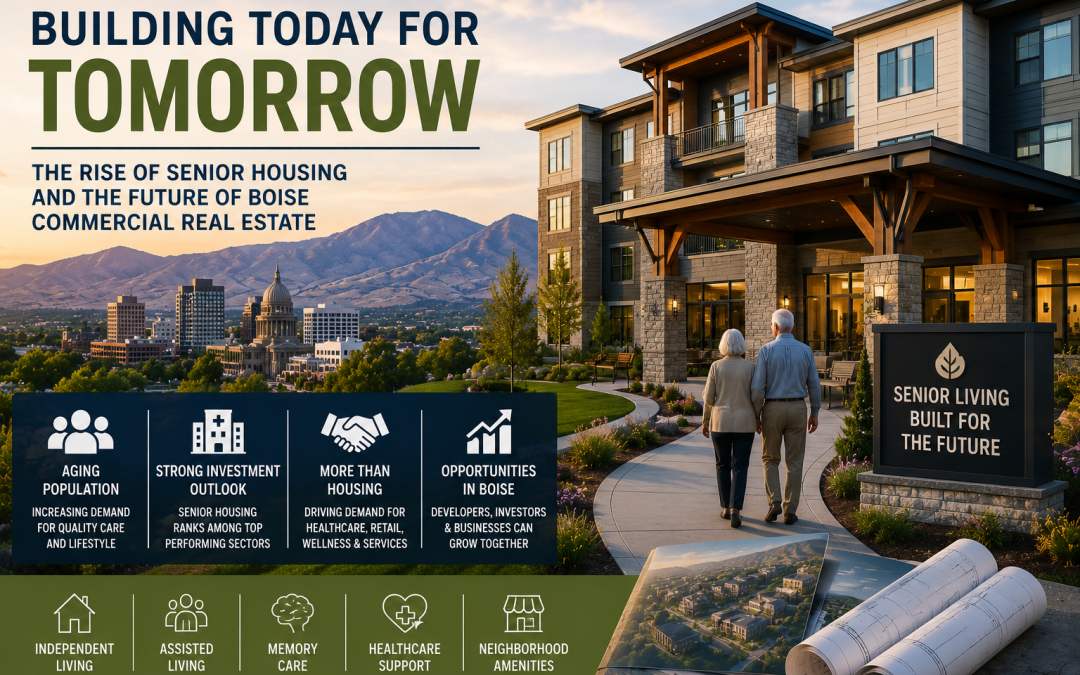
Why Growing Demand for Senior Housing Could Create New Opportunities for Boise Commercial Real Estate
One of the biggest real estate trends over the next decade won’t be driven by younger buyers—it will be shaped by an aging population.
As millions of baby boomers enter their 80s, demand for senior housing is expected to accelerate across the country. Developers and investors are already positioning themselves to meet that need, and recent activity near Seattle offers a glimpse of what could eventually happen in Idaho.
According to reporting by Randyl Drummer in CoStar News, nonprofit senior living provider Emerald Communities has secured more than $107 million in bond financing to expand its Heron’s Key senior living campus in Gig Harbor, Washington. You can read the original CoStar News article here: https://product.costar.com/home/news/730201763. This article is based on that reporting while exploring what expanding senior housing demand could mean for Boise commercial real estate, healthcare development, and future investment opportunities across the Treasure Valley.
Senior Housing Is Becoming One of Commercial Real Estate’s Strongest Sectors
Not every commercial real estate sector is growing at the same pace.
While office properties continue adapting to changing workplace trends, senior housing has emerged as one of the industry’s most attractive investment categories.
The latest Emerging Trends in Real Estate report from the Urban Land Institute and PricewaterhouseCoopers ranks senior housing among the top-performing commercial real estate sectors, trailing only data centers in investment prospects.
That growing confidence is helping finance projects like Emerald Communities’ latest expansion.
The nonprofit operator plans to add a 111,656-square-foot building containing 54 new residential units at its Heron’s Key campus in Gig Harbor.
Construction is expected to begin this year, with the expansion opening in early 2028.
Why Demand Is Increasing
The demographic shift is straightforward.
The oldest members of the baby boomer generation are now reaching their 80s—a life stage when many people begin looking for housing that requires less maintenance and offers easier access to healthcare, dining, recreation, and supportive services.
Many residents move from traditional homes into:
- Independent living communities
- Assisted living facilities
- Memory care communities
- Continuing care retirement campuses
Rather than building isolated facilities, many modern senior living developments are evolving into full-service campuses that provide multiple levels of care as residents’ needs change over time.
The Heron’s Key expansion reflects that strategy.
In addition to new residences, the project includes expanded community amenities, including a new dining hall, swimming pool, connections between existing buildings, and renovations to portions of the current campus.
Why This Matters for Boise Commercial Real Estate
Idaho’s population continues to grow—and it continues to age.
Many retirees relocate to the Treasure Valley because of its quality of life, outdoor recreation, healthcare access, and comparatively affordable cost of living.
That creates long-term demand extending far beyond senior housing itself.
Growing retirement communities often generate additional demand for:
- Medical office buildings
- Physical therapy clinics
- Pharmacies
- Restaurants
- Neighborhood retail centers
- Grocery stores
- Wellness providers
- Professional services
- Hospitality properties serving visiting family members
As more age-restricted communities develop, surrounding commercial corridors frequently experience increased leasing activity from businesses serving nearby residents.
For investors, that creates opportunities across multiple commercial property types—not just senior housing.
Boise Development Could Follow Similar Demographic Trends
The Treasure Valley has already experienced strong residential growth, and demographic changes suggest another wave of development may be approaching.
As Idaho attracts retirees from higher-cost western states, developers may increasingly evaluate sites for:
- Independent living communities
- Assisted living campuses
- Mixed-use projects designed around aging populations
- Healthcare-oriented developments
- Walkable neighborhood retail
Communities that combine housing, healthcare, recreation, dining, and retail in one location may become increasingly attractive as resident preferences continue evolving.
These projects also tend to support stable long-term occupancy because housing demand is driven more by demographics than by short-term economic cycles.
My Take
One lesson from this Seattle-area project stands out.
Developers are not waiting until the retirement wave fully arrives—they’re building ahead of it.
That’s often how successful commercial real estate investing works.
The strongest opportunities frequently emerge before demand reaches its peak.
For those involved in Boise commercial real estate, watching demographic trends may become just as important as monitoring interest rates or construction costs.
As the Treasure Valley continues growing, senior housing could become one of the region’s most active development sectors while creating new opportunities for healthcare providers, retailers, landlords, and investors throughout the Boise market.
Mike Gioioso (joy-OH-so) has for 16+ years been helping companies of all sizes buy, build, and lease perfect places for business in greater Boise, Idaho and beyond. www.streetsmartidaho.com mike@streetsmartidaho.com 208-209-9166
Tags: #boisecommercialrealestate, #boisedevelopment, #seniorhousing, #seniorliving, #retirementcommunities, #assistedliving, #independentliving, #memorycare, #healthcarerealestate, #medicaloffice, #commercialrealestateinvestment, #treasurevalleyrealestate, #boisehealthcare, #idahoseniorhousing, #multifamilydevelopment