
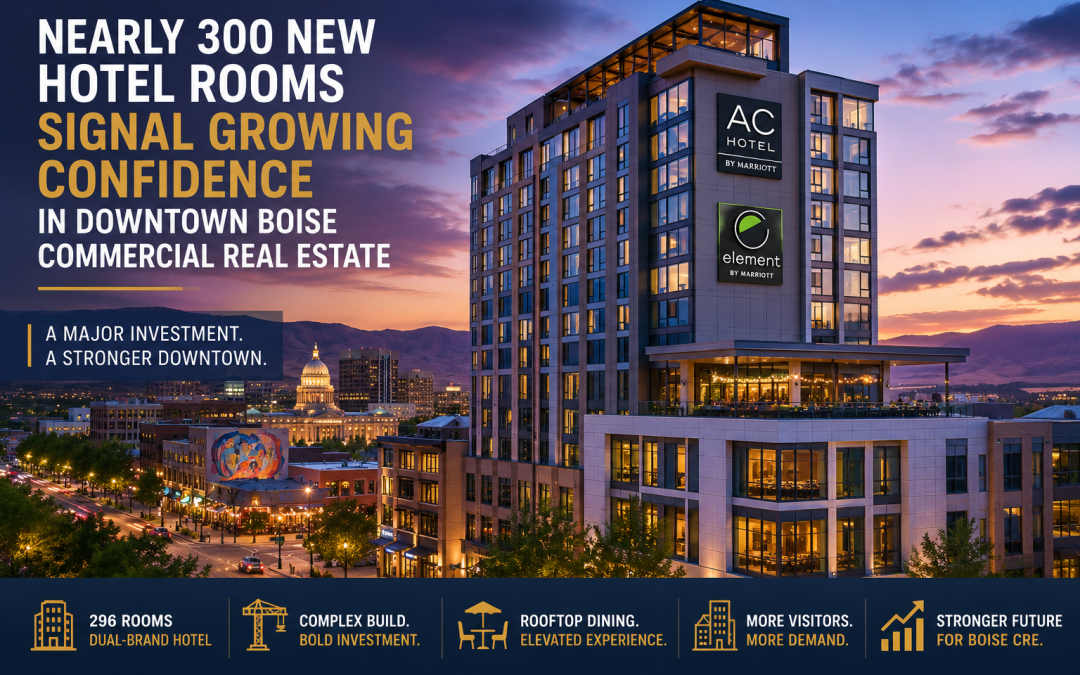
Nearly 300 New Hotel Rooms Signal Growing Confidence in Downtown Boise Commercial Real Estate
Adding nearly 300 hotel rooms to downtown Boise is not a small bet.
It requires confidence that business travel, tourism, restaurants, events, and the broader downtown economy can generate enough activity to support a major new hospitality project.
That is what makes Boise’s newest dual-brand hotel particularly interesting from a Boise commercial real estate perspective.
The newly completed AC Hotel Boise Downtown and Element by Marriott brings two different hospitality concepts together on Grove Street, while adding another major vertical development to Boise’s urban core.
According to reporting by Steve Lombard in the Idaho Business Review, Pennbridge Lodging and Capital developed the project after a process stretching roughly seven years and spanning the pandemic, financing challenges, and a complicated downtown construction environment.
You can read the original Idaho Business Review article here: https://idahobusinessreview.com/2026/07/20/downtown-boise-hotel-ac-element-marriott-296-rooms/
The hotel itself is noteworthy. But the bigger story may be what a project of this scale tells us about the maturation of downtown Boise commercial real estate.
Downtown Boise Is Becoming a Bigger Hospitality Market
The new development sits along Grove Street between 10th and 11th streets and contains 296 hotel rooms within a 15-story building.
Rather than building a traditional single-brand hotel, Pennbridge combined two Marriott concepts.
AC Hotel is positioned toward travelers looking for a more modern, upscale experience, while Element targets longer stays with larger accommodations, kitchens, fitness features, and other amenities.
That gives the property access to different types of customers within one development.
A business traveler coming into Boise for a few nights may have different needs than a consultant, relocating employee, construction executive, or family staying for several weeks.
The dual-brand approach allows the project to capture more of those demand segments.
That’s important because Boise’s hospitality market isn’t driven by just one source.
Demand can come from:
- Corporate travel
- Conventions and conferences
- Boise State University events
- Government activity
- Tourism
- Sporting events
- Relocations
- Construction and development projects
- Weddings and other gatherings
- Longer-term business assignments
A larger and more diverse visitor base can support more than hotels.
It can also help downtown restaurants, bars, retailers, entertainment businesses, and service providers.
That creates a ripple effect across Boise retail leasing and the broader downtown economy.
A Seven-Year Development Timeline Shows How Difficult Big Projects Have Become
The finished building may be the most visible part of the story, but its development timeline is just as important.
Pennbridge acquired the downtown property in early 2020.
Then COVID arrived.
Hospitality was one of the industries hit hardest, creating enormous uncertainty around hotel occupancy, financing, tourism, and business travel.
The developers eventually sold part of the block while maintaining plans for the hotel portion of the property. The project remained on hold before construction finally began in 2024.
That means the development went through several dramatically different commercial real estate environments.
First came the pandemic.
Then construction costs increased.
Interest rates climbed.
Lenders became more cautious.
And large developments became harder to finance.
Yet the project still moved forward.
From an investment standpoint, that’s significant.
Developers generally don’t put hundreds of hotel rooms into a market unless they believe the long-term demand fundamentals can support them.
Pennbridge already had experience in Boise through its Residence Inn near Capitol Boulevard and Myrtle Street. With the addition of the new project, the company’s local properties represent roughly 500 hotel rooms across two locations.
That level of continued investment suggests confidence in Boise as a long-term hospitality market.
Downtown Construction Is Becoming More Complex
The project also offers an interesting look at the construction challenges facing Boise development as the city becomes denser.
The building encompasses roughly 322,000 square feet on a constrained downtown site.
Okland Construction had to manage limited staging space while constructing a tall building surrounded by an active urban environment.
That is very different from developing on a large suburban parcel where contractors may have acres available for equipment, materials, and construction activity.
As Boise continues growing vertically, logistics become more important.
Okland used prefabricated wall systems for portions of the upper floors. Components could be assembled closer to ground level and then lifted into position rather than requiring all work to occur many stories above the street.
That approach can help improve efficiency and reduce exposure to weather and other jobsite risks.
The inspection process was also substantial.
According to the Idaho Business Review, Okland completed 165 internal inspections while the project went through more than 500 municipal walkthroughs.
Those numbers illustrate something developers throughout the Treasure Valley should watch.
Large urban projects require coordination among developers, contractors, lenders, brands, architects, engineers, inspectors, and local government.
As downtown Boise development becomes more ambitious, execution becomes increasingly important.
The Rooftop Restaurant Could Be Just as Important as the Hotel
One of the project’s most interesting features from a commercial real estate perspective isn’t a hotel room.
It’s the restaurant.
The Boise Post sits at the top of the building, giving customers elevated views of downtown and the surrounding area.
Putting a full restaurant at the top of a high-rise adds cost and construction complexity.
But it also creates something valuable: an experience.
That distinction matters in today’s retail and hospitality markets.
Restaurants increasingly compete on more than food.
Consumers want atmosphere, views, patios, design, entertainment, and places that feel memorable.
The developers intentionally positioned The Boise Post as a destination that can attract local residents in addition to hotel guests.
That’s a smart commercial real estate strategy.
A successful hotel restaurant shouldn’t necessarily depend entirely on hotel occupancy. If it becomes a destination for Boise residents, business meetings, celebrations, and visitors, it creates another independent source of traffic and revenue.
This same principle applies to retail leasing in Boise.
The physical experience of a property matters more than it once did.
Great locations combined with distinctive architecture, patios, views, walkability, and surrounding activity can give tenants something that can’t easily be duplicated online or in a generic suburban building.
Local Insight: This Is Really a Bet on Downtown Boise
The most interesting number to me isn’t the height of the building.
It’s the room count.
Adding almost 300 rooms to one downtown location takes conviction.
Boise experienced a significant hotel development wave nearly a decade ago, and there were concerns at the time that downtown might be adding rooms faster than demand could absorb them.
Then the pandemic created an entirely different challenge.
Despite that history, developers are once again willing to make substantial hospitality investments downtown.
That says something about Boise’s evolution.
Downtown isn’t functioning solely as a government and office district anymore.
It increasingly operates as a mixed-use destination combining employment, housing, restaurants, entertainment, hotels, conventions, tourism, and Boise State University activity.
Each use helps support the others.
More hotel guests can mean more restaurant customers.
More restaurants and entertainment make downtown more attractive to visitors.
More residents provide businesses with customers outside traditional office hours.
More activity can make downtown office locations more attractive to companies that value walkable amenities.
That interconnected ecosystem is important for Boise commercial real estate investors, landlords, tenants, and developers.
What This Could Mean for Boise Commercial Real Estate
The AC Hotel and Element project offers several lessons beyond hospitality.
First, institutional-quality developers continue to see opportunity in Boise.
Second, downtown land is increasingly being used vertically and for multiple purposes rather than supporting a single low-density use.
Third, amenities are becoming an important part of development economics.
And finally, Boise is increasingly competing with larger western cities for travelers, companies, residents, and investment capital.
That doesn’t mean every new hotel, restaurant, apartment project, or office development will succeed.
Nearly 300 additional hotel rooms also create more competition.
Existing hotel operators will have to protect occupancy and room rates. Restaurants will compete for both visitors and local customers. Developers considering future hospitality projects will need to watch how quickly the new supply is absorbed.
But that’s what makes this project an important market indicator.
If downtown Boise can successfully absorb a project of this size, it could strengthen the case for additional investment in hospitality, restaurants, entertainment, mixed-use development, and other businesses serving visitors and downtown residents.
For commercial real estate professionals, the opportunity is to watch what happens around these major investments.
Where does pedestrian traffic increase?
Which restaurant concepts perform well?
Do additional retailers follow?
Does hotel demand continue growing?
Do surrounding properties become more valuable for redevelopment?
Those secondary effects can sometimes create better commercial real estate opportunities than the headline project itself.
The new hotel is therefore more than another addition to Boise’s skyline.
It’s a significant vote of confidence in the continued evolution of downtown Boise—and another sign that the city’s commercial real estate market is becoming larger, denser, and more sophisticated.
Mike Gioioso (joy-OH-so) has for 16+ years been helping companies of all sizes buy, build, and lease perfect places for business in greater Boise, Idaho and beyond.
www.streetsmartidaho.com mike@streetsmartidaho.com 208-209-9166
Tags: #boisecommercialrealestate, #downtownboisecommercialrealestate, #boisehoteldevelopment, #downtownboisehotels, #boisedevelopment, #boisehospitalitymarket, #achotelboise, #elementbymarriottboise, #pennbridgelodging, #oklandconstruction, #grovestreetboise, #downtownboisedevelopment, #boiseretailleasing, #retailleasingboise, #boiserestaurantrealestate