
Rising Idaho Fuel Costs Could Put New Pressure on Boise Commercial Real Estate
A jump in gas prices may look like a transportation story.
For commercial real estate, it can quickly become a consumer spending, business operating cost, and location strategy story.
Idaho fuel prices have moved higher again as renewed conflict in the Middle East puts pressure on global energy markets. If elevated prices stick around, the effects could reach retailers, restaurants, contractors, delivery companies, industrial tenants, commuters, and ultimately landlords throughout the Treasure Valley.
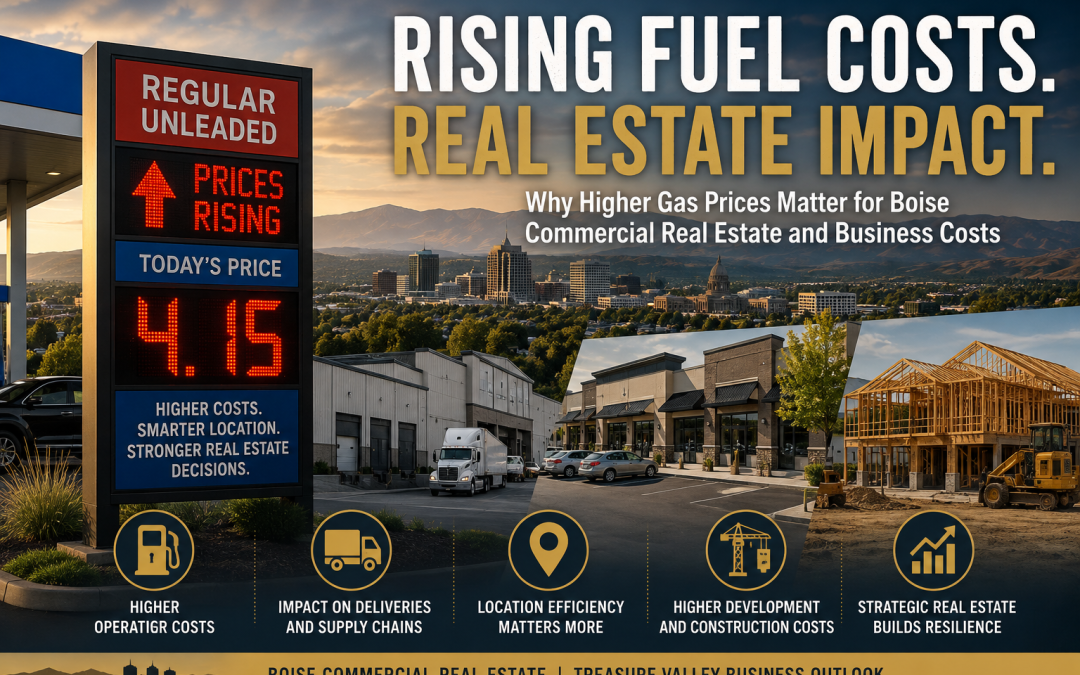
According to reporting by IBR Staff in the Idaho Business Review, Idaho’s average price for regular gasoline reached $4.15 per gallon on July 21 as crude oil markets reacted to renewed geopolitical uncertainty.
The original Idaho Business Review article can be read here:
https://idahobusinessreview.com/2026/07/21/gas-prices-rise-idaho-middle-east-conflict/
The immediate story is about what Idaho drivers are paying.
The bigger Boise commercial real estate question is what happens if higher transportation costs remain part of the economy for months rather than days.
Higher Fuel Costs Can Hit Commercial Tenants Twice
Gas prices affect businesses differently, but many commercial tenants can feel the impact from two directions.
First, their own operating costs increase.
Second, their customers have less disposable income.
That combination matters especially for restaurants and retailers.
A Treasure Valley household spending more each month commuting between Boise, Meridian, Nampa, Caldwell, Kuna, or another community has less money available for discretionary purchases.
A few dollars more at the pump may not dramatically change consumer behavior.
Sustained increases can.
Consumers may make fewer shopping trips, combine errands, eat at restaurants less often, or become more price-sensitive.
For landlords involved in retail leasing in Boise, that means fuel costs are worth watching alongside more traditional indicators such as employment, population growth, retail sales, and consumer confidence.
Retail properties built around frequent convenience trips may react differently than destination-oriented shopping centers.
And businesses selling discretionary products could feel pressure sooner than businesses providing essential goods and services.
There is another side to the equation.
Restaurants, retailers, contractors, wholesalers, service businesses, and manufacturers often depend on deliveries.
Higher fuel costs can work their way into freight charges and supplier pricing.
That means some businesses can get squeezed from both ends: customers become more careful with money while the company’s own expenses increase.
Location Becomes More Valuable When Transportation Gets Expensive
Higher fuel prices can also reinforce something commercial real estate professionals already know:
Location is about more than visibility. It is about efficiency.
The Treasure Valley has expanded considerably.
People routinely travel between communities for work, shopping, entertainment, medical appointments, and services.
Businesses do the same thing.
A contractor based in Caldwell may have employees and projects throughout Ada County.
A Boise restaurant may receive deliveries originating far outside the city.
An industrial tenant in Nampa might send trucks throughout the Treasure Valley.
When fuel is inexpensive, those distances may not attract much attention.
When transportation costs increase, every additional mile becomes more important.
For industrial and service companies, this can affect site-selection decisions.
Businesses may place greater value on locations with:
- Convenient interstate access
- Shorter routes to major customers
- Efficient delivery patterns
- Access to workforce concentrations
- Less time lost in congestion
- Proximity to suppliers
- Central Treasure Valley locations
This does not mean every business should move closer to Boise.
In fact, the opposite may be true for some companies.
A Nampa or Caldwell location could offer lower occupancy costs while still providing strong Interstate 84 access.
The key is looking at total occupancy and transportation costs together, rather than treating rent as the only real estate expense.
A building with slightly cheaper rent can become expensive if employees and delivery vehicles spend significantly more time traveling to and from it.
Industrial and Service Businesses May Feel the Impact Fastest
The connection between energy prices and Boise industrial real estate may be even more direct.
Think about the businesses occupying Treasure Valley industrial and flex buildings.
HVAC companies.
Plumbers.
Electricians.
Landscapers.
Construction companies.
Distributors.
Manufacturers.
Delivery businesses.
Food suppliers.
Equipment companies.
Many operate fleets of vehicles every day.
For these companies, gasoline and diesel are operating expenses rather than occasional household purchases.
Even relatively small changes can add up when multiplied across multiple vehicles and thousands of miles.
Suppose a company operates 20 trucks.
If each vehicle consumes hundreds of gallons annually, a sustained increase in fuel costs can quickly become a meaningful expense.
That may influence where companies locate future branches, warehouses, yards, and service facilities.
It may also increase demand for strategically located small-bay industrial and flex space closer to customers.
Rather than serving the entire Treasure Valley from one distant facility, some growing companies could eventually find it more efficient to establish multiple service points.
That creates another potential source of commercial real estate demand.
Fuel Prices Can Also Influence Boise Development Costs
There is another commercial real estate connection that is less visible to consumers.
Construction requires transportation.
Building materials have to reach job sites.
Heavy equipment needs fuel.
Workers commute.
Concrete, lumber, steel, mechanical equipment, roofing materials, fixtures, and countless other products move through supply chains before reaching a development.
Higher energy prices can therefore contribute to higher construction and logistics expenses.
For Boise development, this matters because projects are already sensitive to land costs, interest rates, labor, materials, impact fees, and rents.
Fuel is unlikely to determine whether most developments move forward by itself.
But development feasibility is rarely destroyed by one expense.
It is usually pressured by several expenses moving in the wrong direction at the same time.
Energy costs can become another piece of that equation.
Developers evaluating new retail, industrial, multifamily, or mixed-use projects should therefore pay attention to energy markets even if they are not directly involved in transportation.
What Idaho’s Latest Gas Increase Tells Us
The speed of the recent move is worth noting.
According to the Idaho Business Review’s July 21 report, AAA said Idaho gasoline prices had increased by roughly 23 cents per gallon, reaching an average of $4.15.
That was about 32 cents higher than the same period a year earlier.
Idaho ranked as the 17th most expensive state for gasoline at the time.
Meanwhile, West Texas Intermediate crude was trading around $84.64 per barrel, up approximately 2.55% at the time of the report.
Earlier in 2026, WTI had reached roughly $112 per barrel.
The important commercial real estate takeaway is not any single day’s gasoline or crude oil price.
It is the volatility.
Businesses can adjust to expensive energy.
They can also adjust to cheap energy.
Rapid changes are harder because they complicate budgets and make future operating expenses less predictable.
That uncertainty can influence expansion decisions, hiring, capital expenditures, and eventually real estate decisions.
Local Insight: Start Looking at Real Estate Through the Transportation Lens
For Boise commercial real estate, rising fuel costs reinforce the importance of analyzing properties beyond rent per square foot.
A tenant may compare two industrial buildings and see that one costs less.
But what if that building adds substantial mileage to every delivery route?
What if employees spend more time commuting?
What if service technicians lose an additional hour each day sitting in traffic?
The cheapest building on paper may not be the cheapest place to operate a business.
That is particularly important as the Treasure Valley expands westward.
Boise, Meridian, Nampa, Caldwell, Kuna, Eagle, and Star are increasingly connected economically, but distance still matters.
Transportation costs make those distances easier to measure.
For landlords, good access can become a stronger leasing advantage.
For tenants, transportation analysis should become part of site selection.
For developers, access to major transportation corridors can help protect the long-term competitiveness of a project.
And for investors, properties positioned near major employment centers, population concentrations, and transportation routes may have advantages that become more valuable when energy prices rise.
What This Means for Boise Commercial Real Estate
Gasoline prices will move up and down.
The Middle East conflict could ease, crude supplies could improve, and fuel prices could fall again.
But the broader commercial real estate lesson remains.
Transportation is part of occupancy cost.
A retailer depends on customers reaching its stores.
An industrial company depends on products reaching customers.
A contractor depends on crews reaching job sites.
A restaurant depends on food reaching its kitchen.
And employees have to reach all of those businesses.
When transportation becomes more expensive, location efficiency becomes more valuable.
That is why energy prices deserve a place in the broader conversation about Boise commercial real estate.
The strongest commercial locations are not necessarily the ones with the cheapest rent or the newest buildings.
Increasingly, they may be the places that allow businesses, employees, products, and customers to move through the Treasure Valley as efficiently as possible.
Mike Gioioso (joy-OH-so) has for 16+ years been helping companies of all sizes buy, build, and lease perfect places for business in greater Boise, Idaho and beyond.
www.streetsmartidaho.com mike@streetsmartidaho.com 208-209-9166
Tags: #boisecommercialrealestate, #idahocommercialrealestate, #boisegasprices, #idahogasprices, #treasurevalleycommercialrealestate, #boisedevelopment, #treasurevalleydevelopment, #boiseretailrealestate, #retailleasingboise, #boiseindustrialrealestate, #treasurevalleyindustrialrealestate, #boiseindustrialleasing, #boiseflexspace, #smallbayindustrialboise