
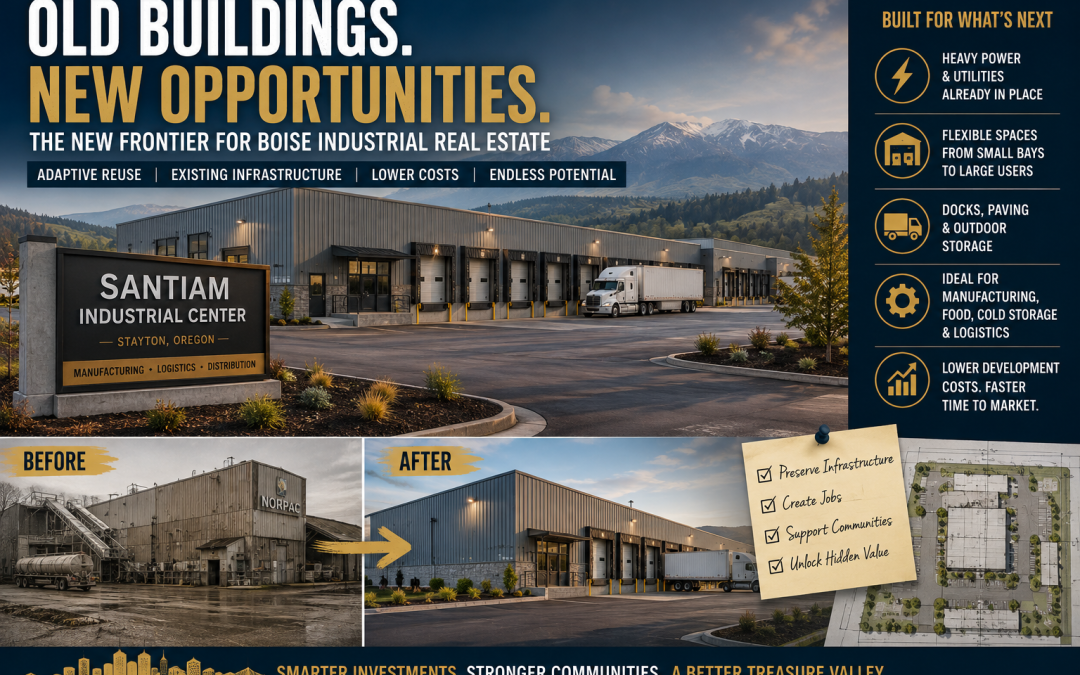
Why Old Industrial Buildings Could Become New Opportunities for Boise Commercial Real Estate
Sometimes the best industrial development site is already built.
Across the country, investors are finding new uses for former factories, food-processing plants, warehouses, and other large industrial properties that no longer serve their original purpose.
A recent project in Oregon shows what that strategy can look like—and it offers some useful lessons for Boise commercial real estate as land, construction, power, and infrastructure become increasingly expensive.
According to reporting by Randyl Drummer of CoStar News, Industrial Realty Group has completed the transformation of a former food-processing facility near Salem, Oregon, into a large manufacturing and logistics campus.
You can read the original CoStar News article here:
https://product.costar.com/home/news/802021566
The Oregon project is hundreds of miles from Boise.
But the strategy behind it could become increasingly relevant to industrial investors, developers, tenants, and property owners throughout the Treasure Valley.
Existing Infrastructure Can Be More Valuable Than It Looks
The property now known as Santiam Industrial Center is located in Stayton, Oregon, between the Portland and Eugene areas.
The site previously housed a vegetable-processing and canning operation run by North Pacific Canners and Packers, commonly known as Norpac.
Before the operation shut down in 2019, the facility employed nearly 500 workers.
Industrial Realty Group acquired the property in 2023 and began repositioning it for a broader range of industrial tenants.
Today, the campus contains approximately 528,000 square feet on 50 acres.
Instead of demolishing everything and starting over, the developer upgraded the existing property.
Improvements included utilities, pavement, lighting, and loading docks.
The site also provides heavy electrical power and land that can accommodate outdoor storage.
Those features are important.
A large older industrial building may appear obsolete when judged by its age or original use.
But underneath the building can be infrastructure that would be extremely expensive to recreate today.
That could include:
- Heavy electrical service
- Water and sewer capacity
- Loading infrastructure
- Large paved areas
- Outdoor storage
- Industrial zoning
- Truck circulation
- Existing utility connections
- Large parcels under one ownership
For Boise industrial real estate, those characteristics can dramatically change how investors should evaluate older properties.
Sometimes the real value is not the building.
It is everything already connected to it.
Boise’s Rising Development Costs Make Adaptive Reuse More Interesting
Building a modern industrial facility from the ground up is not simple.
A developer needs land.
Then come entitlement, engineering, utilities, site work, construction materials, labor, financing, and often substantial electrical infrastructure.
Each step adds cost and time.
That makes existing industrial properties more interesting, particularly when they already have difficult-to-replicate infrastructure.
The Treasure Valley has plenty of older industrial and manufacturing properties in Boise, Garden City, Meridian, Nampa, and Caldwell.
Not all of them should be preserved.
Some properties eventually make more sense as redevelopment sites.
Others, however, may have characteristics that would be costly or difficult to replace.
Power is a good example.
Manufacturing businesses increasingly care about electrical capacity. Advanced manufacturing, automation, refrigeration, food production, fabrication, and other industrial operations can require significantly more power than conventional warehouse users.
If an older property already has substantial electrical infrastructure, that can become a major competitive advantage.
The same applies to outdoor storage.
Industrial outdoor storage has become increasingly valuable because many contractors, equipment businesses, building suppliers, transportation companies, and service businesses need secure yard space.
New development does not always provide it.
An older industrial property sitting on excess land might.
Flexible Industrial Space Can Reach More Tenants
Industrial Realty Group also made another interesting decision with the Oregon property.
It did not position the entire building for one enormous user.
Available spaces reportedly range from approximately 8,000 square feet to nearly 247,000 square feet.
That creates flexibility.
A smaller manufacturer could potentially occupy part of the project.
So could a regional distributor.
A larger company could take considerably more space.
The project is being marketed toward manufacturing, food production, cold storage, distribution, and related industrial uses.
That approach has implications for Treasure Valley industrial leasing.
Large industrial buildings can become difficult to lease when they depend on finding one company willing to absorb hundreds of thousands of square feet.
Breaking a property into multiple functional spaces can potentially expand the tenant pool.
That is especially relevant in a market like Boise.
The Treasure Valley has major industrial users, but it also has a large base of small and midsize companies.
Many growing businesses need 10,000, 20,000, 40,000, or 75,000 square feet rather than half a million square feet.
Industrial properties capable of accommodating multiple tenant sizes can therefore appeal to a much broader group of businesses.
Flexibility can also help landlords retain tenants.
A company might start with 15,000 square feet and eventually expand into neighboring space.
That can be valuable for both the tenant and the property owner.
Former Single-Purpose Buildings Can Become Multi-Use Industrial Campuses
The Oregon project also demonstrates how the identity of an industrial property can change.
This was once primarily a food-processing facility.
Now it is being marketed as a broader manufacturing and logistics center.
That transition matters.
Many older industrial properties were designed around one company’s operation.
When that company closes, moves, or becomes obsolete, the building can appear to have little value to anyone else.
The challenge is figuring out which parts of the property are truly specialized and which parts can serve new users.
Loading docks can serve many industries.
Heavy power can serve many industries.
Warehouse areas can serve many industries.
Outdoor storage can serve many industries.
Large parking and circulation areas can serve many industries.
The building may have been designed for one business, but its underlying infrastructure may work for dozens of others.
That is where adaptive reuse becomes an investment strategy rather than simply a construction project.
Local Insight: Don’t Judge an Industrial Property by Its Current Tenant
There is a useful lesson here for Boise commercial real estate investors.
When evaluating an older manufacturing or industrial facility, ask a different question.
Instead of:
“What company would use this exact building?”
Ask:
“What infrastructure already exists here that future tenants will need?”
That change in perspective can uncover value.
A dated building with strong power, industrial zoning, truck access, loading, yard space, and utility capacity might have more long-term potential than a newer building without those features.
The opportunity may be to modernize it.
Divide it.
Add loading.
Improve the exterior.
Upgrade lighting.
Create separate entrances.
Reconfigure warehouse and manufacturing areas.
Improve parking and circulation.
Then market the property to several types of tenants instead of searching for a replacement for the previous operator.
That strategy could become increasingly important as Boise development costs rise.
New construction has to recreate infrastructure from scratch.
Adaptive reuse starts with whatever infrastructure is already there.
Industrial Real Estate Is Increasingly an Infrastructure Business
There is an even bigger takeaway.
Industrial real estate is becoming increasingly dependent on infrastructure.
For years, investors often focused heavily on building size, clear height, dock doors, and location.
Those things still matter.
But electrical capacity, water, sewer, fiber, outdoor storage, transportation access, and utility reliability are becoming more important.
Manufacturing growth makes those features valuable.
Cold storage makes them valuable.
Automation makes them valuable.
Data-intensive businesses make them valuable.
And the expansion of artificial intelligence and advanced manufacturing could make electrical capacity especially important.
For investors looking at Boise industrial properties, understanding utility infrastructure may eventually become just as important as understanding rent.
That could give some older industrial properties an unexpected advantage.
Large Industrial Investors Are Also Looking for Scale
Industrial Realty Group’s strategy extends far beyond this Oregon property.
According to CoStar News, the company owns approximately 200 properties totaling roughly 100 million square feet nationwide.
The firm has also announced plans involving a real estate investment trust, IRG Realty Trust, through publicly traded lender Sachem Capital.
The proposed REIT would reportedly include 98 properties and have an implied enterprise value of approximately $3.4 billion.
Whether the Oregon property becomes part of that portfolio has not been disclosed.
But the larger strategy is noteworthy.
Institutional investors continue looking for ways to aggregate industrial properties into large portfolios.
That reinforces the investment case for industrial real estate beyond traditional warehouse development.
Manufacturing campuses, adaptive-reuse projects, logistics properties, and infrastructure-heavy industrial sites can all become institutional investment products when assembled and operated at scale.
What This Could Mean for Boise Commercial Real Estate
The Santiam Industrial Center is an Oregon project, not an Idaho development.
But its transformation provides a useful blueprint.
As the Treasure Valley continues growing, commercial real estate investors should expect increasing pressure on industrial land, construction costs, utilities, and infrastructure.
That makes existing properties more important.
Some older buildings will become redevelopment sites.
Others may deserve a second life.
For landlords, repositioning an obsolete property could open it to an entirely new tenant pool.
For industrial tenants, renovated older facilities may provide infrastructure that is difficult to find in new construction.
For developers, adaptive reuse can provide another path when ground-up construction becomes too expensive.
And for investors, the opportunity may be hidden inside properties that the market initially considers outdated.
The future of Boise industrial real estate will not be built entirely from the ground up.
Some of it may already be standing.
The opportunity will be figuring out which buildings have the infrastructure, location, land, and flexibility needed for their next chapter.
Mike Gioioso (joy-OH-so) has for 16+ years been helping companies of all sizes buy, build, and lease perfect places for business in greater Boise, Idaho and beyond.
www.streetsmartidaho.com mike@streetsmartidaho.com 208-209-9166
Tags: #boisecommercialrealestate, #boiseindustrialrealestate, #boiseindustrialdevelopment, #boiseindustrialleasing, #treasurevalleycommercialrealestate, #treasurevalleyindustrialrealestate, #idahocommercialrealestate, #idahoindustrialrealestate, #adaptivereuseboise, #industrialadaptivereuse, #industrialredevelopment, #boiseredevelopment, #boisedevelopment