
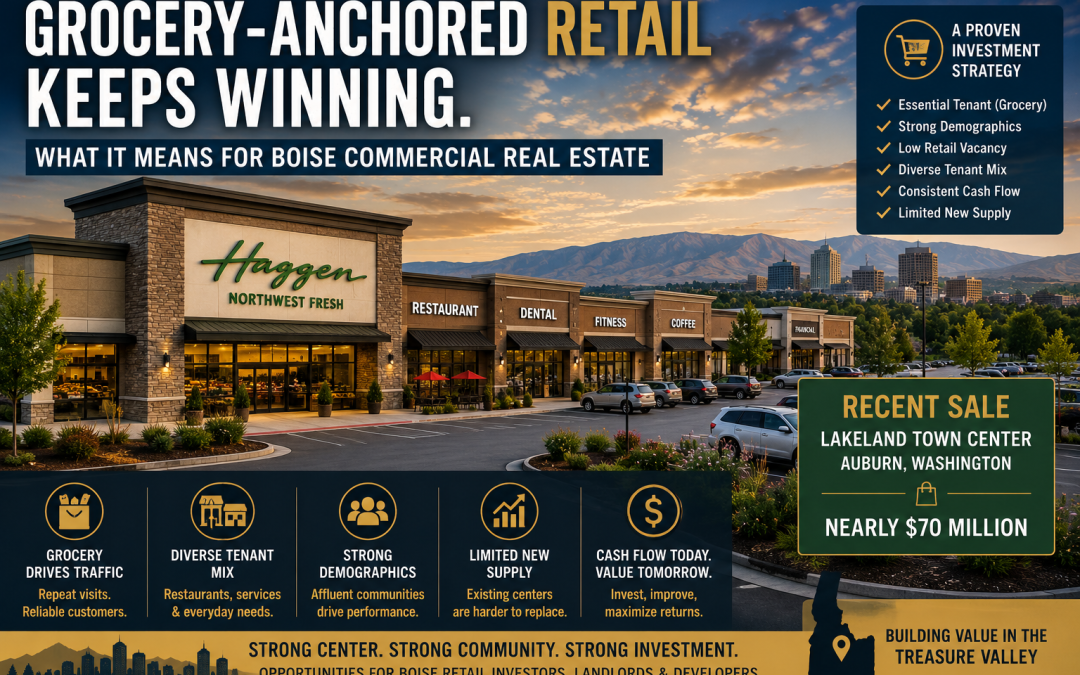
Why Grocery-Anchored Retail Keeps Winning—and What It Could Mean for Boise Commercial Real Estate
Investors are still willing to write big checks for the right shopping centers.
But the properties attracting attention are not necessarily flashy malls or luxury retail destinations.
They are often neighborhood centers built around something people need every week: groceries.
A nearly $70 million shopping center sale in the Seattle area provides another example of how investors are valuing grocery anchors, limited new retail construction, strong demographics, and a diverse mix of service-oriented tenants.
According to reporting by Randyl Drummer of CoStar News, Intercontinental Real Estate recently acquired Lakeland Town Center in Auburn, Washington, for approximately $69.5 million.
You can read the original CoStar News article here:
https://product.costar.com/home/news/816553107
The property is outside Idaho, but the investment strategy behind the purchase has clear implications for Boise commercial real estate, particularly as investors evaluate grocery-anchored shopping centers throughout Boise, Meridian, Eagle, Nampa, Caldwell, and the rest of the Treasure Valley.
Investors Are Paying for Predictable Customer Traffic
Lakeland Town Center contains approximately 125,233 square feet on 12.6 acres.
The property was built in 2002 and is anchored by Haggen Northwest Fresh, a regional grocery chain connected to Albertsons and Safeway.
More importantly from an investment standpoint, the shopping center was fully leased at the time of the sale.
Its tenant lineup includes more than 20 businesses.
And this is where the property becomes particularly interesting.
The center does not depend entirely on traditional retail.
It includes roughly 10 restaurants along with medical, dental, financial, fitness, and other service businesses.
That is increasingly what a strong neighborhood shopping center looks like.
Consumers can buy groceries.
Eat dinner.
Visit the dentist.
Work out.
Handle financial services.
Pick up food.
Complete several errands during one trip.
This creates what commercial real estate investors value most: repeat traffic.
A grocery store may bring customers to a property multiple times each month. Restaurants, fitness businesses, medical offices, and service tenants can then benefit from that traffic.
The relationship works in both directions.
A good tenant mix makes the shopping center more convenient, which can help strengthen the grocery anchor.
That is one reason grocery-anchored properties continue attracting investment capital.
Limited New Retail Construction Makes Existing Centers More Valuable
There is another important piece of the Auburn transaction.
Supply.
According to CoStar News, retail vacancy in east Pierce County was approximately 2.4%, with essentially no new supply under construction.
That creates a powerful commercial real estate equation.
Strong tenant demand plus limited available space can support occupancy and rents.
And when developers are not adding significant competing inventory, an existing well-located shopping center becomes harder to replace.
That lesson translates directly to Boise retail real estate.
Building a shopping center today is expensive.
Developers have to account for land, construction, financing, impact fees, utilities, parking, landscaping, tenant improvement allowances, and other costs.
Then they have to generate rents high enough to justify the investment.
That can create a gap between what new construction needs to charge and what many retailers can afford.
Existing shopping centers have an advantage.
Their original construction costs are already behind them.
When they have good access, strong anchors, healthy demographics, and functional buildings, they can become increasingly valuable simply because reproducing them would be difficult.
This is especially important in established parts of Boise, Meridian, Eagle, and Nampa where large commercial parcels are becoming harder to assemble.
Grocery Anchors Can Help Stabilize the Entire Tenant Mix
The grocery component matters because food shopping is different from many other retail activities.
People may delay buying furniture.
They may postpone purchasing clothing.
They may cut back on entertainment.
They still need groceries.
That does not make grocery stores recession-proof, and grocery operators face their own competitive and margin pressures.
But grocery traffic tends to be more consistent than many discretionary retail categories.
That consistency can benefit neighboring tenants.
For retail leasing in Boise, grocery-anchored centers can therefore appeal to businesses that want regular customer activity nearby.
Restaurants are an obvious example.
So are:
- Coffee shops
- Dental offices
- Medical clinics
- Fitness concepts
- Salons
- Financial services
- Wireless stores
- Pet businesses
- Quick-service restaurants
- Personal services
Many of these businesses also have another attractive characteristic for landlords.
They are difficult to replace with e-commerce.
You cannot get a haircut online.
You cannot complete a physical workout at an e-commerce warehouse.
Most dental procedures still require a physical office.
Restaurants obviously need kitchens and customer access.
That makes the combination of grocery plus food plus service tenants particularly interesting for long-term retail ownership.
Strong Household Incomes Can Strengthen the Investment Case
Lakeland Town Center also benefits from its location.
The property sits within Lakeland Hills, a master-planned community south of Seattle.
According to the buyer, average household income in the surrounding community exceeds $183,000.
That matters because successful neighborhood retail usually follows rooftops and purchasing power.
A grocery store needs households.
Restaurants need customers.
Medical and dental offices need patients.
Fitness businesses need members.
And service businesses need people living close enough to visit regularly.
This same principle applies throughout the Treasure Valley.
When evaluating Boise commercial real estate, investors should pay close attention to the residential neighborhoods surrounding a shopping center.
Population growth is important.
But population alone does not tell the whole story.
Household income, homeownership, age, family size, daytime population, traffic patterns, residential development, and competing retail supply can all affect performance.
A shopping center surrounded by growing neighborhoods can essentially become the commercial service hub for those households.
That can create durable value.
Investors Are Buying Cash Flow—and Then Improving the Property
Intercontinental Real Estate is not simply acquiring Lakeland Town Center and leaving it untouched.
According to CoStar News, the buyer plans to replace the property’s roof and make improvements to retail spaces as tenants eventually turn over.
That strategy is worth noting.
Value creation in retail real estate does not always require dramatic redevelopment.
Sometimes it comes from maintaining the property well and improving spaces gradually.
Replace a roof.
Modernize storefronts.
Improve signage.
Upgrade landscaping.
Reconfigure outdated tenant spaces.
Improve lighting.
Create better patios.
Add drive-thru capability where appropriate.
Strengthen the tenant mix.
Those improvements can help an older shopping center compete with newer development without requiring the owner to demolish and rebuild the property.
For investors evaluating Treasure Valley shopping centers, that can create an attractive middle ground between passive ownership and full redevelopment.
Grocery-Anchored Retail Is Attracting Serious Capital
The size of the Auburn transaction also provides some perspective.
The approximately $69.5 million purchase was reportedly the largest shopping center transaction in the greater Seattle region since October 2024.
In that earlier transaction, Lightstone Group acquired the Outlet Collection Seattle for approximately $82 million.
CoStar also reported that grocery-anchored shopping center transactions are helping Seattle-area retail investment volume move toward the $1.2 billion recorded during 2025.
That tells us institutional investors have not abandoned retail.
They have become more selective about which retail they want to own.
The strongest properties tend to combine several characteristics:
Essential retail.
Strong demographics.
Limited competing supply.
High occupancy.
Service-oriented tenants.
Good access.
Established surrounding neighborhoods.
And opportunities to improve the property over time.
Those characteristics are not unique to Seattle.
They can also be found in the Boise market.
Local Insight: Boise’s Best Shopping Centers May Become Harder to Replace
From a Boise commercial real estate perspective, one of the biggest lessons from this transaction is replacement cost.
Imagine trying to recreate a successful grocery-anchored neighborhood center today.
First, find 10 to 15 acres in a strong Boise-area residential growth corridor.
Then acquire the land.
Get the property entitled.
Bring utilities to the site.
Build roads and parking.
Construct more than 100,000 square feet of retail.
Secure a grocery anchor.
Sign restaurants and service tenants.
Fund tenant improvements.
Then wait for the surrounding neighborhoods to mature.
That process can take years and require substantial capital.
An existing shopping center may already have all of it.
That scarcity can become valuable.
This is why some older grocery-anchored centers could become increasingly attractive investment properties even if they are not architecturally exciting.
The land is already assembled.
The customers already live nearby.
The traffic patterns already exist.
The tenants already know the location.
And the center may already be generating cash flow.
For investors, those fundamentals can matter much more than whether the property is brand new.
What This Could Mean for Boise Commercial Real Estate
The Lakeland Town Center transaction is another reminder that retail commercial real estate is not one single asset class.
Some retail properties face significant challenges.
Others remain highly desirable.
Grocery-anchored neighborhood centers sit in an interesting position because they combine essential shopping with restaurants, services, healthcare, fitness, and other uses that benefit from proximity to residential neighborhoods.
For Boise commercial real estate investors, that could make well-located grocery-anchored properties particularly worth watching.
For landlords, the lesson is to build tenant mixes around repeat visits rather than relying entirely on discretionary shopping.
For tenants, locating near strong grocery traffic can provide valuable exposure.
For developers, limited new supply can create opportunities—but only when construction economics support the rents necessary to make new projects feasible.
And for existing shopping center owners, rising replacement costs may make their properties more valuable than they realize.
The future of retail leasing in Boise may not be about building dramatically more retail.
It may increasingly be about making existing retail better.
When a shopping center combines strong demographics, essential traffic, limited competition, and a diversified tenant mix, investors are still willing to pay for it.
The nearly $70 million sale in Auburn shows just how valuable that combination can become.
Mike Gioioso (joy-OH-so) has for 16+ years been helping companies of all sizes buy, build, and lease perfect places for business in greater Boise, Idaho and beyond.
www.streetsmartidaho.com mike@streetsmartidaho.com 208-209-9166
Tags: #boisecommercialrealestate, #boiseretailrealestate, #boiseretailleasing, #retailleasingboise, #groceryanchoredshoppingcenters, #groceryanchoredretail, #groceryanchoredrealestate, #shoppingcenterinvestment, #boiseshoppingcenters, #boiseretailinvestment, #treasurevalleycommercialrealestate, #treasurevalleyretail, #treasurevalleyshoppingcenters, #idahocommercialrealestate, #idahoretailrealestate