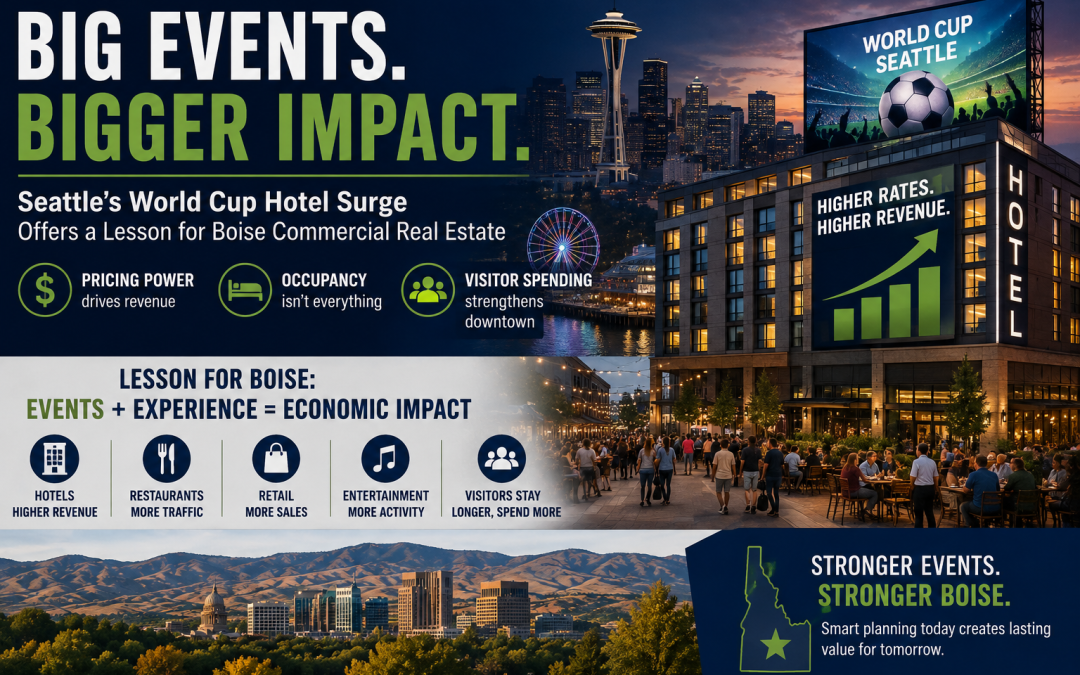
Seattle’s World Cup Hotel Surge Offers a Lesson for Boise Commercial Real Estate
A major event doesn’t need to sell out every hotel room to have a big impact on commercial real estate.
Seattle’s experience during the 2026 FIFA World Cup shows why.
Hotels were able to dramatically increase room rates around the tournament’s most popular matches, especially when Team USA played in the city. In several cases, higher pricing—not huge jumps in occupancy—produced the biggest revenue gains.
For Boise commercial real estate, that’s an interesting lesson.
Boise may not be hosting the World Cup, but the city continues attracting sporting events, conventions, concerts, festivals and visitors. Understanding how those events translate into hotel revenue, restaurant traffic and retail spending can help investors and developers evaluate opportunities differently.
According to reporting by Michael Stathokostopoulos of CoStar Analytics, Seattle hotels saw meaningful revenue gains during the World Cup, with the strongest results surrounding U.S. national team matches.
You can read the original CoStar Analytics article here:
https://product.costar.com/home/news/296415503
The bigger story isn’t simply that soccer fans traveled to Seattle.
It’s how hotels made money from that demand.
Hotels Didn’t Need To Fill Every Room To Win
One of the most important commercial real estate lessons from Seattle was the difference between occupancy and pricing.
Around the June 19 match between Australia and the United States, Seattle hotels posted some of their strongest results of the tournament.
Revenue per available room, commonly called RevPAR, increased 76% the day before the match and another 69% on match day compared with the prior year.
But occupancy didn’t rise nearly as dramatically.
It increased about 7.8% the day before and only 2.9% on game day.
So what drove the revenue?
Room rates.
Average daily rates increased by more than 63%.
That distinction matters for hotel investors.
Hotels don’t necessarily need dramatically higher occupancy to generate exceptional revenue during periods of strong demand.
If a hotel is already relatively full, even a modest increase in occupancy combined with much higher room rates can produce a major revenue boost.
That can change how investors think about event-driven hotel markets.
The question isn’t simply:
How many additional visitors will come?
Another important question is:
How much more will visitors pay to stay during periods when demand peaks?
Not Every Event Creates the Same Commercial Impact
Seattle’s experience also demonstrates that simply hosting an event doesn’t guarantee strong hotel performance.
Different World Cup matches produced very different results.
The Belgium-Egypt match provided a noticeable boost before game day, with RevPAR rising about 27%. But performance was much weaker on the actual match day as occupancy declined.
Another matchup, Bosnia and Herzegovina versus Qatar, produced much weaker results. RevPAR declined roughly 17% to 18% during its three-day window.
Meanwhile, Belgium versus Senegal generated stronger demand, with RevPAR increasing roughly 30% before the match and 25% on game day.
The takeaway is important for Boise development and hospitality investment.
Not all events are equal.
A sold-out sporting event involving popular teams may attract visitors from hundreds or thousands of miles away.
A different event with the same number of attendees might primarily attract local residents who return home afterward.
Those two events could look identical on an attendance report while producing completely different economic results for hotels.
For hotel investors, restaurants and retailers, where attendees come from may matter almost as much as how many attend.
The Surrounding Experience Can Extend Visitor Spending
Seattle also did something beyond hosting soccer matches.
The city created additional reasons for visitors to remain downtown.
World Cup celebrations included large public viewing areas at Seattle Center along with fan activities, match screenings and cultural programming along the waterfront.
Those events helped turn the tournament into a broader citywide experience rather than a series of isolated games.
That’s another lesson worth considering for Boise commercial real estate.
A major event creates the most economic value when visitors have reasons to spend money before and after the event itself.
Imagine someone traveling to Boise for a tournament or concert.
If they arrive, attend the event and leave immediately, their economic impact is limited.
But if they stay two nights, eat downtown, visit local breweries, shop, attend another event and explore nearby attractions, the impact spreads across multiple commercial property types.
Hotels benefit.
Restaurants benefit.
Retailers benefit.
Entertainment businesses benefit.
Transportation providers benefit.
That activity ultimately supports commercial rents and property values.
This is why programming around events can matter almost as much as the event itself.
Why This Matters for Boise Hotels and Downtown Real Estate
Boise has increasingly developed the ingredients needed to capture event-driven demand.
The city has hotels, restaurants, entertainment venues, convention facilities, sports facilities and a walkable downtown core.
That creates an opportunity for multiple pieces of Downtown Boise commercial real estate to benefit from the same visitor.
A hotel guest doesn’t simply occupy a hotel room.
That person may buy coffee in the morning.
Eat lunch at a restaurant.
Shop in the afternoon.
Attend an event.
Visit a bar afterward.
Then repeat portions of that spending the next day.
That means hospitality demand can have a multiplier effect across surrounding commercial properties.
For landlords and developers, this is one reason proximity to hotels, entertainment venues and event destinations can matter when evaluating Boise retail real estate.
Visitor traffic can supplement the spending generated by residents and downtown employees.
Local Insight: Boise Should Think in Terms of Visitor Nights, Not Just Visitors
If I’m evaluating the economic impact of a major Boise event, I don’t just want to know attendance.
I want to know how many people traveled here and how long they stayed.
Those numbers can tell us much more about the potential impact on commercial real estate.
Ten thousand local attendees and 10,000 visitors from outside Idaho create very different spending patterns.
The same applies to length of stay.
A visitor staying three nights can generate substantially more economic activity than someone who drives into Boise for an afternoon and leaves after the event.
That’s why major events can become part of a larger commercial real estate strategy.
Cities can ask:
Can we turn a one-day event into a weekend?
Can restaurants create special programming?
Can downtown businesses coordinate promotions?
Can additional entertainment encourage visitors to arrive earlier?
Can attractions give families another reason to stay an extra night?
The goal is not simply filling seats.
It’s extending the visitor experience.
Boise Commercial Real Estate Can Benefit From Better Event Economics
Seattle’s World Cup experience provides another important reminder for investors.
Revenue matters more than raw traffic.
Hotel occupancy alone doesn’t tell the entire story.
A hotel running at slightly higher occupancy but charging dramatically higher rates may outperform one that simply fills more rooms.
The same principle applies across commercial real estate.
A retail district isn’t successful simply because thousands of people walk through it.
Those visitors need to spend money.
An entertainment district isn’t successful simply because an arena is full.
Visitors need reasons to stay nearby.
And a downtown doesn’t maximize the value of a major event simply by hosting it.
The surrounding businesses need opportunities to capture that demand.
For Boise commercial real estate investors, developers and business owners, that’s the larger takeaway from Seattle.
Events can temporarily increase demand.
But creating an environment where visitors stay longer and spend more can turn that temporary surge into a much broader economic opportunity.
Mike Gioioso (joy-OH-so) has for 16+ years been helping companies of all sizes buy, build, and lease perfect places for business in greater Boise, Idaho and beyond.
www.streetsmartidaho.com mike@streetsmartidaho.com 208-209-9166
Tags: #boisecommercialrealestate, #boisehotelmarket, #boisehospitalityrealestate, #downtownboisecommercialrealestate, #boisedevelopment, #downtownboisedevelopment, #idahocommercialrealestate, #treasurevalleycommercialrealestate, #boisehotels, #boisetourism, #boiseretailrealestate, #retailleasingboise, #downtownboiseretail, #boiseinvestmentproperty