
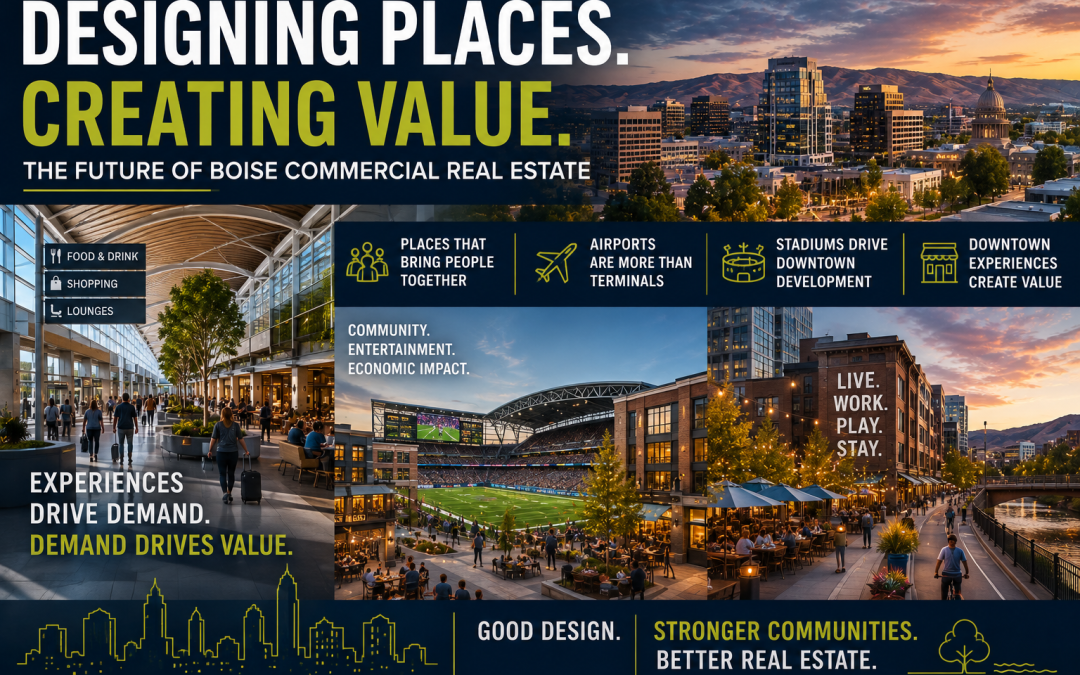
Why Experience-Driven Development Could Shape the Future of Boise Commercial Real Estate
The next generation of successful commercial real estate may have less to do with the building itself.
It may have more to do with what happens there.
Airports are becoming shopping and dining destinations. Stadiums are anchoring mixed-use districts. Downtown developments are adding entertainment, public spaces and experiences designed to keep people around longer.
That shift has important implications for Boise commercial real estate.
According to reporting by Andy Peters of CoStar News, architect Loren Supp recently returned to global design firm Populous as senior principal and head of design for the Western United States. Supp’s career has included work on stadiums, hospitals, airport terminals and other major public projects.
You can read the original CoStar News article here:
https://product.costar.com/home/news/1379495976
Supp’s comments provide an interesting window into where large-scale development may be heading—and why developers increasingly need to think beyond square footage.
Commercial Real Estate Is Becoming More About Experience
One theme stands out from Supp’s discussion with CoStar:
Places where people gather matter.
Populous has built its reputation around projects including sports venues, aviation facilities and mixed-use districts.
Those properties have something important in common.
People don’t simply occupy them.
They experience them.
That distinction is becoming increasingly important across commercial real estate.
Think about the traditional shopping center.
For decades, the basic formula was straightforward:
Build stores.
Provide parking.
Lease the space.
Collect rent.
Today, successful retail projects increasingly include restaurants, outdoor gathering areas, entertainment, landscaping, events and other amenities.
The goal is not simply getting someone onto the property.
It’s giving them reasons to stay.
The same principle applies to Boise retail leasing.
A restaurant benefits when nearby businesses create traffic.
A retailer benefits from entertainment.
Entertainment benefits from restaurants.
Hotels benefit from all of them.
The strongest mixed-use developments create a network of businesses that help generate customers for one another.
Airports Show Where Commercial Design Is Heading
Supp identified airports as a major opportunity for future architectural work.
That makes sense.
Air travel has become increasingly complicated.
Passengers spend significant amounts of time moving through security, waiting at gates, eating, shopping and navigating terminals.
As a result, airports have evolved beyond transportation infrastructure.
Many modern terminals function almost like shopping centers with airplanes attached.
Restaurants.
Retail stores.
Lounges.
Public art.
Workspaces.
Local food concepts.
Comfortable gathering areas.
Those amenities aren’t simply decorative.
They generate revenue.
For Boise commercial real estate, that’s an interesting point because the Boise Airport continues to play an increasingly important role in the Treasure Valley economy.
More air connectivity can support tourism, corporate travel, business recruitment and convention activity.
It can also create opportunities for restaurants, retailers and service businesses that want exposure to travelers.
Airport development therefore isn’t just an aviation story.
It can become part of the larger Boise economic development and commercial real estate story.
Stadiums Can Become Development Engines
Supp also pointed to a project from earlier in his career: the Houston Dynamo soccer stadium.
The stadium opened in Houston’s East Downtown area and became part of a broader neighborhood transformation.
That’s an important commercial real estate lesson.
Large sports venues can become more than buildings where games happen.
When designed and located correctly, they can become anchors for surrounding development.
Restaurants want to locate nearby.
Bars want event traffic.
Hotels can benefit from visiting fans.
Apartments can benefit from entertainment access.
Retailers can gain exposure to pedestrians.
That can create an entire commercial district around one major destination.
We’ve seen versions of this strategy across the country.
Developers increasingly view sports and entertainment facilities as anchors for larger mixed-use developments rather than isolated venues surrounded by parking lots.
That distinction matters.
An arena that is active 80 nights per year creates one type of economic impact.
An arena surrounded by restaurants, apartments, hotels, retail and public gathering areas can create activity throughout the year.
For Boise development, that’s worth paying attention to.
Downtown Boise Needs Reasons for People To Stay
Supp also discussed something particularly relevant to Boise: activating downtown areas.
Cities across the country are trying to determine how to make downtown districts more active throughout the day and week.
That challenge became even more important as office work patterns changed.
If fewer employees are downtown five days a week, cities cannot depend entirely on office workers to support restaurants and retailers.
Downtowns increasingly need multiple sources of traffic.
Residents.
Visitors.
Events.
Entertainment.
Tourism.
Hotels.
Restaurants.
Retail.
Public spaces.
That diversification can make a downtown more resilient.
Downtown Boise already has many of those ingredients.
The opportunity is to continue connecting them.
A visitor attending an event should have somewhere nearby to eat.
A hotel guest should have places to explore.
A downtown resident should have everyday services within walking distance.
A family attending a festival should have reasons to remain downtown afterward.
That’s where thoughtful Downtown Boise commercial real estate development becomes important.
Good Design Can Directly Affect Leasing
Architecture sometimes gets treated as an aesthetic decision.
In commercial real estate, it can also be an economic decision.
Consider two retail projects with similar rents and locations.
One has attractive outdoor spaces, visible storefronts, comfortable pedestrian areas and restaurants that spill onto patios.
The other is difficult to navigate, poorly connected and offers little reason to stay after completing a purchase.
Which one will businesses prefer?
Which one will customers visit more frequently?
Which one is more likely to support stronger rents over time?
Good design doesn’t guarantee commercial success.
But bad design can make success much harder.
This is especially important when construction costs are high.
Developers may be tempted to eliminate gathering spaces, landscaping or architectural features to reduce upfront expenses.
Sometimes that’s necessary.
But cutting the elements that create the customer experience can also reduce the long-term competitiveness of a project.
Local Insight: Stop Thinking Only in Square Feet
One of the biggest mistakes in commercial development is evaluating everything primarily in terms of square footage.
How much can we build?
How much can we lease?
How many parking spaces can we fit?
Those questions matter.
But another question may be equally important:
Why will people want to come here?
For Boise commercial real estate developers, that question can influence everything from site planning to tenant mix.
A shopping center with a great restaurant patio may keep customers around longer.
A mixed-use project with an inviting plaza can become a community gathering place.
A hotel connected to restaurants and entertainment may attract more visitors.
An office building near amenities may become easier for employers to recruit workers to.
A commercial district that hosts events can generate traffic beyond normal business hours.
Those experiences can eventually translate into stronger tenant demand.
Boise’s Growth Creates an Opportunity To Build Places, Not Just Buildings
The Treasure Valley is still growing.
That means Boise and surrounding communities have an opportunity many mature cities don’t have.
We’re still building substantial portions of the region’s future commercial landscape.
The decisions developers make today about retail centers, mixed-use projects, entertainment districts, offices and public spaces could shape how people experience the Treasure Valley for decades.
That’s why Supp’s point about architecture being a long game is especially relevant to commercial real estate.
Buildings last.
Street layouts last.
Public spaces last.
Development patterns last.
And successful commercial properties need to remain useful long after the original development team has moved on.
For Boise commercial real estate investors, landlords and developers, the opportunity isn’t simply creating more buildings.
It’s creating places businesses want to occupy and customers want to visit.
If Boise can continue doing that as it grows, good design won’t simply make the city look better.
It could make its commercial real estate perform better too.
Mike Gioioso (joy-OH-so) has for 16+ years been helping companies of all sizes buy, build, and lease perfect places for business in greater Boise, Idaho and beyond.
www.streetsmartidaho.com mike@streetsmartidaho.com 208-209-9166
Tags: #boisecommercialrealestate, #boisedevelopment, #boisecommercialdevelopment, #downtownboisecommercialrealestate, #downtownboisedevelopment, #idahocommercialrealestate, #treasurevalleycommercialrealestate, #boiseretailrealestate, #retailleasingboise, #boisemixedusedevelopment, #mixedusedevelopment, #experiencedrivendevelopment, #commercialrealestatedesign, #boisearchitecture, #boiseurbandevelopment