
Apartment Demand Is Shifting to Growth Markets—and Boise Multifamily Investors Should Pay Attention
For decades, America’s biggest cities dominated the apartment business.
More people, more jobs and more renters generally meant more apartment demand.
That relationship is changing.
Some of the strongest gains in renter demand are now showing up in fast-growing Sun Belt cities and secondary markets that once played much smaller roles in the national apartment industry.
For Boise commercial real estate, there is an important lesson here: apartment demand doesn’t automatically belong to the biggest cities. It can move toward places where population growth, jobs, affordability and new housing supply come together.
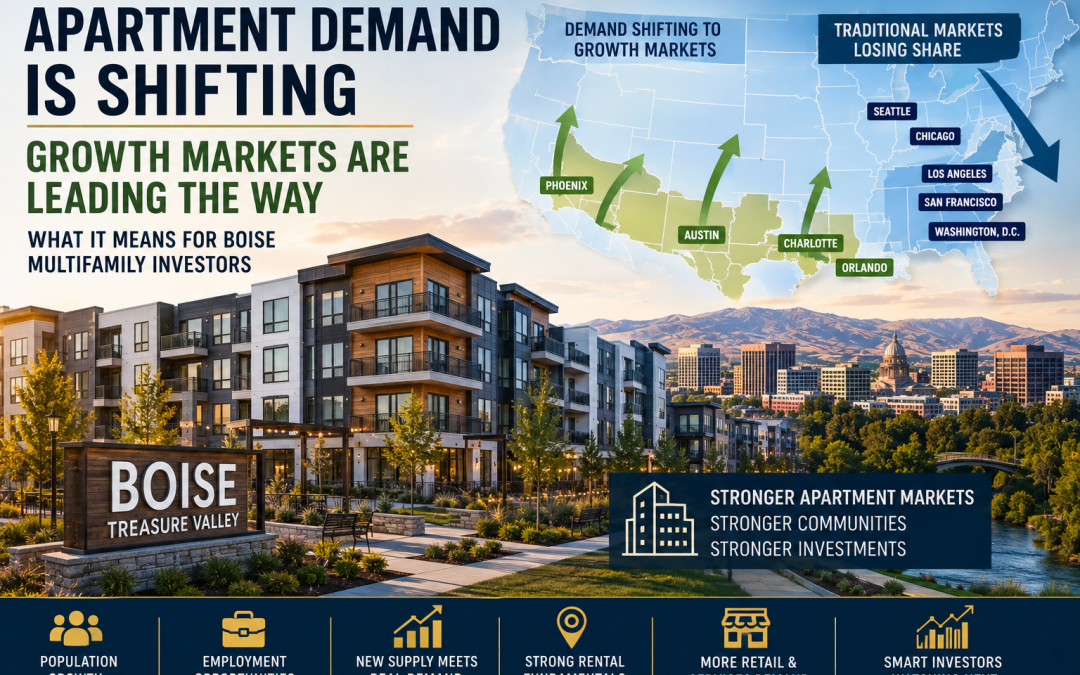
According to analysis by Grant Montgomery of CoStar Analytics, markets including Phoenix, Austin, Charlotte and Orlando have captured substantially larger portions of U.S. apartment demand over the past decade, while several traditional gateway markets have lost ground.
You can read Montgomery’s original CoStar analysis here:
https://product.costar.com/home/news/752171108
The trend raises an interesting question for Boise and the Treasure Valley.
Could smaller growth markets continue taking a larger role in America’s multifamily investment landscape?
Renters Are Redrawing the Apartment Map
Apartment development has surged across the United States over the past decade.
But the more important story may be where renters actually absorbed those units.
CoStar’s analysis examined apartment absorption, essentially looking at the balance between people moving into and out of units.
Some of the biggest changes have occurred outside the traditional coastal giants.
Phoenix is a standout.
According to CoStar, its share of nationwide apartment absorption increased from roughly 2% in 2017 to nearly 5% in 2026.
Austin moved from approximately 2.4% to 4.5%.
Charlotte climbed from 1.9% to 3.2%, while Orlando increased from 1.5% to 2.4%.
Charlotte now represents a larger portion of national apartment absorption than Seattle.
That’s a remarkable change.
Meanwhile, Washington, D.C., Seattle, Chicago, Los Angeles and San Francisco collectively surrendered about 6.7 percentage points of national absorption share during the past decade.
The message isn’t that America’s major cities no longer matter.
They clearly do.
The bigger takeaway is that renter demand has become more geographically distributed.
Growth markets are becoming heavyweights of their own.
Building Apartments Isn’t Enough—Demand Has to Follow
There is another important lesson in CoStar’s analysis for Boise development.
Supply and demand have to grow together.
Many markets that expanded their apartment inventories also captured larger shares of renter demand. Developers effectively created capacity for population and household growth.
But that wasn’t true everywhere.
Boston, for example, expanded beyond 300,000 apartment units while still losing share of national apartment absorption.
That’s an important warning for multifamily developers.
You can’t manufacture demand simply by constructing apartments.
Successful multifamily development depends on the economic engine underneath the project.
That can include:
- Population and household formation
- Employment growth
- Migration
- Relative affordability
- Wage growth
- New business investment
- Lifestyle and quality-of-life factors
For Treasure Valley developers, those fundamentals matter more than simply knowing that Boise has grown quickly in the past.
The question should always be: Who will rent the next apartment we build?
If the answer isn’t clear, additional supply can become a problem.
What This Could Mean for Boise Multifamily Real Estate
Boise isn’t Phoenix, Austin or Charlotte.
The Treasure Valley operates at a much smaller scale.
But that’s exactly why this national trend is worth watching.
Many of today’s increasingly influential apartment markets were considered secondary markets not that long ago.
CoStar points to places such as Huntsville, Colorado Springs, Sarasota and Charleston as examples of smaller markets that have become increasingly meaningful contributors to national apartment demand.
That suggests investors shouldn’t evaluate markets based only on their current size.
Direction matters too.
For Boise commercial real estate investors, the more useful questions may be:
Is the population still expanding?
Are employers creating enough jobs?
Are wages supporting rents?
Is Boise still attractive compared with larger Western markets?
Are new apartments leasing quickly enough?
And how much additional supply is already under construction?
Those questions help separate a genuine long-term growth market from one that simply experienced a temporary development boom.
The Treasure Valley has benefited from many of the forces helping secondary markets nationally: migration, business expansion, quality of life and relative affordability compared with some larger Western metros.
But past growth doesn’t guarantee future absorption.
That makes disciplined underwriting increasingly important.
Apartment Growth Can Influence More Than Multifamily
There is another reason this matters to the broader Boise commercial real estate market.
Apartments create customers.
A new multifamily development can put hundreds of households within walking distance or a short drive of nearby businesses.
Those households need groceries, restaurants, coffee, fitness, medical care, daycare, personal services and entertainment.
That’s why multifamily growth can eventually support retail leasing in Boise, medical office development and neighborhood commercial projects.
For developers, the relationship can work in both directions.
A successful mixed-use area with restaurants, parks, services and entertainment can make apartments more attractive.
More residents can then make the commercial portion of the project more viable.
This is one reason mixed-use development can become increasingly important as the Treasure Valley matures.
Instead of treating housing, retail and services as completely separate markets, developers can think about how they reinforce each other.
Local Insight: Boise Doesn’t Need to Become Phoenix to Benefit
One of the most interesting points in CoStar’s analysis is that America’s apartment hierarchy hasn’t disappeared.
It has expanded.
Large markets such as New York, Dallas-Fort Worth, Houston and Atlanta remain enormously important.
But they now share the stage with more fast-growing metros.
That may be the better framework for thinking about Boise.
Boise doesn’t need to compete with Dallas or Phoenix in total apartment demand.
It needs to capture enough household and employment growth relative to its size to support sustainable development.
That distinction matters.
A smaller market growing consistently can provide excellent opportunities.
But smaller markets can also become oversupplied more quickly because a few large projects can meaningfully change available inventory.
For Boise multifamily investors and developers, that makes timing critical.
Watch migration.
Watch job creation.
Watch concessions.
Watch lease-up velocity.
Watch the construction pipeline.
And perhaps most importantly, watch the relationship between rents and local incomes.
The national apartment story shows that renter demand can migrate.
Markets that once sat outside the industry’s top tier can become increasingly important when people, businesses and developers move in the same direction.
The opportunity for Boise isn’t necessarily to become one of America’s largest apartment markets.
It’s to remain one of the smaller markets where people continue choosing to live, work and invest.
If that continues, multifamily demand can support much more than apartments.
It can help shape the next generation of Boise retail, mixed-use development, medical space and neighborhood commercial real estate throughout the Treasure Valley.
Mike Gioioso (joy-OH-so) has for 16+ years been helping companies of all sizes buy, build, and lease perfect places for business in greater Boise, Idaho and beyond.
www.streetsmartidaho.com mike@streetsmartidaho.com 208-209-9166
Tags: #boisecommercialrealestate, #boisemultifamily, #boiseapartmentmarket, #boisedevelopment, #treasurevalleycommercialrealestate, #idahomultifamilyrealestate, #boiseinvestmentproperty, #multifamilyinvestment, #apartmentdemand, #treasurevalleyapartments, #meridiandevelopment, #nampadevelopment, #retailleasingboise, #mixedusedevelopment, #boisepopulationgrowth