
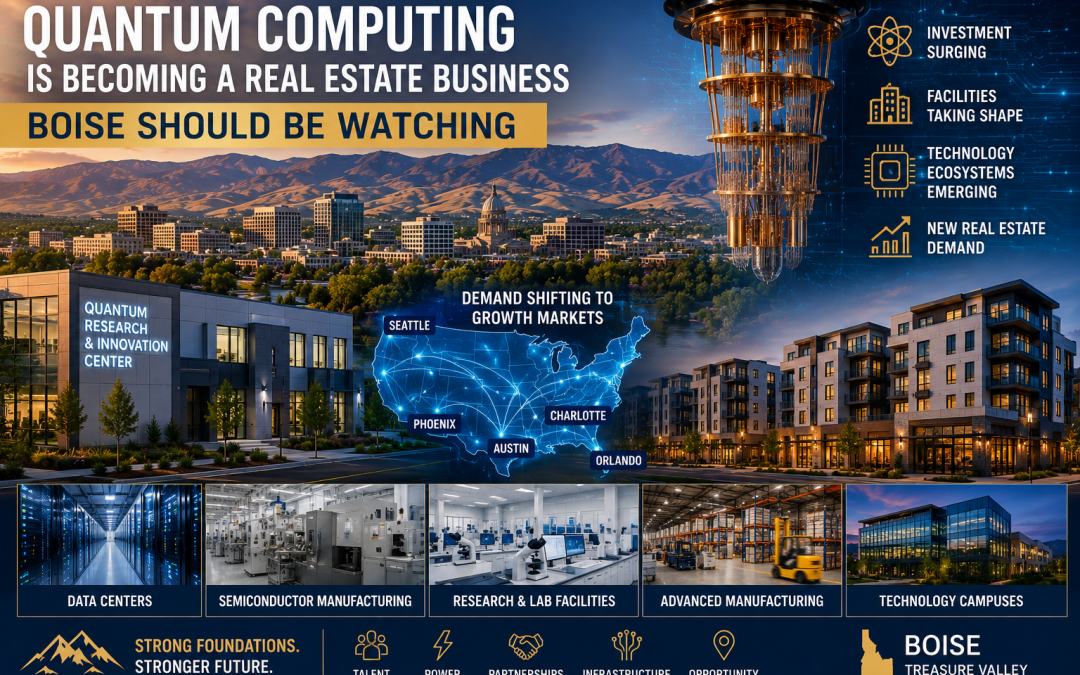
Quantum Computing Is Becoming a Real Estate Business—and Boise Should Be Watching
Artificial intelligence has already changed the conversation around commercial real estate.
Data centers need enormous amounts of land, electricity and infrastructure. Semiconductor manufacturing has created demand for specialized industrial facilities. Technology companies continue searching for markets with skilled workers, power and room to expand.
Now another technology may be moving from the laboratory into the real estate market: quantum computing.
For Boise commercial real estate, this isn’t about predicting that a quantum computing campus will suddenly appear in the Treasure Valley.
It’s about recognizing a familiar pattern early.
Emerging technologies start with research. Investment follows. Companies grow. Suppliers arrive. And eventually, those businesses need physical places to operate.
According to reporting by Randyl Drummer of CoStar News, investment in quantum computing is beginning to translate into demand for research centers, specialized computing facilities, semiconductor operations and larger technology campuses.
CoStar cites JLL research tracking approximately $71 billion in global quantum-related investment, with more than $4 billion in quantum computing real estate projects already underway.
You can read Drummer’s original CoStar News article here:
https://product.costar.com/home/news/825438796
For Boise investors, developers and economic development leaders, the important question isn’t whether quantum computing is ready to replace conventional computing.
It’s whether the next technology infrastructure boom is already starting to take physical shape.
Technology Innovation Eventually Needs Buildings
Quantum computing can sound almost entirely theoretical.
But commercial real estate has seen this movie before.
Cloud computing sounded abstract until companies needed massive data centers.
Artificial intelligence seemed largely software-driven until the industry began consuming huge amounts of computing power, electricity and real estate.
Semiconductors are tiny, but producing them requires enormous manufacturing facilities and complicated supply chains.
Quantum computing could follow its own version of that path.
According to CoStar, private and public funding for quantum technology reached an estimated $9.3 billion last year, more than five times the previous annual level.
That capital is beginning to produce physical infrastructure.
JLL’s research identified more than 240 quantum-related facilities across 35 countries.
The property types vary considerably and can include:
- Research and development facilities
- Semiconductor fabrication operations
- Specialized computing centers
- University research buildings
- Government laboratories
- Private technology campuses
- Supercomputing facilities
- Advanced manufacturing space
- Hybrid research and commercial facilities
Many existing facilities remain relatively small. CoStar reports that typical projects are often below 150,000 square feet and frequently operate in university or government environments.
But private capital is becoming more involved.
That’s where the commercial real estate implications become more interesting.
Quantum Campuses Could Create Entire Technology Ecosystems
One of the best examples is emerging in Chicago.
The Illinois Quantum and Microelectronics Park is being developed on approximately 128 acres of a former U.S. Steel property along the city’s lakefront.
The site had been underused for years.
Now it is being repositioned around one of the world’s most advanced emerging technologies.
Companies connected with the project include PsiQuantum, IBM, Infleqtion, Diraq and Quantum Machines. DARPA, the federal research agency, is also expected to have a presence.
That illustrates something important about technology-driven commercial real estate development.
The opportunity isn’t always limited to one large tenant.
Major technology investments can create clusters.
A specialized company may need suppliers.
Suppliers need warehouses and offices.
Engineers need housing.
Employees need restaurants, medical services and retail.
Visiting executives need hotels.
Startups want to locate near talent and research institutions.
Eventually, an initial technology investment can influence several different property types.
That’s why Boise commercial real estate professionals should watch emerging technology clusters even when the first projects occur elsewhere.
The ripple effects can be larger than the original facility.
Why Boise Has a Reason to Pay Attention
Boise isn’t currently one of the quantum computing centers highlighted in CoStar’s reporting.
But the Treasure Valley already has an important connection to the infrastructure behind advanced computing.
Semiconductors.
Micron’s continued investment in Boise strengthens the region’s position in advanced manufacturing and chip technology.
That doesn’t automatically make Boise a future quantum computing hub.
But it does give the market something many secondary cities don’t have: an existing ecosystem tied to semiconductor expertise, engineering talent and advanced manufacturing.
That could become increasingly valuable.
Quantum computers rely on highly specialized hardware. The technology also requires carefully controlled environments because quantum bits, or qubits, can be extremely sensitive to temperature and other disturbances.
If the industry moves further toward commercialization, site selection could depend on a combination of factors including:
Power availability. Advanced computing requires reliable electricity.
Technical talent. Engineers, researchers and semiconductor specialists are essential.
Research partnerships. Universities and government institutions can help create innovation ecosystems.
Specialized real estate. Conventional office or industrial buildings may not satisfy technical requirements without major improvements.
Capital. Many early projects require significant public or private investment.
Infrastructure. Fiber, transportation, utilities and security can become major site-selection factors.
Those requirements sound familiar because many are already shaping decisions involving semiconductor manufacturing, AI infrastructure and data centers.
For Boise development, that’s worth paying attention to.
Specialized Real Estate Could Become More Valuable
Quantum computing also reinforces a broader commercial property trend.
Some of tomorrow’s most valuable buildings may be highly specialized.
For years, investors often preferred flexible properties that could accommodate many different tenants.
That strategy still makes sense.
But advanced technology is creating demand for buildings with characteristics that aren’t easily replicated.
High electrical capacity.
Advanced cooling.
Clean rooms.
Heavy security.
Specialized laboratories.
Redundant systems.
Fiber connectivity.
Vibration control.
Those improvements can be expensive.
But they can also create barriers to entry.
If a tenant spends millions adapting a facility to its technical requirements, moving to another building becomes more difficult.
That can potentially create long-term value for landlords who understand the operational requirements of these users.
It can also create risk.
A highly specialized facility may be difficult to re-lease if the original tenant leaves.
For investors, the lesson isn’t simply “build quantum facilities.”
It’s to understand the tenant, technology and alternative uses before committing capital.
Boise Could Benefit Even Without a Quantum Computer
There is another important point for Treasure Valley commercial real estate.
Boise doesn’t necessarily need a giant quantum computer to benefit from growth in the industry.
Technology ecosystems have supply chains.
Companies involved in semiconductors, electronics, precision manufacturing, testing, cooling systems, electrical equipment, software, engineering and research could all participate in some way.
Some of those businesses may require traditional industrial or flex buildings rather than exotic research facilities.
That’s where secondary markets can sometimes benefit.
A company may conduct its core research in Chicago, Seattle or Silicon Valley while placing manufacturing, testing, administrative or supply-chain operations in a lower-cost market.
That possibility makes technology-related tenant recruitment particularly interesting for Boise.
Rather than asking only, “Can we attract a quantum computing company?”
A better economic development question might be:
Which pieces of the advanced-computing supply chain fit the strengths Boise already has?
That’s a much larger opportunity set.
Local Insight: Follow the Infrastructure Before the Headlines
Commercial real estate investors don’t need to become quantum physicists.
But we do need to understand where capital is flowing.
CoStar’s reporting shows that quantum computing is beginning to cross an important line.
Money that once primarily funded research is increasingly helping create physical facilities.
IBM has announced plans to spend more than $10 billion toward developing a fault-tolerant quantum computer targeted for 2029, according to CoStar.
IonQ has also been expanding its physical footprint. The company opened a 22,000-square-foot semiconductor testing facility in Boulder, Colorado, and previously established a quantum manufacturing operation near Seattle.
Those are real buildings occupied by real companies employing real people.
The technology still faces major engineering challenges, particularly around error correction and creating reliable systems at commercial scale.
There is no guarantee quantum computing develops exactly like AI.
But commercial real estate decisions often happen before a technology reaches full maturity.
Companies secure sites.
Governments invest in infrastructure.
Developers assemble land.
Universities establish partnerships.
Suppliers position themselves near emerging clusters.
By the time the technology becomes obvious to everyone, many of the best-positioned sites may already be controlled.
That’s the lesson Boise should take from this.
Don’t chase every technology trend.
Instead, watch where sustained capital investment intersects with Boise’s existing strengths.
Semiconductors are already one of those strengths.
Advanced manufacturing is becoming increasingly important.
Reliable power, infrastructure, workforce development and appropriately zoned employment land could become even more valuable as computing technology evolves.
Quantum computing may still be early.
Its impact on commercial real estate apparently isn’t waiting.
For Boise commercial real estate investors, developers and landlords, that makes it a trend worth watching before it becomes a mainstream real estate story.
Mike Gioioso (joy-OH-so) has for 16+ years been helping companies of all sizes buy, build, and lease perfect places for business in greater Boise, Idaho and beyond.
www.streetsmartidaho.com mike@streetsmartidaho.com 208-209-9166
Tags: #boisecommercialrealestate, #quantumcomputing, #boisetechnology, #boisedevelopment, #idahocommercialrealestate, #treasurevalleycommercialrealestate, #boiseindustrialrealestate, #advancedmanufacturingboise, #semiconductormanufacturing, #micronboise, #technologyrealestate, #datacentersboise, #boiseinvestmentproperty, #industrialdevelopment, #technologyinfrastructure