
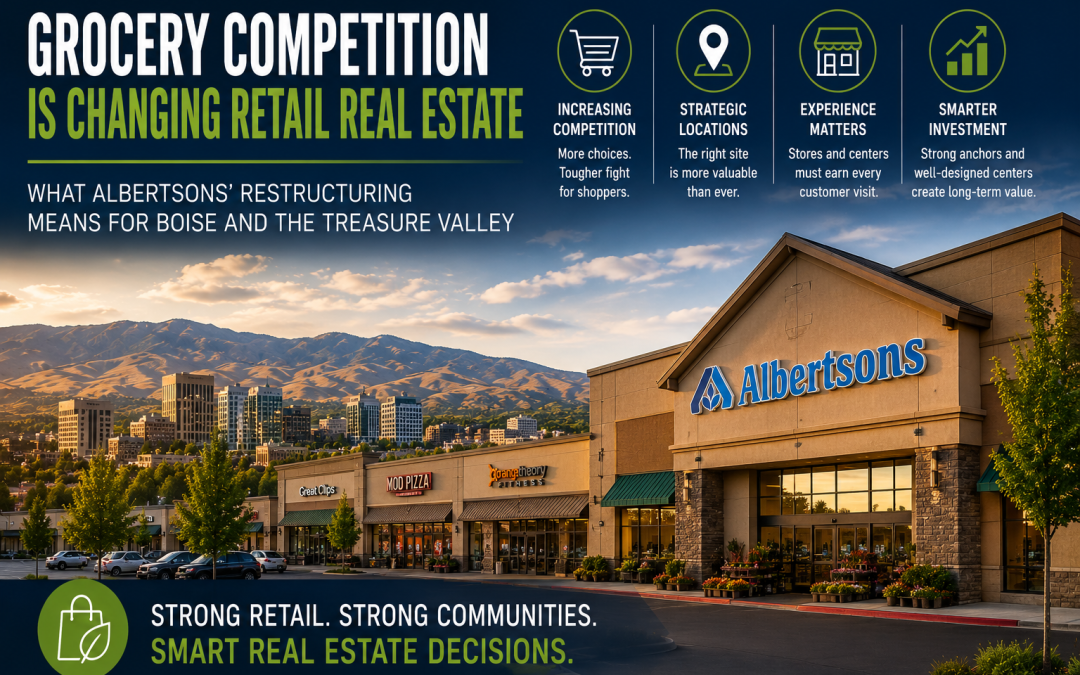
Albertsons’ Restructuring Shows Why Boise Retail Real Estate Must Keep Evolving
A grocery store can have a great location and thousands of customers nearby.
That doesn’t guarantee shoppers will keep coming through the door.
Competition over price, convenience, product selection and customer experience is becoming increasingly intense, and Boise-based Albertsons is reorganizing its national business in response.
For Boise commercial real estate, the bigger lesson isn’t simply about corporate restructuring.
It’s about what happens to shopping centers when major retailers have to fight harder for every customer—and why landlords, developers and investors can’t assume yesterday’s successful retail formula will continue working tomorrow.
According to reporting by Linda Moss of CoStar News, Albertsons Companies is consolidating its operating structure from 11 divisions into four larger regions while centralizing important merchandising functions.
You can read the original CoStar News article here:
https://product.costar.com/home/news/12333051
The initiative, known as ACI Edge, comes as Albertsons competes against an increasingly broad group of grocery retailers, ranging from Walmart and Amazon to Aldi, Trader Joe’s, Sprouts Farmers Market, Whole Foods Market and other specialty and regional operators.
For commercial real estate, that competition could eventually influence which stores receive investment, how shopping centers are designed and which grocery locations outperform.
Grocery Stores Are Fighting for More Than Market Share
Albertsons operates roughly 2,240 stores across the United States under numerous banners, including Albertsons, Safeway, Vons, Jewel-Osco, Shaw’s and several others.
Under its new structure, the company will operate through four major regions: California, West, South and East.
The West Region will include the Mountain West along with Portland and Seattle markets.
Albertsons is also moving major merchandising decisions—including areas involving pricing, products and supplier relationships—into a centralized organization.
CEO Susan Morris has said the structure is intended to combine national purchasing scale with stronger accountability at the regional and local level.
Albertsons expects the initiative to eventually generate roughly $200 million in annual benefits, with most of those gains anticipated during fiscal 2027. The transition is expected to cost approximately $50 million across fiscal 2026 and 2027.
Those are corporate numbers.
But underneath them is a real estate question:
How does a traditional supermarket remain relevant when customers have more choices than ever?
That’s increasingly important for retail leasing in Boise.
The Grocery Anchor Still Matters—But It Has to Perform
Grocery stores have historically been among the most desirable shopping-center anchors.
There’s a good reason for that.
People buy groceries frequently.
A successful supermarket can generate customer traffic throughout the day and throughout the week.
That traffic can support surrounding tenants such as:
- Coffee shops
- Restaurants
- Fitness businesses
- Salons
- Medical providers
- Banks
- Pet services
- Cellular stores
- Personal-service businesses
This is why grocery-anchored shopping centers are often viewed differently from properties anchored by retailers that customers visit only occasionally.
But there’s an important distinction.
Having a grocery store isn’t enough.
The grocery store needs to attract customers.
As competition increases, landlords should pay attention not only to whether they have a grocery anchor but also to the competitive position of that anchor.
Does the store offer a good customer experience?
Is it investing in the location?
Is the parking lot easy to navigate?
Does the store feel modern?
Are pickup and delivery operations convenient?
Does the surrounding tenant mix complement the grocery traffic?
Those questions increasingly affect the entire shopping center.
Store Experience Is Becoming a Real Estate Issue
One of the more interesting aspects of CoStar’s report was criticism from retail analyst Neil Saunders of GlobalData, who argued that Albertsons faces challenges around store experience and price competitiveness.
Whether that assessment applies equally across Albertsons’ many banners and locations is another question.
But the broader point is important.
Retail properties compete on experience.
A grocery store built 25 years ago may occupy an excellent corner with strong demographics and still lose customers to a newer competitor down the road.
Why?
Maybe the newer store has better lighting.
Better prepared foods.
More attractive fresh departments.
Easier pickup.
Better parking.
Cleaner interiors.
More convenient checkout.
A stronger surrounding tenant mix.
Or simply a shopping experience customers prefer.
That means the physical store itself remains part of the competitive strategy.
For Boise retail real estate investors, this creates both risk and opportunity.
Older shopping centers may require reinvestment.
But well-located properties can sometimes be significantly improved without being completely redeveloped.
New façades.
Updated signage.
Better landscaping.
Improved parking.
Outdoor dining.
Modern lighting.
Improved pedestrian connections.
Those improvements can help an older center compete for both customers and tenants.
Treasure Valley Growth Creates Opportunity—and Competition
The Treasure Valley continues adding households, and rooftops create demand for grocery stores.
That makes grocery retail an important piece of Boise development.
But growth doesn’t necessarily mean every operator wins.
Consider what happens as communities such as Meridian, Kuna, Star, Nampa and Caldwell continue expanding.
New households create additional grocery spending.
Retailers notice.
New stores follow.
Then existing stores have to compete with those newer locations.
For commercial real estate investors, this means population growth should never be analyzed alone.
You also need to look at competitive supply.
A shopping center surrounded by thousands of new homes may look attractive.
But if several grocery stores and retail centers are planned nearby, the available spending will be divided among more competitors.
The important question isn’t simply:
“How many people live here?”
It’s:
“How much demand exists relative to the amount of retail space competing for it?”
That’s a much better real estate question.
Grocery Competition Can Reshape Site Selection
Albertsons’ restructuring also shows how sophisticated large retailers have become.
Centralizing merchandising and supplier relationships can give a national operator greater purchasing power.
Regional management can provide local accountability.
But real estate decisions also increasingly depend on data.
Retailers can analyze customer locations, transaction patterns, online orders, demographics, competition and drive times at a level that would have been difficult decades ago.
That changes retail leasing in Boise.
A retailer may like a particular intersection but still reject the site because its customer data suggests another location will perform better.
Likewise, a store may appear busy while internal data shows customers shifting toward another location or ordering more products digitally.
For landlords and developers, understanding these patterns can become increasingly important when pursuing major tenants.
The Best Grocery Sites May Become More Valuable
Competition can create another effect.
It can increase the value of truly strong locations.
Imagine a site with:
Strong population growth.
Excellent visibility.
Easy access.
Multiple entrances.
Good parking.
Nearby housing.
Strong household incomes.
Convenient pickup circulation.
Complementary tenants.
Limited opportunities for competing developments nearby.
A location like that can become increasingly difficult to reproduce as the surrounding community develops.
This is one reason strong grocery-anchored Boise investment property can remain attractive.
The building can be renovated.
The tenant can change.
The signage can change.
But the intersection cannot be moved.
Real estate fundamentals still matter.
What Landlords Should Watch
For Boise shopping-center owners, Albertsons’ restructuring is a reminder to look beyond the lease.
The financial strength of an anchor tenant obviously matters.
But landlords should also pay attention to what’s happening at the store level.
Is the retailer remodeling?
Is customer traffic strong?
How does the parking lot look during peak periods?
Are competitors entering the trade area?
Is the tenant expanding pickup areas?
Are neighboring tenants benefiting from the anchor?
Are customers cross-shopping the center?
These observations can provide valuable clues about a property’s future.
A long-term lease is valuable.
A long-term lease attached to a productive store is better.
Local Insight: Retail Real Estate Has to Earn the Customer Visit
Albertsons’ restructuring highlights something I think is becoming increasingly important across Boise commercial real estate:
Retailers can’t take customer traffic for granted anymore.
Neither can landlords.
Consumers have more choices.
They can shop at traditional supermarkets.
Warehouse clubs.
Discount grocers.
Specialty markets.
Online retailers.
Delivery services.
Or a combination of all of them.
That means the physical shopping center has to provide something valuable.
Convenience.
Experience.
Location.
Tenant mix.
Accessibility.
Service.
Ideally, several of those things at once.
For Boise retail landlords and developers, the opportunity isn’t simply building more retail because the Treasure Valley is growing.
It’s creating places where customers actually want to spend their time and money.
Albertsons is reorganizing its national operation to become faster and more competitive.
Commercial real estate owners should be thinking about their properties in much the same way.
Because in today’s retail market, a great location is still incredibly valuable.
But a great location that continues improving can be even better.
Mike Gioioso (joy-OH-so) has for 16+ years been helping companies of all sizes buy, build, and lease perfect places for business in greater Boise, Idaho and beyond.
www.streetsmartidaho.com mike@streetsmartidaho.com 208-209-9166
Tags: #boisecommercialrealestate, #albertsonsboise, #boiseretailrealestate, #retailleasingboise, #boisedevelopment, #boiserealestate, #treasurevalleycommercialrealestate, #groceryanchoredretail, #groceryrealestate, #shoppingcentersboise, #boiseinvestmentproperty, #meridianretaildevelopment, #namparetaildevelopment, #caldwellretaildevelopment, #kunadevelopment