
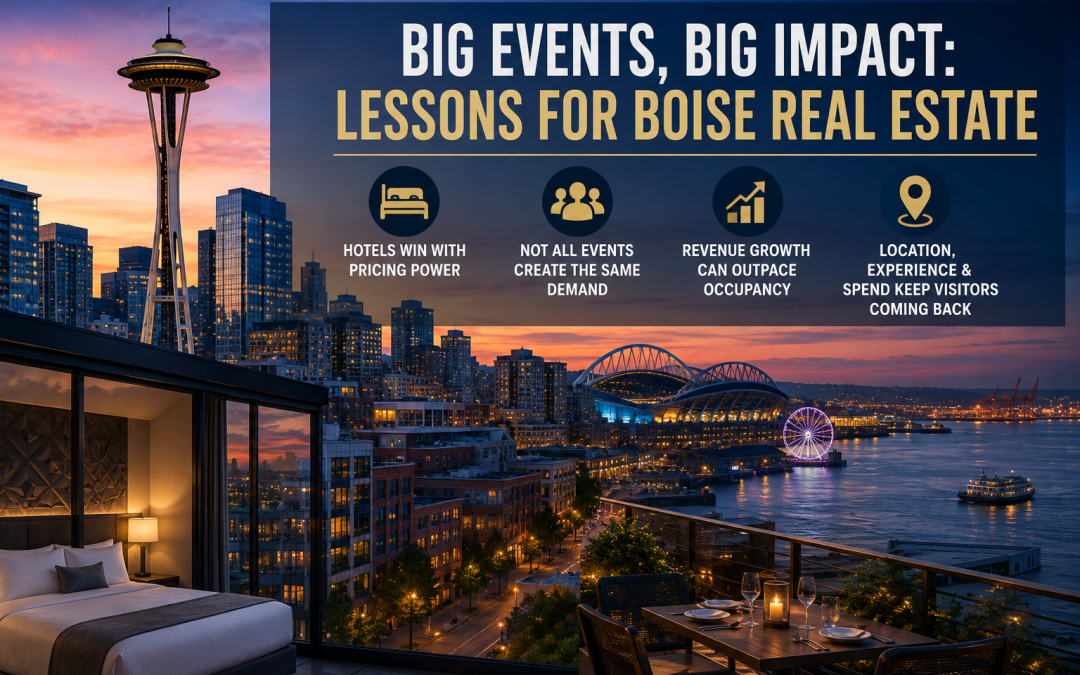
Big Events Don’t Guarantee Full Hotels: What Seattle’s World Cup Teaches Boise Real Estate
A major event comes to town.
Thousands of visitors arrive.
Hotels fill up, room rates jump, restaurants get busy, and the entire hospitality market wins.
At least, that’s the assumption.
Seattle’s experience during the FIFA World Cup shows the reality can be much more complicated.
According to analysis by Michael Stathokostopoulos of CoStar Analytics, Seattle hotels generated impressive revenue gains around some World Cup matches, but those gains depended heavily on the teams playing, the type of hotel, and how much operators could increase room rates.
You can read the original CoStar News analysis.
For Boise commercial real estate, there is a useful lesson here: attracting major events can create significant economic activity, but the value doesn’t necessarily come from filling every available hotel room.
Sometimes the biggest opportunity is simply having enough demand to charge more for the rooms, restaurants, venues and experiences people already want.
Seattle’s Hotels Won With Price More Than Occupancy
Seattle’s strongest World Cup hotel performance came around the Australia-United States match.
Luxury and upper-upscale hotels more than doubled revenue per available room the day before the match and recorded a 96% increase on game day, according to CoStar.
Other hotel categories benefited too.
Upscale and upper-midscale hotels generated revenue-per-available-room gains of 59% and 51%, while midscale and economy hotels increased by roughly one-third.
Those numbers sound like a massive surge in hotel occupancy.
That wasn’t really what happened.
Occupancy increased just 13% the day before the match and 7% on game day.
The real story was room pricing.
Average daily rates increased 78% the day before the match and 83% on game day.
In other words, Seattle hotels didn’t necessarily win because dramatically more rooms were occupied.
They won because guests were willing to pay much more for them.
That’s an important distinction for anyone evaluating hospitality real estate.
Not every event created the same demand
The World Cup also demonstrated how difficult it can be to predict event-driven demand.
Some matches produced strong hotel results.
Others didn’t.
Seattle’s Belgium-Senegal match helped luxury and upper-upscale hotels generate a 33% increase in revenue per available room the day before the game and 25% on game day.
The United States-Belgium Round of 32 match produced approximately 35% gains for those hotels both the day before and the day of the game.
But several other matches delivered much weaker results.
The Bosnia and Herzegovina-Qatar matchup resulted in declining revenue per available room across hotel categories during the surrounding three-day period.
Other games produced mixed results, particularly after visiting fans left town.
That shows how event demand can depend on far more than attendance.
Which teams are playing?
How far are their fans traveling?
How long will visitors stay?
How much money are they willing to spend?
Are visitors flying in or driving?
Do they already have friends or family nearby?
Are they combining the event with a vacation?
Those details can dramatically change the economic impact.
Why This Matters for Boise Hospitality and Commercial Real Estate
Boise isn’t hosting the World Cup.
But the lesson applies directly to the Treasure Valley.
Boise continues attracting sporting events, concerts, conventions, business gatherings, youth tournaments, university events, weddings and other activities that bring visitors into the market.
Each event creates potential demand for more than hotel rooms.
Visitors eat.
They shop.
They use transportation.
They visit bars and breweries.
They attend entertainment venues.
They purchase services.
They sometimes extend their trips.
That means event-driven tourism can support Boise commercial real estate across several property types.
Hotels are the most obvious beneficiaries.
But restaurants, retail centers, entertainment businesses, event venues and mixed-use developments can also capture spending.
The key is understanding that visitor volume alone doesn’t tell the whole story.
Visitor quality and spending behavior matter too.
A three-day corporate conference with attendees staying in full-service downtown hotels may generate a very different commercial impact than a one-day regional sporting event where most visitors drive home afterward.
Both events can be successful.
They simply affect commercial real estate differently.
Downtown Boise Could Capture an Outsized Share
Seattle’s results also reinforce the value of having hotels near the places visitors actually want to be.
This is particularly relevant for Downtown Boise commercial real estate.
Downtown Boise combines hotels, restaurants, nightlife, entertainment, parks, offices and event facilities within a relatively compact area.
That creates opportunities for visitor spending to spread between properties.
Someone attending an event downtown may stay at a nearby hotel, get coffee the next morning, eat at a restaurant, visit a bar after the event and shop before leaving.
The same visitor can generate revenue for multiple businesses during one trip.
That is one reason walkable commercial districts can perform differently from isolated properties.
Each business becomes part of a larger ecosystem.
A hotel creates customers for restaurants.
Restaurants make the hotel location more attractive.
Entertainment generates evening traffic.
Public spaces encourage people to stay longer.
Retail captures additional spending.
The stronger the overall destination becomes, the more valuable individual commercial properties within it can become.
Pricing Power May Matter More Than Simply Filling Rooms
Seattle’s experience also provides an important lesson for hotel investors.
Occupancy gets a lot of attention because it is easy to understand.
A full hotel sounds successful.
But a full hotel at the wrong room rate can leave money on the table.
Imagine two similar hotels.
One is 95% occupied at $175 per night.
Another is 85% occupied at $275.
The second hotel could potentially generate substantially more room revenue despite having more empty rooms.
That is why average daily rate and revenue per available room are so important when evaluating hotel performance.
Seattle’s World Cup numbers demonstrate this clearly.
Luxury hotels were especially successful because they had the ability to raise rates dramatically around high-demand matches.
That pricing power becomes valuable because hotel inventory is fixed in the short term.
A hotel cannot suddenly build another 100 rooms because a major event arrives next weekend.
When demand exceeds available desirable rooms, pricing can rise quickly.
For Boise hospitality investors, that means the quality and positioning of a property can be just as important as the number of rooms.
Big Events Can Benefit More Than Hotel Owners
There is also a broader Boise development implication.
Cities often evaluate major events based on attendance.
Commercial real estate investors should look at something broader:
How much additional economic activity does the event create around the venue?
A successful event district should encourage visitors to arrive early and leave late.
Ideally, they spend money before and after the event.
That makes surrounding commercial uses important.
Restaurants and bars can benefit from pre-event and post-event traffic.
Hotels capture overnight visitors.
Entertainment concepts can extend stays.
Retailers can capture incidental spending.
Parking facilities generate revenue.
Event venues themselves can become anchors for surrounding development.
This is why the relationship between venues and nearby commercial real estate matters.
A stadium surrounded entirely by parking lots may generate enormous attendance but limited spillover spending.
A venue integrated into a walkable district with hotels, restaurants, bars and entertainment can potentially distribute that spending across many properties.
That is worth considering as Boise and the Treasure Valley continue investing in entertainment, sports and gathering spaces.
Local Insight: Boise Should Focus on Events That Create Overnight Stays
For Boise, I think the Seattle numbers point toward a particularly important strategy.
Not all visitors have equal economic impact.
A visitor who drives into Boise at 4 p.m., attends an event and drives home at 10 p.m. can certainly spend money.
But someone who stays two nights can spend much more.
That visitor needs lodging.
They may eat six meals.
They may shop.
They might visit an attraction.
They could explore Downtown Boise, Garden City, Meridian or another part of the Treasure Valley.
They may even decide to return.
That means events capable of generating overnight stays can have an outsized impact on commercial real estate.
Youth sports tournaments are one example.
Multi-day conferences are another.
Large weddings and family gatherings matter.
University events matter.
Concerts can matter when performers have enough regional drawing power.
And multi-day festivals can create significant hospitality demand.
For economic development groups and tourism organizations, the goal shouldn’t simply be increasing visitor counts.
It should also be increasing visitor nights and visitor spending.
Those metrics ultimately matter more to commercial property performance.
There is a development lesson too
I also think Boise developers should pay attention to how hospitality connects with entertainment and mixed-use development.
Hotels don’t have to operate as isolated buildings.
A well-positioned hotel can support surrounding restaurants, retail and entertainment.
Those businesses, in turn, make the hotel more attractive.
This creates a reinforcing cycle.
For developers considering mixed-use projects, hospitality can sometimes serve as another demand generator alongside residential and office uses.
For landlords involved in retail leasing in Boise, visitor traffic can expand the customer base beyond the immediate residential trade area.
For restaurant operators, proximity to hotels and event venues can create additional dayparts and customer segments.
For investors, properties located where visitor spending concentrates may have revenue opportunities that traditional demographic reports don’t fully capture.
Boise’s Opportunity Is Bigger Than Tourism
Seattle’s World Cup experience ultimately demonstrates something important about event-driven commercial real estate.
The biggest event does not automatically produce the biggest economic return.
The strongest results come when the right visitors arrive, stay nearby and are willing to spend.
That is particularly relevant as Boise continues evolving from a primarily regional city into a destination attracting more business travelers, tourists, sporting events and entertainment.
For Boise commercial real estate, the opportunity is not simply building more hotels.
It is creating places where visitors have multiple reasons to stay, spend and return.
That means connecting hospitality with restaurants.
Connecting events with entertainment.
Connecting hotels with walkable districts.
And creating commercial environments where one visitor can support several businesses during the same trip.
Seattle showed that even an event as enormous as the World Cup can produce uneven results.
But it also showed what happens when hotels have something extremely valuable:
pricing power at exactly the moment demand peaks.
For Boise hotel owners, developers and commercial real estate investors, that may be the more important lesson.
Mike Gioioso (joy-OH-so) has for 16+ years been helping companies of all sizes buy, build, and lease perfect places for business in greater Boise, Idaho and beyond.
www.streetsmartidaho.com mike@streetsmartidaho.com 208-209-9166
Tags: #boisecommercialrealestate, #boisehotels, #boisehospitalityrealestate, #downtownboisecommercialrealestate, #boisetourism, #boisedevelopment, #boiseinvestmentproperty, #treasurevalleycommercialrealestate, #idahocommercialrealestate, #hotelinvestmentboise, #retailleasingboise, #boiserestaurants, #downtownboisedevelopment, #boiseevents, #eventdrivendevelopment