
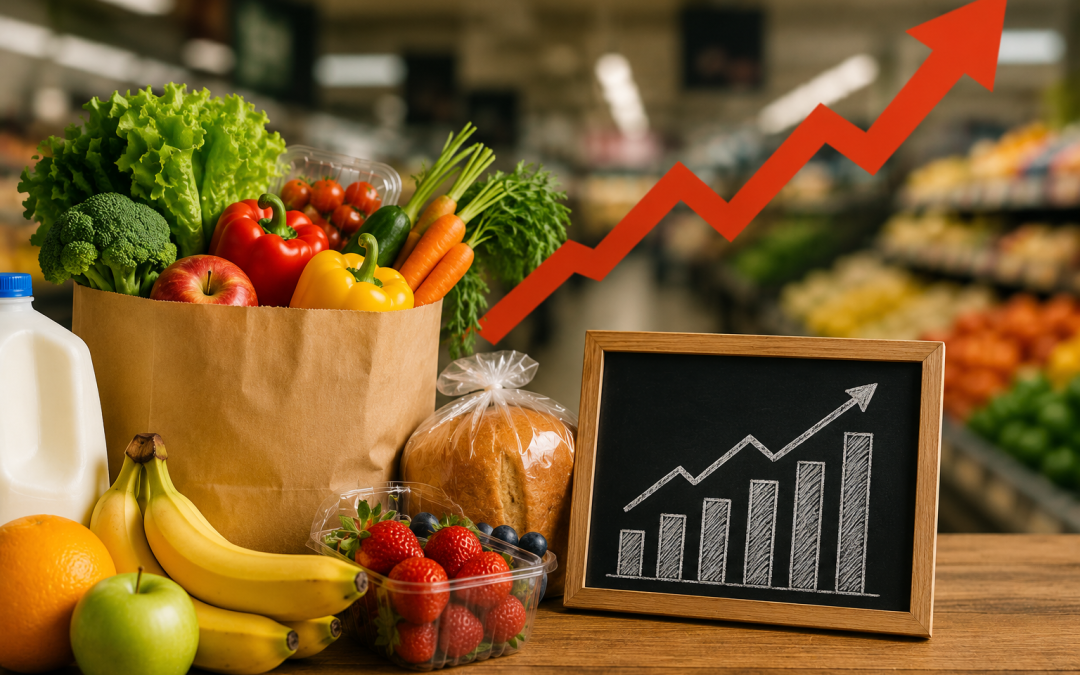
Rising Grocery Costs Could Reshape Boise Retail Real Estate and Consumer Spending
Idaho households are feeling more pressure at the grocery store, and the impact may reach well beyond the supermarket checkout line.
A recent consumer survey found that Idaho respondents reported one of the largest increases in spending on fresh produce in the country. For Boise commercial real estate, the bigger question is what happens when households have to devote more of their monthly budget to necessities.
According to reporting by IBR Staff in the Idaho Business Review, Idaho consumers surveyed said their fruit and vegetable spending had risen by about $52 per month. The findings were based on a national Advance America consumer survey and USDA price projections, rather than direct comparisons of grocery-store shelf prices.
You can read the original Idaho Business Review article for the full survey findings.
From a commercial real estate perspective, this is less about the price of lettuce or apples and more about consumer purchasing power.
Grocery Inflation Can Spill Into Retail Leasing
Idaho respondents reported spending approximately $52 more each month on produce, or about $624 annually. The survey estimated that as a 20% increase.
Only North Dakota reported a larger dollar increase.
At the national level, consumers also reported changing what they buy. About 34% said they were purchasing less fresh produce per shopping trip. Other respondents said they were buying more frozen or canned foods, while nearly half reported eating more processed food as a way to reduce costs.
Those changes matter for retail leasing in Boise because every additional dollar spent on necessities is a dollar that can’t be spent somewhere else.
Consider a household dealing with higher costs for groceries, insurance, utilities, housing, and transportation at the same time. That household may still go out to eat, shop, or pay for entertainment—but it may become much more selective.
That can affect discretionary businesses such as restaurants, boutiques, entertainment concepts, personal services, fitness operators, and other retailers competing for household income.
For Boise landlords, watching consumer expenses can therefore be just as important as watching vacancy and asking rents.
Value Could Become an Even Bigger Retail Advantage
The survey points to another trend that could affect the types of retailers expanding in the Treasure Valley.
Consumers aren’t necessarily eliminating purchases. They’re changing how they spend.
When budgets get tight, value becomes more important.
For grocery retailers, that can favor discount concepts, private-label products, bulk purchasing, frozen foods, and stores built around lower prices. Similar behavior can spread into other retail categories.
Restaurants may see consumers trade down from higher-priced meals to fast casual or quick service. Shoppers may become more responsive to promotions. Discount stores and off-price retailers can become more attractive.
This matters when evaluating Boise retail real estate.
A shopping center filled with businesses dependent on high levels of discretionary spending may react differently to inflation than a center anchored by grocery, medical, service, or value-oriented tenants.
That doesn’t mean higher-end concepts suddenly stop working. The Boise metro continues to attract households with different income levels and spending habits.
It does mean tenant mix matters.
For investors buying shopping centers in Boise, Meridian, Eagle, Nampa, Caldwell, Kuna, or Star, understanding who ultimately pays the tenants’ bills—the consumer—is critical.
Boise’s Growth Doesn’t Make It Immune to Affordability Pressure
The Treasure Valley has experienced significant population and development growth, creating opportunities for new grocery stores, restaurants, shopping centers, and neighborhood retail projects.
But population growth alone doesn’t guarantee strong retail sales.
Household purchasing power matters too.
The USDA’s June 2026 outlook cited in the survey projected fresh vegetable prices to rise 7.7% during the year, while fresh fruit prices were projected to increase 2%.
Meanwhile, more than half of national survey respondents said they believed their diets were less healthy than they had been a few years earlier. Twenty-eight percent said eating healthy was becoming financially difficult.
For Boise development, those numbers are worth watching because grocery stores often serve as anchors for new residential growth.
A grocery-anchored project can generate frequent customer trips that support neighboring restaurants, coffee shops, salons, fitness concepts, medical users, and service businesses.
If grocery shopping patterns change, some of those traffic patterns can change with them.
That makes grocery performance an important piece of the larger Treasure Valley retail picture.
Local Insight: Watch the Consumer, Not Just the Construction
Driving around the Boise metro, it’s easy to focus on what’s being built.
New rooftops. New shopping centers. New restaurants. New grocery stores.
But commercial real estate demand ultimately depends on the businesses occupying those buildings—and those businesses depend on customers.
That’s why consumer affordability deserves more attention in Boise commercial real estate.
A growing population can support additional retail square footage, but developers still need the right tenant mix, price points, demographics, visibility, access, and occupancy costs.
For landlords, this may also be a good time to pay attention to tenants’ sales performance rather than relying exclusively on market rent comparisons.
A restaurant paying a high rent isn’t necessarily a stronger tenant than one paying a sustainable rent and generating consistent sales.
The same applies to investors. When evaluating a retail property, I would want to know more than the cap rate and lease expiration dates. I’d also want to understand whether the tenant mix fits how consumers are actually spending money.
What This Means for Boise Commercial Real Estate
Idaho’s reported increase in produce spending is a small piece of a much larger economic picture, but it provides a useful reminder.
Consumers are the foundation of retail real estate.
If basic household expenses keep climbing faster than incomes, some discretionary retailers could face greater pressure. At the same time, grocery, discount, service, medical, and value-oriented concepts could become even more important parts of successful shopping centers.
For Boise landlords and developers, that means thinking carefully about tenant mix and keeping occupancy costs realistic.
For retailers considering expansion, it means understanding the income and spending habits around each potential location rather than assuming Treasure Valley population growth will lift every concept equally.
And for investors, it means looking beyond today’s rent roll to determine whether a property’s tenants are positioned for the way tomorrow’s consumers may actually spend.
Mike Gioioso (joy-OH-so) has for 16+ years been helping companies of all sizes buy, build, and lease perfect places for business in greater Boise, Idaho and beyond.
www.streetsmartidaho.com mike@streetsmartidaho.com 208-209-9166
Tags: #boisecommercialrealestate, #boiseretailrealestate, #retailleasingboise, #boisedevelopment, #idahocommercialrealestate, #treasurevalleyretail, #groceryanchoredretail, #boiseinvestmentproperty, #meridiancommercialrealestate, #nampacommercialrealestate, #consumerspending, #groceryinflation, #retaildevelopment, #idahoeconomy, #boiseshoppingcenters