
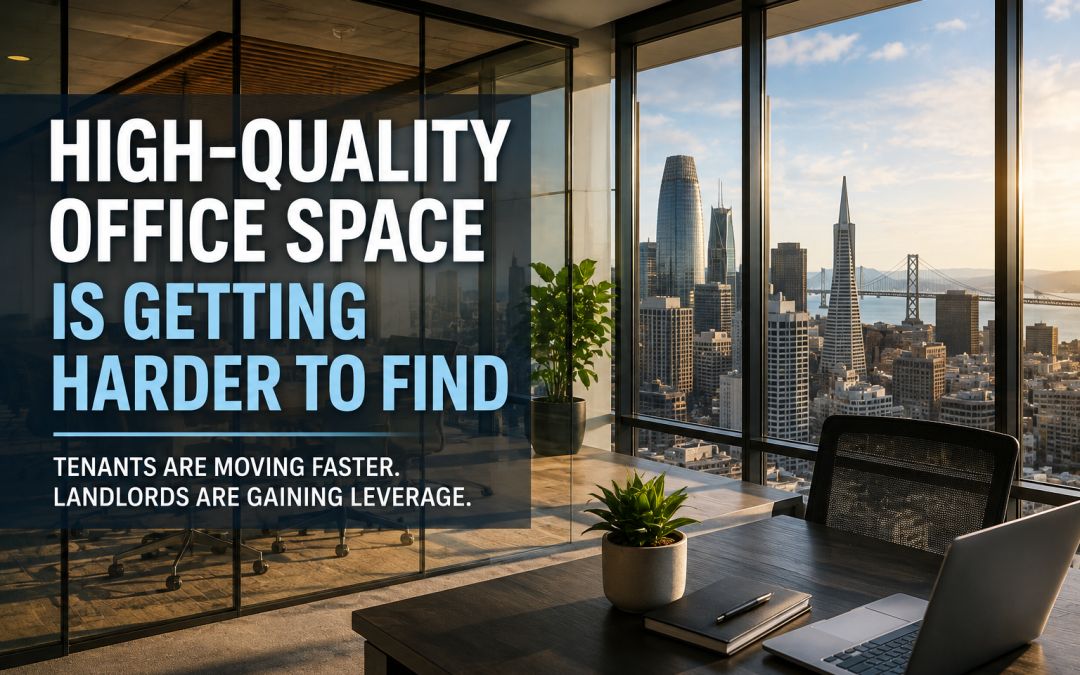
The Office Market May Be Turning — What Boise Tenants and Landlords Should Watch
For several years, office tenants had a powerful advantage: time.
Companies could tour multiple buildings, negotiate large improvement packages, ask for months of free rent, and often wait without worrying that another tenant would take their favorite space.
That dynamic may finally be starting to change in some West Coast markets.
According to reporting by Katie Burke of CoStar News, Kilroy Realty is seeing stronger leasing, higher rents, and more urgency from companies competing for premium office space. The trend is especially visible in San Francisco, but it offers an important lesson for Boise commercial real estate: a market can still have significant vacancy while the best space becomes increasingly difficult to find.
You can read the original CoStar News article for the complete reporting and market data.
The Boise office market isn’t San Francisco. But the underlying trend is worth paying attention to.
The Office Recovery Is Becoming a Quality Story
Kilroy Realty reported nearly 945,000 square feet of leasing activity since the beginning of 2026, roughly 40% more than during the comparable period last year.
The landlord also reported rents increasing by more than 20%.
Perhaps even more telling is what’s coming next. Kilroy has more than 1 million square feet of signed leases that have not yet started, according to CoStar’s reporting.
Those numbers point toward a shift in tenant behavior.
Companies that spent the past several years delaying decisions are beginning to compete for desirable offices. In San Francisco, direct availability and sublease options are declining, particularly at the upper end of the market.
Large tenants face an even tighter situation.
According to Kilroy’s management, roughly 20 premium options remained for companies seeking approximately 100,000 contiguous square feet, while more than 25 tenants were looking for blocks around that size.
That’s simple supply and demand.
Once multiple tenants want the same limited group of buildings, landlords gain negotiating power.
And that may be one of the most important trends to watch in Boise office leasing.
A market’s headline vacancy rate doesn’t necessarily tell you how many spaces actually meet a particular tenant’s needs.
Tenants Could Lose Some of Their Negotiating Leverage
The office downturn wasn’t only about falling rents.
Concessions became a major part of lease negotiations.
Landlords trying to attract tenants offered free rent, larger tenant-improvement allowances, flexible lease structures, and other incentives.
CoStar reported that Kilroy has recently been able to reduce some of those concessions as competition for desirable offices increases.
That matters because effective rent can change well before asking rents make a dramatic move.
Imagine two landlords both asking roughly the same rent.
One offers a large improvement allowance and significant free rent. The other offers substantially less.
Those deals may look similar on a listing sheet but have very different economics.
That’s why landlords and tenants in Boise commercial real estate should pay attention to more than advertised rental rates.
Watch concessions.
Watch tenant-improvement packages.
Watch free-rent periods.
Watch how quickly good spaces are leasing.
Those can provide early clues that negotiating leverage is shifting.
What This Could Mean for Boise Office Space
Boise has its own office-market challenges, and a San Francisco recovery shouldn’t be treated as proof that every office market is suddenly booming.
But there is an important parallel.
Not all vacant office space competes equally.
A tenant looking for modern space with good parking, strong visibility, efficient floor plans, updated finishes, nearby restaurants, and an attractive location may have far fewer choices than the overall vacancy rate suggests.
The same becomes true for larger tenants.
Finding 2,000 square feet of office space is one challenge.
Finding 30,000 or 50,000 square feet that meets a company’s exact requirements is another.
As companies become more confident about their long-term workplace strategies, some may also be willing to sign larger leases rather than maintaining temporary or undersized footprints.
If that happens, Boise’s best office buildings could tighten well before older or less competitive properties see a meaningful recovery.
That creates the possibility of a two-speed office market.
High-quality buildings could experience stronger leasing, better rents, and fewer concessions while older properties continue struggling with vacancy.
The Flight to Quality Can Eventually Spread
There is another reason Boise landlords should watch what’s happening in larger markets.
Premium buildings don’t have unlimited capacity.
When the best properties fill, tenants eventually have to consider the next tier.
That appears to be part of the expectation in San Francisco. As premium options disappear, competition may gradually move into other buildings.
Boise could eventually experience something similar.
The first stage of recovery doesn’t necessarily mean every office building improves simultaneously.
Instead, it might look something like this:
Premium buildings tighten first.
Recently renovated properties benefit next.
Well-located Class B buildings become attractive alternatives.
Then landlords of more challenged properties have to decide whether renovations can make their buildings competitive.
That last point could create opportunities for Boise office investment.
An older office property isn’t automatically obsolete. A building with good bones, strong parking, the right location, and a realistic acquisition basis may be repositioned to compete for tenants priced out of premium space.
But owners need to understand what today’s tenants actually value.
Simply replacing carpet and paint may not be enough.
Local Insight: Don’t Let the Vacancy Rate Fool You
One of the biggest mistakes in commercial real estate is assuming that a high vacancy rate automatically means tenants can wait indefinitely.
Tenants don’t choose from the entire market.
They choose from the small group of spaces that actually work for them.
A company may need a specific location, parking ratio, floor plate, signage opportunity, building quality, lease term, budget, and move-in date.
Once you apply all those filters, dozens of available spaces can quickly become three or four realistic choices.
That’s why I think the Kilroy numbers are worth watching from Boise.
If a company finds an office that checks nearly every box, waiting six months to negotiate may not always be the smartest strategy.
For landlords, the lesson is different.
Quality matters.
Owners who reinvest in their properties may be better positioned to capture the first wave of improving demand. That could mean updated common areas, better amenities, modern conference facilities, improved outdoor spaces, stronger technology infrastructure, or ready-to-occupy suites.
The goal isn’t necessarily to make every building Class A.
It’s to give tenants a clear reason to choose your property.
Boise’s Office Recovery May Happen Building by Building
Nationally, there are additional signs that the office market is stabilizing.
CoStar reported that net absorption for premium office properties has been improving, meaning tenants are occupying more space than they’re giving back. National vacancy for this segment has also moved below 14% after remaining elevated for years.
That doesn’t erase the structural changes caused by remote and hybrid work.
Instead, it may show that companies are becoming clearer about what kind of office space they want.
That distinction matters.
The future office market may not be about returning to the way companies used space before 2020. It may be about companies committing to better space that employees actually want to use.
For Boise commercial real estate, that could favor buildings with strong locations, parking, amenities, natural light, efficient layouts, and nearby restaurants and services.
It could also create redevelopment and repositioning opportunities for landlords willing to invest.
Boise’s office recovery probably won’t arrive everywhere at once.
It may happen one building, one submarket, and one tenant at a time.
And if the West Coast trend continues, tenants who wait until everyone agrees the market has recovered may discover that the best opportunities have already been leased.
Mike Gioioso (joy-OH-so) has for 16+ years been helping companies of all sizes buy, build, and lease perfect places for business in greater Boise, Idaho and beyond.
www.streetsmartidaho.com mike@streetsmartidaho.com 208-209-9166
Tags: #boisecommercialrealestate, #boiseofficespace, #boiseofficeleasing, #boisedevelopment, #boiseinvestmentproperty, #idahocommercialrealestate, #treasurevalleycommercialrealestate, #officemarketrecovery, #officeinvestment, #classaoffice, #commercialleasingboise, #meridianofficespace, #tenantimprovements, #officevacancy, #commercialrealestateinvestment