
Why Medical Office Real Estate Keeps Getting Investor Attention — and What Boise Can Learn
Traditional office real estate continues to face questions in many markets. Medical office buildings are telling a different story.
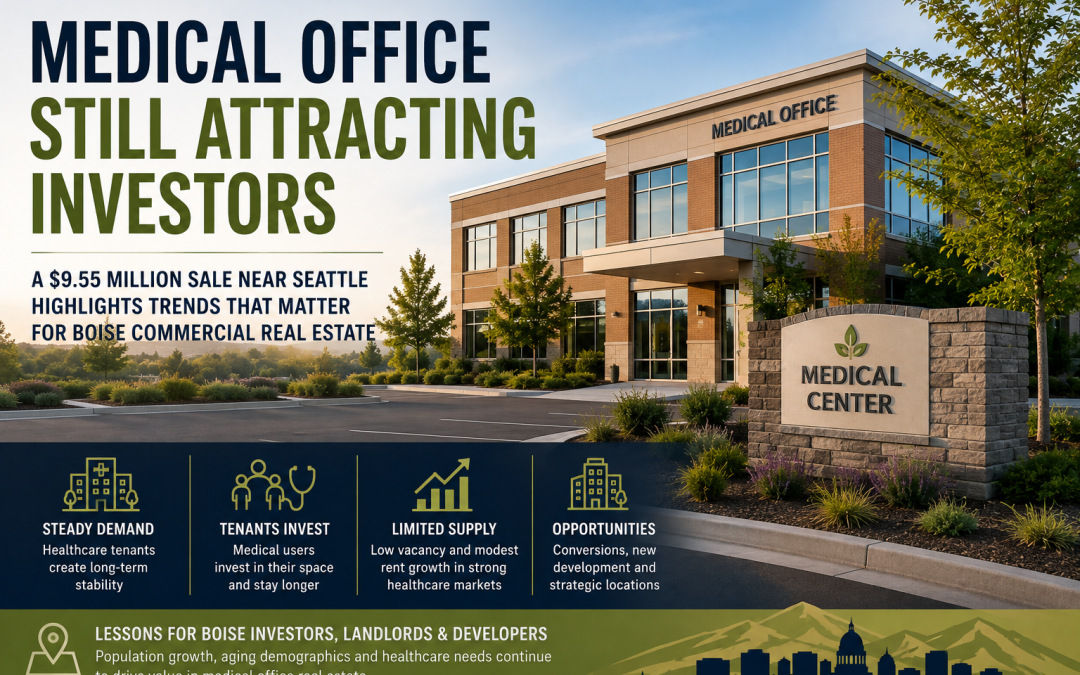
A recent $9.55 million medical office sale near Seattle provides a useful example. Despite the property having some deferred maintenance and spending months on the market, an investor ultimately stepped in at roughly $446 per square foot.
For Boise commercial real estate investors, the transaction highlights why healthcare properties can behave differently from conventional offices—and why medical real estate deserves attention as the Treasure Valley grows.
According to reporting by Chuck Larocco with CoStar AI and CoStar Research, a private investor purchased the Schmidt Medical Center in Mill Creek, Washington, from Azose Commercial Properties. The original CoStar News article provides additional details on the transaction.
Medical Office Is Playing by Different Rules
The Schmidt Medical Center is a 21,433-square-foot, two-story medical office building located at 1025 153rd St. SE in Mill Creek.
Built in 2000, the property sits on approximately 2.7 acres. CoStar reported that Mill Creek Family Practice occupies 10,716 square feet, representing roughly half of the building.
The property was initially marketed at $10.4 million before selling for $9.55 million after approximately 220 days on the market.
That works out to about $446 per square foot.
The roughly $850,000 difference between asking and sale price represents a discount of just over 8% from the original asking price.
What makes the transaction more interesting is that the property reportedly had deferred maintenance considerations.
Investors weren’t simply buying a perfect building with no future capital needs. Someone was willing to accept the physical condition of the asset because the location, tenancy and medical-office fundamentals were compelling enough to make the investment work.
That’s an important distinction.
Medical office buildings aren’t valued solely on bricks and mortar. The stability of the tenant base and difficulty of replacing specialized locations can significantly influence investor demand.
Why Healthcare Tenants Can Create Durable Real Estate Value
Medical tenants tend to use space differently from conventional office tenants.
A general office company can often move from one building to another without dramatically changing its business. Moving a medical practice can be much more complicated.
Practices may invest heavily in plumbing, electrical systems, exam rooms, imaging equipment, specialized treatment areas and patient infrastructure. Physicians also build referral networks and patient familiarity around their locations.
Once those investments are made, moving can become expensive and disruptive.
That can translate into longer occupancy periods.
CoStar’s market analysis pointed to this dynamic in Mill Creek, where healthcare vacancy has remained in the low single digits. The submarket has also continued to experience some rent growth despite greater challenges facing portions of the Seattle-area traditional office market.
For investors, that’s an attractive combination:
- Limited available medical space
- Tenants with significant investments in their locations
- Potentially longer occupancy periods
- Continued healthcare demand
- More defensive cash flow than some traditional office properties
None of this means every medical office building is automatically a strong investment.
Lease expiration dates, tenant credit, building condition, reimbursement trends, location and future capital requirements still matter.
But the basic demand drivers can be quite different from those affecting a conventional office building.
What This Could Mean for Boise Medical Office Real Estate
This is where the Seattle-area transaction becomes relevant to Boise commercial real estate.
The Treasure Valley continues to add residents, and population growth eventually creates greater demand for healthcare.
More residents need primary care doctors, dentists, physical therapists, specialists, imaging facilities, urgent care, rehabilitation services and other medical providers.
Those businesses need real estate.
Boise also has established healthcare anchors that help create clusters of medical activity. Areas surrounding major hospital campuses can attract physicians and complementary providers because proximity can improve referrals and convenience for patients.
Similar opportunities are developing throughout Meridian, Nampa and other growing Treasure Valley communities.
Healthcare follows rooftops.
As residential development pushes farther into the Treasure Valley, medical providers eventually have to follow their patients.
That can create opportunities for developers who identify underserved areas before medical-office supply catches up.
Medical Office Can Also Create Opportunities for Older Properties
Not every new medical tenant needs a purpose-built building.
Some retail and office properties can potentially be converted for healthcare use.
This creates another interesting opportunity within Boise development and leasing.
A traditional office property struggling to attract conventional users might perform differently if it can accommodate medical tenants.
Likewise, certain retail spaces can work well for healthcare businesses because they already offer visibility, convenient access and surface parking.
But conversion isn’t always simple.
Medical users may require more plumbing, additional power, stronger HVAC systems, different parking ratios and substantial tenant improvements.
That’s why landlords should evaluate the economics before assuming that “medical” automatically solves a vacancy problem.
A $35-per-square-foot office conversion is very different from a medical buildout requiring significantly more capital.
The lease structure has to justify the investment.
Local Insight: Follow Healthcare Growth Across the Treasure Valley
From my perspective, medical office is one of the more interesting segments to watch in Boise commercial real estate.
The reason isn’t complicated.
People can work remotely. They can’t receive every medical service remotely.
Healthcare still depends heavily on physical locations.
And as the Treasure Valley population expands geographically, providers need locations that are convenient to patients.
That makes me particularly interested in commercial sites near growing residential areas, major transportation corridors and established healthcare campuses.
For investors, I would also pay close attention to replacement cost.
If construction costs make it increasingly expensive to build new medical office space, well-located existing buildings can become more valuable—especially when they already contain expensive medical improvements.
The Mill Creek transaction illustrates another important lesson: don’t ignore capital expenditures.
The Washington property reportedly had deferred maintenance, yet it still attracted an investor at approximately $446 per square foot.
That doesn’t mean maintenance doesn’t matter. It means investors will sometimes accept physical-property challenges when the income stream and underlying market fundamentals are strong enough.
Boise investors should approach medical properties the same way.
Look beyond the headline cap rate.
Understand the HVAC systems. Inspect the roof. Review tenant improvements. Study lease expirations. Determine who owns specialized equipment and improvements. Understand exactly what happens if a major medical tenant leaves.
The stability can be attractive, but the cost of re-tenanting specialized medical space can also be significant.
Medical Real Estate Offers a Useful Contrast to Traditional Office
The broader office market has changed dramatically over the past several years.
Medical office reminds us that “office” isn’t one single asset class.
A downtown corporate office tower and a suburban medical building may both contain offices, but their demand drivers can be completely different.
Healthcare space is tied more closely to population, patient demand, demographics and access to medical services.
That distinction could become increasingly important for Boise commercial real estate investors.
As Treasure Valley growth continues, medical-office demand should be watched alongside residential construction, demographic changes and expansion by major healthcare providers.
The $9.55 million Mill Creek transaction happened hundreds of miles from Boise.
But the investment logic behind it is highly relevant here.
When medical vacancy stays tight, tenants remain in place and replacement space is difficult or expensive to create, investors may be willing to pay a premium for dependable healthcare real estate.
That’s a trend worth watching in Boise.
Mike Gioioso (joy-OH-so) has for 16+ years been helping companies of all sizes buy, build, and lease perfect places for business in greater Boise, Idaho and beyond.
www.streetsmartidaho.com mike@streetsmartidaho.com 208-209-9166
Tags: #boisecommercialrealestate, #boisemedicaloffice, #medicalofficeinvestment, #boisehealthcarerealestate, #boisedevelopment, #idahocommercialrealestate, #treasurevalleycommercialrealestate, #medicalofficebuildings, #boiseinvestmentproperty, #healthcarerealestate, #meridiancommercialrealestate, #nampacommercialrealestate, #officeinvestment, #commercialrealestateinvestment, #medicalofficedevelopment