
Idaho’s Nuclear Campus Bid Could Reshape the State’s Commercial Real Estate Landscape
Idaho could be competing for one of the largest economic development opportunities the state has seen in years—and the impact could stretch far beyond the nuclear energy industry.
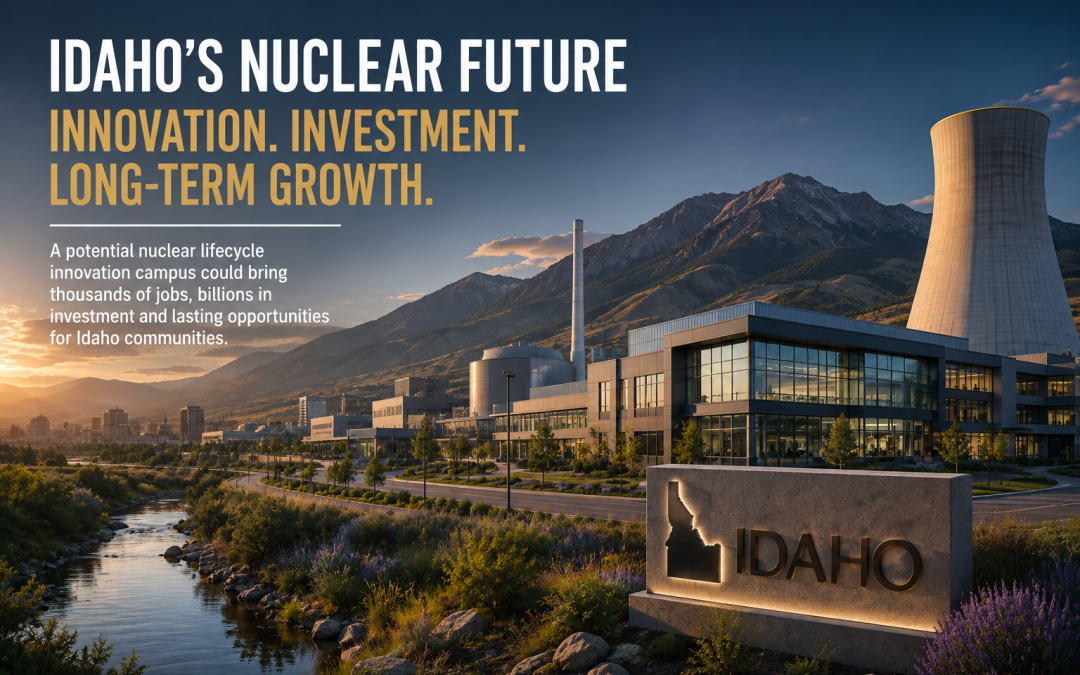
The state has advanced to the final round of consideration for a new federal Nuclear Lifecycle Innovation Campus. If Idaho ultimately lands the project, the potential combination of capital investment, high-paying jobs, infrastructure spending and new business activity could create significant ripple effects for Idaho commercial real estate.
According to reporting by IBR Staff in the Idaho Business Review, the U.S. Department of Energy selected Idaho along with Utah, Tennessee, Oklahoma and Louisiana from an initial field representing 26 states. The federal government is evaluating the five locations as potential hosts for a campus designed to expand America’s domestic nuclear fuel capabilities.
Read the original Idaho Business Review article for its coverage of the announcement.
For those of us watching Boise development, industrial real estate and investment property, the numbers attached to this initiative make it worth paying attention to.
The Scale of the Opportunity Is the Bigger Story
The proposed campuses aren’t simply research facilities.
According to the Idaho Business Review’s summary of information released by the Department of Energy, an innovation campus could potentially attract up to $50 billion in capital investment, support roughly 25,000 jobs, and generate as much as $10 billion in state and local tax revenue.
Those figures represent the potential scale of the federal initiative rather than a guarantee of what Idaho would receive if selected. Still, they show why the competition matters.
The proposed campus model could include several stages of the nuclear fuel lifecycle, including fuel manufacturing, enrichment, recycling of used nuclear material and its eventual disposition.
Idaho enters the competition with an important advantage: an existing nuclear research ecosystem.
The state has spent decades developing expertise and infrastructure around nuclear energy, much of it connected to Idaho National Laboratory.
INL Director John Wagner said Idaho’s selection provides an opportunity to build on the state’s existing infrastructure, technical knowledge and industry partnerships as the Department of Energy determines where to move forward.
Governor Brad Little also pointed to Idaho’s long history in nuclear research and development when responding to the state’s selection.
The competition remains substantial. The Department of Energy reportedly received 28 applications from 26 states before reducing the field to five finalists.
Why 25,000 Jobs Could Become a Commercial Real Estate Story
For commercial real estate, the most interesting part isn’t necessarily the nuclear facility itself.
It’s everything that could follow it.
A major employment center creates demand throughout an economy. Engineers and technicians need housing. Contractors need warehouse and yard space. Suppliers need industrial buildings. Companies need offices. Workers need restaurants, medical services, childcare, fitness centers and everyday retail.
That means a project of this scale could create opportunities across multiple property types.
Industrial real estate could be one of the biggest beneficiaries. Nuclear and advanced-energy projects depend on complicated supply chains involving equipment, components, fabrication, transportation and specialized contractors.
Those businesses need real estate.
Some may require traditional warehouse space. Others could need heavy industrial facilities, outdoor storage, manufacturing buildings or specialized build-to-suit projects.
The impact can spread well beyond companies directly involved in nuclear technology.
Professional services, engineering firms, construction companies, logistics operators and vendors can all expand alongside a major industry cluster.
That’s where an energy announcement starts becoming a broader Idaho commercial real estate story.
Boise Could Benefit Even If the Campus Isn’t in the Treasure Valley
The location question will be critical.
Idaho’s nuclear industry is strongly associated with eastern Idaho and INL, so investors shouldn’t automatically assume a project like this translates into a massive physical campus in the Boise metro.
But the economic effects don’t necessarily stop at the property line—or even the regional boundary.
Boise is Idaho’s largest business center and home to companies involved in construction, engineering, finance, professional services, technology, real estate and government affairs.
Large investments elsewhere in Idaho can create business opportunities that eventually flow through the Treasure Valley.
That could translate into additional demand for Boise office space, industrial properties, flex buildings and supporting businesses.
There is another factor worth watching: workforce migration.
Thousands of well-paying technical and manufacturing jobs could bring additional workers and families into Idaho. Population growth eventually translates into demand for housing and consumer services.
And consumer growth drives commercial development.
More households can support grocery stores, restaurants, medical offices, fitness operators, childcare providers and service businesses. That matters for anyone involved in retail leasing in Boise and other growing Idaho markets.
Energy Infrastructure Is Becoming a Real Estate Issue
This announcement also fits into a much larger commercial real estate trend.
Access to reliable electricity is becoming increasingly important in site selection.
Data centers, advanced manufacturing, semiconductor facilities and other technology-intensive projects can require enormous amounts of power. Idaho is already seeing how conversations around energy capacity, transmission and infrastructure can influence development decisions.
Nuclear technology adds another dimension to that discussion.
If Idaho continues building its reputation around advanced energy research and nuclear technology, the state could become more attractive to companies that want proximity to technical expertise, energy infrastructure and a skilled workforce.
That doesn’t mean every industrial site suddenly becomes more valuable.
Location, utilities, zoning, transportation, labor availability and development costs still matter.
But energy availability is becoming something commercial real estate investors and developers need to evaluate much earlier in the site-selection process.
Local Insight: Watch the Suppliers, Not Just the Mega-Project
From a commercial real estate perspective, I would not focus only on whether Idaho wins a giant federal campus.
I’d watch what happens around it.
Large economic development projects often attract an ecosystem of smaller companies.
Those companies can be easier to miss, but they are often the businesses actually signing leases and purchasing commercial buildings.
A major nuclear investment could create demand from:
- Engineering and technical firms
- Construction contractors
- Equipment and component manufacturers
- Logistics and transportation companies
- Industrial service businesses
- Professional and financial services
- Restaurants and retailers
- Medical and healthcare providers
- Housing and multifamily developers
For owners of Boise commercial real estate, that’s the opportunity worth monitoring.
A 25,000-job economic engine doesn’t require every worker or supplier to be located next to the main campus. Business relationships spread across regions, particularly when a state already has a strong commercial center like Boise.
There is also an important reason not to get ahead of the story.
Idaho is a finalist, not the announced winner.
Commercial real estate decisions shouldn’t be based on projected investment or job numbers that may never materialize here.
Instead, investors and developers should watch for the next concrete signals: site selection, federal commitments, infrastructure planning, utility investment, private-sector announcements and supplier expansions.
Those milestones would tell us much more about where actual real estate demand could emerge.
What Boise Investors and Developers Should Watch Next
Idaho making the final five is meaningful by itself. It reinforces the state’s position in the national nuclear energy industry and could bring additional attention from companies operating in advanced manufacturing and energy.
Winning the campus would raise the stakes considerably.
If even a portion of the investment and employment envisioned for these campuses ultimately reaches Idaho, the effects could extend into industrial development, housing, retail, infrastructure and commercial leasing.
For anyone following Boise commercial real estate, Boise development, Idaho industrial real estate or investment property, the key is to follow the second- and third-order effects.
The biggest real estate opportunity may not be the nuclear campus.
It may be the hundreds of businesses, workers and development decisions that could follow it.
Mike Gioioso (joy-OH-so) has for 16+ years been helping companies of all sizes buy, build, and lease perfect places for business in greater Boise, Idaho and beyond.
www.streetsmartidaho.com mike@streetsmartidaho.com 208-209-9166
Tags: #boisecommercialrealestate, #boisedevelopment, #idahocommercialrealestate, #idahonuclearenergy, #idahonationallaboratory, #nuclearenergyidaho, #idahoindustrialrealestate, #boiseindustrialrealestate, #idahoeconomicdevelopment, #advancedmanufacturingidaho, #energyinfrastructureidaho, #boiseinvestmentproperty, #retailleasingboise, #idahodevelopment, #commercialrealestateinvestment