
Spokane’s Top Commercial Property Sales Offer Lessons for Boise Investors
What are commercial real estate buyers actually putting money into right now?
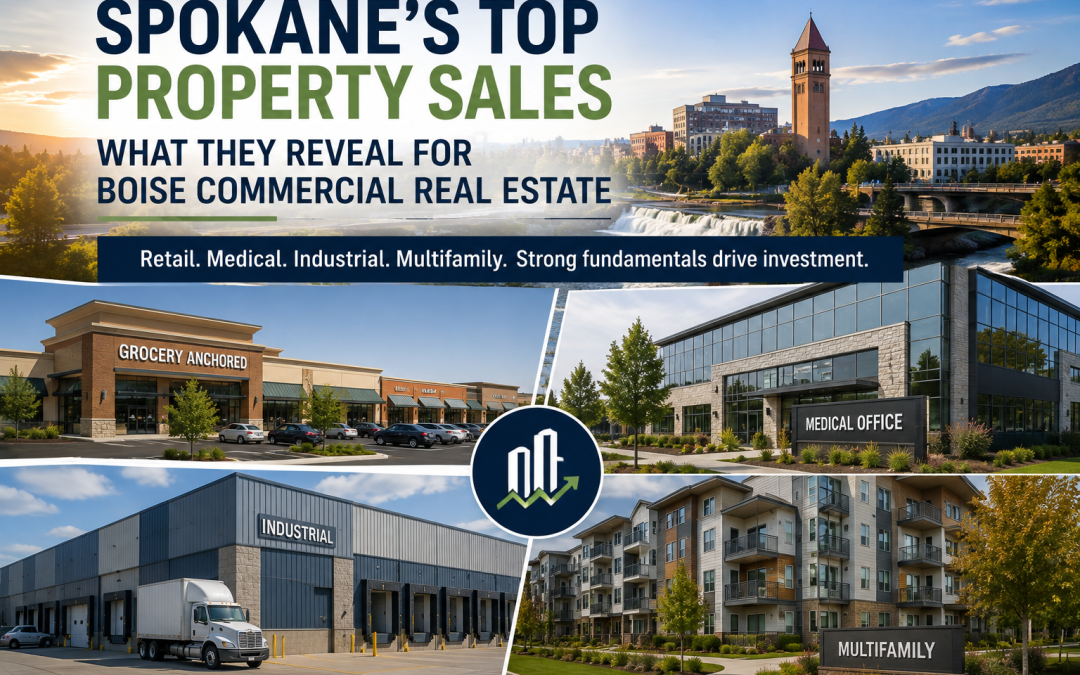
Spokane’s largest property transactions from the second quarter of 2026 provide an interesting answer. Buyers weren’t concentrated in a single asset class. Capital moved into grocery-anchored retail, medical real estate, industrial property and multifamily housing.
For anyone following Boise commercial real estate, that mix is worth studying. Boise and Spokane are different markets, but both serve growing regional economies in the Inland Northwest. Investment activity in Spokane can offer useful clues about what buyers value when they’re underwriting properties in today’s higher-cost capital environment.
According to CoStar Research, five Spokane-area transactions were selected for CoStar’s second-quarter 2026 Power Broker Quarterly Deal Awards. You can review the transactions in the original CoStar News article.
The bigger story isn’t simply which buildings sold. It’s why these types of properties continue attracting capital.
Buyers Are Targeting Real Estate With Durable Demand
The five recognized transactions covered very different property types:
- A roughly 149,845-square-foot retail portfolio anchored by a supermarket.
- A $28.7 million medical office portfolio totaling 72,613 square feet.
- A $11.19 million industrial sale-leaseback involving a 73,500-square-foot building.
- A 30-unit apartment property selling for $5.95 million.
- A 55-unit apartment community trading for about $5.22 million.
On the surface, those deals don’t have much in common.
Look closer, however, and there’s a theme: each is tied to a relatively basic source of real estate demand.
People buy groceries.
Patients need healthcare.
Industrial businesses need facilities.
People need housing.
That’s particularly important when interest rates are elevated and investors have less room for underwriting mistakes.
When financing becomes more expensive, buyers tend to scrutinize income durability, tenant demand and future capital requirements more carefully.
That could favor properties tied to essential or difficult-to-replace uses.
Grocery-Anchored Retail Still Has a Strong Story
One of Spokane’s largest recognized transactions was the sale of a 15-property retail portfolio totaling approximately 149,845 square feet.
The centerpiece was Five Mile Plaza, a shopping center originally developed in 1959 and later renovated. Rosauers supermarket anchors the property. The sale price wasn’t disclosed.
The age of the center is interesting.
Commercial real estate investors aren’t necessarily chasing only new construction. An older shopping center can remain valuable when it has the right location, traffic, tenant mix and anchor.
Grocery stores can be especially important.
Unlike many discretionary retailers, supermarkets generate frequent customer visits. Those trips can support neighboring restaurants, service businesses and smaller retailers.
That’s highly relevant to retail leasing in Boise.
Across Boise, Meridian, Eagle, Nampa and Caldwell, grocery-anchored centers continue to play an important role in neighborhood retail. As rooftops expand outward, well-positioned centers serving everyday needs can become increasingly difficult to replicate.
For investors, the lesson isn’t that every grocery center is automatically a great investment.
Lease structure, anchor performance, co-tenancy provisions, tenant rollover, rents and future capital needs still matter.
But daily-needs retail has a clear demand story.
Medical Real Estate Continues to Attract Capital
Another major Spokane transaction involved a four-building Spokane Eye Clinic portfolio.
The 72,613-square-foot medical property sold for $28.7 million to Nashville-based Montecito Medical Real Estate.
That works out to roughly $395 per square foot based on the reported price and building area.
The portfolio includes specialized clinical improvements and sits near Spokane’s medical district.
This transaction reinforces something we’re also seeing across Boise commercial real estate: healthcare properties can occupy a different investment category than traditional office buildings.
Medical tenants often make substantial investments in their spaces.
Exam rooms, specialized equipment, plumbing, power, medical infrastructure and patient layouts can make relocation more difficult than moving a conventional office user.
That can potentially increase tenant stickiness.
Healthcare also has another advantage: much of it can’t be done remotely.
That’s one reason I continue watching Boise medical office closely.
As the Treasure Valley grows, healthcare demand grows with it. More households create demand for primary care, dentistry, physical therapy, behavioral health, specialists and other outpatient services.
That creates opportunities not just for purpose-built medical buildings but also for office and retail properties capable of accommodating medical uses.
The Industrial Sale-Leaseback Is Particularly Interesting
One of the more instructive Spokane transactions occurred at 12740 E. Pinecroft Way in Spokane Valley.
The 73,500-square-foot industrial property sold for $11.19 million, or roughly $152 per square foot.
The transaction was structured as a sale-leaseback.
That matters.
A sale-leaseback allows a company that owns its building to sell the real estate while continuing to occupy it under a lease.
From the business owner’s perspective, that can convert real estate equity into working capital without requiring the company to relocate.
From the investor’s perspective, it can create an opportunity to acquire an occupied industrial property with a lease established as part of the transaction.
This structure could become increasingly relevant in Boise industrial real estate.
Many businesses across the Treasure Valley own valuable real estate that has appreciated significantly over time.
But capital trapped in a building can’t necessarily be used to purchase equipment, hire employees, acquire another company or expand operations.
A sale-leaseback can change that.
For investors, however, the tenant’s financial strength becomes critical.
You’re not simply buying an industrial building.
You’re buying the income stream associated with the business occupying it.
Multifamily Buyers Are Still Finding Deals
Two apartment transactions also made CoStar’s Spokane list.
River City Apartments, a newer 30-unit property, sold for $5.95 million.
That’s approximately $198,000 per unit.
Cedar Ridge Apartments, a 55-unit property dating to 1978, sold for approximately $5.22 million, or about $95,000 per unit.
The contrast is useful.
One property represents newer construction and modern finishes. The other is an older community with a much lower price per unit.
Those can represent very different investment strategies.
A buyer of newer apartments may be seeking lower near-term capital expenditures and newer building systems.
A buyer of older multifamily might see opportunities to renovate units, improve operations or reposition the property over time.
The same thinking applies when evaluating Boise investment property.
Purchase price alone doesn’t tell the story.
Investors need to understand existing rents, vacancy, operating expenses, deferred maintenance, property taxes, insurance, future renovations and achievable rent growth.
A cheaper property isn’t necessarily a better deal.
And a newer property isn’t necessarily safer if the buyer pays too much for the income.
Local Insight: Follow the Income, Not the Asset-Class Hype
The most interesting takeaway from these Spokane transactions isn’t that retail is back, medical is hot or industrial is unbeatable.
It’s that investors appear willing to put meaningful capital into very different types of real estate when the income story makes sense.
That’s an important distinction.
Commercial real estate moves in cycles, and every cycle creates a fashionable asset class.
At different times, investors have chased apartments, industrial buildings, self-storage, medical office and grocery-anchored retail.
But the label on the property isn’t what ultimately pays the mortgage.
The tenant does.
For a Boise investor, I would focus heavily on questions like:
Who occupies the property?
Why are they there?
How difficult would it be for them to relocate?
How much time remains on their lease?
Are current rents above or below the market?
How much capital will the building require?
And most importantly, how predictable is the property’s income?
Those questions matter even more when financing costs remain elevated.
What This Means for Boise Commercial Real Estate
Spokane’s second-quarter transactions show that capital is still moving.
But investors appear to have multiple paths.
Grocery-anchored retail offers daily consumer traffic.
Medical buildings provide specialized space tied to healthcare demand.
Industrial sale-leasebacks can offer long-term income while helping businesses unlock real estate equity.
Multifamily properties provide housing demand with different opportunities depending on age, condition and basis.
Boise offers versions of all four opportunities.
The Treasure Valley’s population growth creates demand for housing and neighborhood retail. Business expansion supports industrial space. An expanding population increases healthcare needs. And established owner-users create potential sale-leaseback opportunities.
For Boise development, there’s another lesson here.
Developers should pay close attention to the kinds of properties investors are willing to acquire after construction is complete.
A project that creates durable income and serves a clear economic need is generally going to have a larger pool of potential buyers than one dependent entirely on optimistic rent growth.
That’s particularly important when exit cap rates and financing costs are difficult to predict.
The Investment Market Isn’t Frozen—It’s More Selective
It’s easy to look at higher interest rates and assume commercial property transactions simply stop.
They don’t.
The standards change.
Buyers demand stronger fundamentals. Financing becomes more important. Tenant quality receives more scrutiny. Price matters more. And properties with complicated stories can take longer to trade.
Spokane’s recognized transactions illustrate that investors are still purchasing commercial property across several asset classes.
For those following Boise real estate and Idaho commercial real estate, that’s encouraging.
But it doesn’t mean the market has returned to the easy-money environment of several years ago.
Today’s buyer needs a reason to act.
The strongest Boise investment opportunities will likely be properties where location, tenant demand, lease structure, basis and future growth all work together.
In this market, the best question may not be “Which asset class should I buy?”
It may be:
“Which property’s income am I most confident owning for the next five to ten years?”
Mike Gioioso (joy-OH-so)has for 16+ years been helping companies of all sizes buy, build, and lease perfect places for business in greater Boise, Idaho and beyond.
www.streetsmartidaho.com mike@streetsmartidaho.com 208-209-9166
Tags: #boisecommercialrealestate, #boiseinvestmentproperty, #idahocommercialrealestate, #boisedevelopment, #spokanecommercialrealestate, #groceryanchoredretail, #boiseretailrealestate, #retailleasingboise, #boisemedicaloffice, #medicalofficeinvestment, #boiseindustrialrealestate, #industrialsaleleaseback, #boisemultifamily, #commercialrealestateinvestment, #treasurevalleycommercialrealestate