
Oregon Wildfires Create New Risks for Boise Commercial Real Estate and Regional Business
Wildfires hundreds of miles from Boise can still become a Boise business problem.
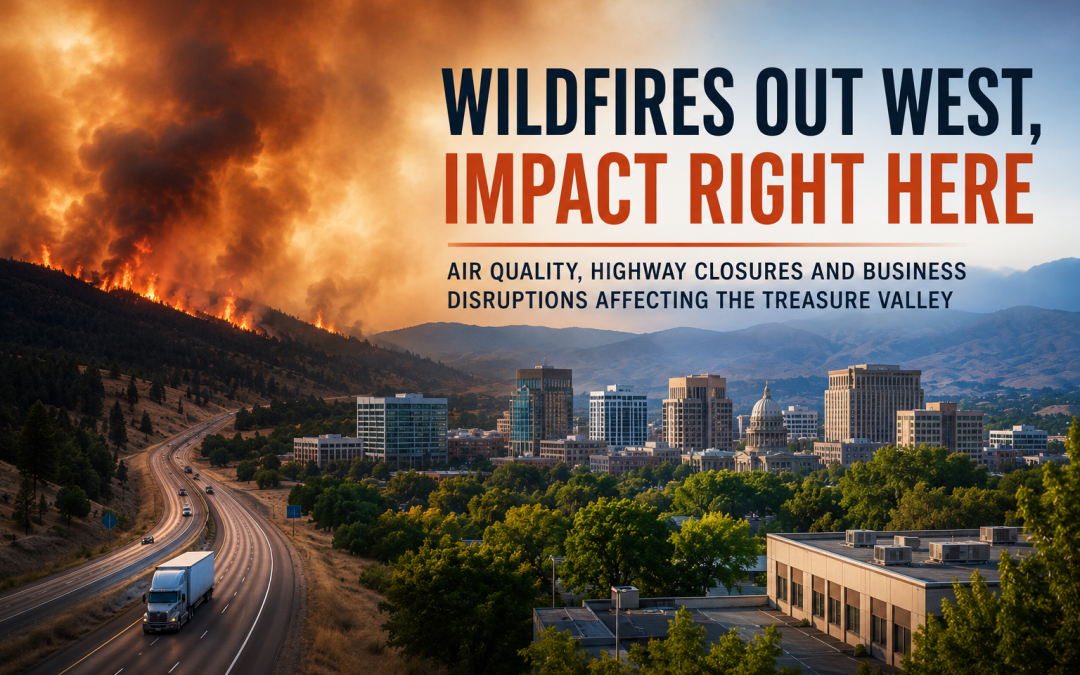
That is becoming clear as major fires across Oregon and near the Idaho border send smoke into the Treasure Valley, threaten communities, and disrupt some of the transportation routes connecting Boise with the Pacific Northwest.
According to reporting by Zach Urness, Riley Ellis and Makenzie Stamets of the Salem Statesman Journal, distributed through the USA TODAY Network via Reuters Connect and published by the Idaho Business Review, more than 1.5 million acres were involved in active Oregon wildfires as of late July. The fires also contributed to poor air quality across a large portion of Idaho.
The original Idaho Business Review article provides detailed fire locations, evacuation information, road closures, and containment updates.
For Boise commercial real estate, however, there is another side of the story: what happens when wildfire season begins affecting transportation, construction, employees, customers, and the cost of operating properties?
Wildfire Is Becoming a Regional Business Issue
Oregon’s 2026 fire season was already approaching historic levels before August began.
According to the Idaho Business Review report, roughly 1.47 million acres had burned in Oregon, approaching the approximately 1.97 million acres recorded during 2024.
Some individual fires had grown extremely large. The Big Grass Fire near the Oregon-Idaho border approached 200,000 acres, while the Coleman Creek Fire exceeded 130,000 acres. Other fires threatened homes, recreational areas, highways, and rural communities.
Thousands of firefighters were deployed across Oregon as crews responded to dozens of major incidents.
For Idaho businesses, though, one of the biggest concerns is location.
Eastern Oregon is Boise’s western gateway.
Interstate 84 connects the Treasure Valley with eastern Oregon, the Columbia River corridor, Portland, and other Pacific Northwest markets. When fire closes or restricts that highway, the effects can extend directly into Idaho.
The Idaho Business Review reported significant disruptions along I-84 between Baker City and Ontario, along with closures affecting other Oregon highways.
That creates a commercial real estate issue because buildings don’t operate independently of transportation.
Retailers need inventory.
Restaurants need deliveries.
Construction sites need materials.
Industrial tenants need trucks moving reliably.
Employees need safe routes to work.
When transportation becomes unpredictable, the usefulness and cost of occupying commercial property can change—even when the building itself is nowhere near the fire.
Smoke Can Affect Boise Retail, Construction and Property Operations
The more immediate impact for the Treasure Valley may be smoke.
The article reported air-quality alerts affecting 30 Idaho counties, including Ada and Canyon counties.
That puts Boise, Meridian, Nampa, Caldwell, Eagle, Star, Kuna and much of the surrounding commercial market within the broader area affected by wildfire smoke.
For commercial property owners and tenants, repeated smoke events can have practical consequences.
Outdoor restaurants and patios can lose traffic. Construction crews may face difficult working conditions. Recreation businesses and outdoor events can see cancellations. HVAC systems may work harder to maintain indoor air quality. Employers may also have to adjust outdoor work schedules.
Even businesses that primarily operate indoors can feel the effects when customers decide to stay home.
For retail leasing Boise landlords, this is particularly important for properties dependent on restaurants, entertainment, fitness, recreation, and other experience-based tenants.
A smoky week doesn’t change the long-term value of a good shopping center. But repeated environmental disruptions can affect seasonal sales and operating costs.
Developers should be paying attention as well.
Wildfire smoke during the summer construction season can create another variable alongside labor shortages, material costs, permitting delays, and extreme heat.
Why Transportation Resilience Matters to Boise Industrial Real Estate
The highway disruptions highlight another issue that deserves more attention in Boise commercial real estate: transportation resilience.
The Treasure Valley sits along Interstate 84, giving Boise-area businesses a strong connection east toward Salt Lake City and west toward Portland and the Pacific Northwest.
That location has helped support warehouse, distribution, manufacturing, and logistics demand.
But dependence on a major corridor also creates exposure.
Wildfires, winter storms, crashes, construction, and other disruptions can temporarily restrict freight movement.
For industrial tenants evaluating Boise, Meridian, Nampa or Caldwell, the conversation therefore shouldn’t stop with clear height, dock doors and lease rates.
Companies increasingly need to understand:
- How quickly can trucks reach Interstate 84?
- Are there practical alternate routes?
- Where are suppliers and customers located?
- How much inventory needs to be maintained locally?
- What happens if a major transportation corridor is interrupted?
Those questions can influence site selection.
Properties with strong interstate access will continue to be valuable, but businesses may also place greater importance on redundancy, inventory planning, and proximity to customers.
Wildfire Risk Can Influence Development and Investment Decisions
Wildfire doesn’t affect every Boise commercial property equally.
A downtown office building has a very different risk profile from a development parcel near the foothills or a rural commercial property surrounded by vegetation.
That makes property-specific due diligence increasingly important.
Investors and developers should consider access, emergency routes, water availability, surrounding vegetation, insurance costs, utility infrastructure, and proximity to wildfire-prone areas when evaluating certain sites.
Insurance deserves particular attention.
Commercial property insurance has already become a larger expense in many markets. Properties with greater wildfire exposure can face higher premiums, tighter underwriting requirements, larger deductibles, or fewer insurance options.
Those costs eventually affect investment returns.
For developers, higher insurance and risk-mitigation costs can also become another item that has to fit into an already difficult development pro forma.
Local Insight: Boise’s Growth Story Needs Resilient Infrastructure
Boise and the Treasure Valley remain attractive because of population growth, business expansion, transportation access, and quality of life.
Wildfire doesn’t erase those advantages.
But it does remind us that commercial real estate is connected to a much larger regional system.
A warehouse in Nampa depends on highways outside Idaho.
A Boise restaurant can be affected by smoke from Oregon.
A development project in Meridian can feel the impact when construction deliveries are delayed.
And an investor purchasing property today may need to think differently about insurance and environmental risk than an investor did a decade ago.
For me, the commercial real estate takeaway isn’t that wildfire should discourage investment in Boise.
It’s that resilience should become part of site selection and property analysis.
Access to multiple transportation routes, modern HVAC systems, good infrastructure, appropriate insurance coverage, emergency planning, and thoughtful property maintenance can all help reduce disruption.
For industrial users, logistics planning becomes especially important. For retail and restaurant operators, indoor air quality and seasonal business planning deserve consideration. For developers, infrastructure and wildfire exposure should be evaluated early rather than after a site is under contract.
The Treasure Valley’s growth creates tremendous opportunities. Protecting those opportunities means understanding the regional risks that come with them.
Mike Gioioso (joy-OH-so) has for 16+ years been helping companies of all sizes buy, build, and lease perfect places for business in greater Boise, Idaho and beyond.
www.streetsmartidaho.com mike@streetsmartidaho.com 208-209-9166
Tags: #boisecommercialrealestate, #boiserealestate, #boisedevelopment, #idahocommercialrealestate, #boiseindustrialrealestate, #retailleasingboise, #treasurevalleycommercialrealestate, #boiseinvestmentproperty, #idahowildfires, #oregonwildfires, #interstate84, #boiselogistics, #nampaindustrialrealestate, #commercialpropertyinsurance, #treasurevalleydevelopment