
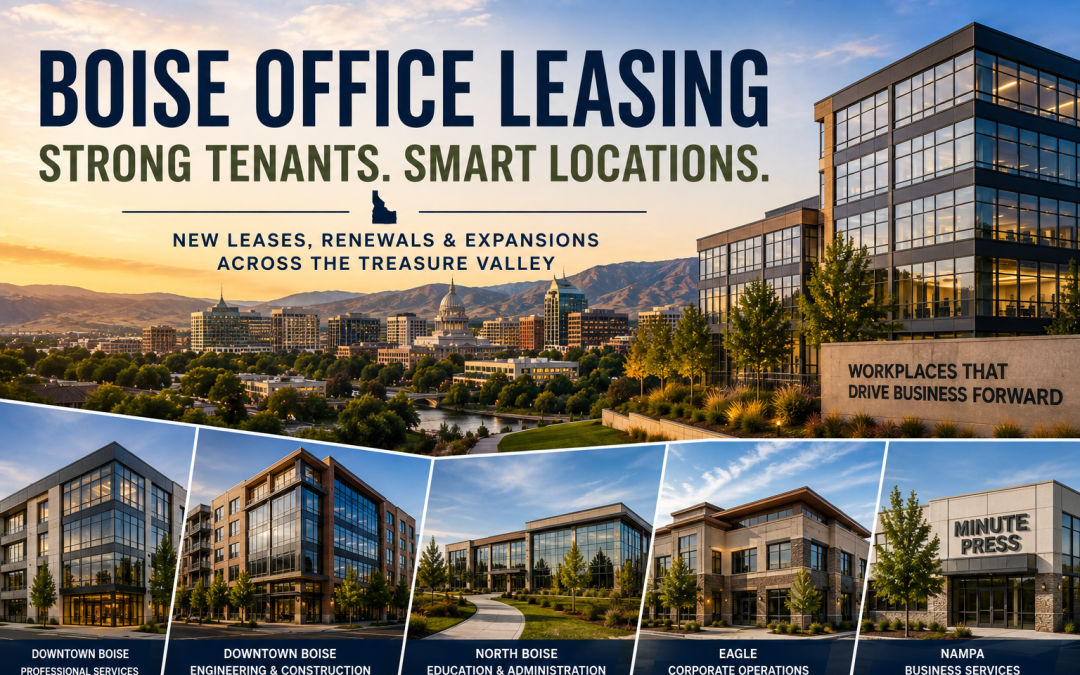
Boise Office Leasing Shows Companies Still Value the Right Workplace
The office market has changed, but companies haven’t stopped leasing offices.
Recent Boise-area transactions show financial services, engineering, education, food production and business-service companies committing to physical workplaces across Boise, Eagle and Nampa. Even more interesting, some tenants aren’t simply staying put—they’re expanding.
For Boise commercial real estate, that’s an important distinction. The office market may be more selective than it was before remote and hybrid work became common, but businesses are still willing to make meaningful commitments when a building, location and workspace fit their needs.
According to CoStar Research, five Boise City/Nampa transactions were recognized among its leading office leases for the second quarter of 2026. The original CoStar News article provides the full transaction details and recognizes the brokers involved.
Together, these deals represent more than 50,000 square feet of office leasing activity and offer a useful look at where Boise-area office demand is coming from.
Downtown Boise Is Still Winning New Tenants
Two of the largest recognized transactions occurred in or near Downtown Boise.
Helmstar Wealth Management signed a new lease for approximately 13,087 square feet at 250 S. Fifth St.
The financial planning and wealth management company is taking space in a roughly 106,000-square-foot multitenant building near Boise’s central business district.
The transaction matters because professional and financial services remain an important part of the traditional office tenant base.
Those companies often care about more than simply finding the cheapest square footage.
Location, image, client accessibility, employee experience and nearby amenities can all influence the decision.
Another significant transaction occurred at 251 E. Front St., where Shambaugh & Son leased approximately 12,760 square feet.
The national engineering and construction services company works in areas including mechanical, electrical and fire-protection systems. The Boise office will support the firm’s expanding regional operations.
This is the type of office demand I think is especially worth watching.
Engineering, construction, technology and professional service companies may still need physical workplaces because their employees collaborate on complex projects, meet with clients and coordinate regional operations.
For landlords involved in Boise office leasing, tenants like these can represent a strong segment of the market.
Office Demand Is Spreading Beyond Downtown
Downtown Boise isn’t the only place seeing activity.
The remaining recognized leases occurred in North Boise, Eagle and Nampa.
iSucceed Virtual Schools renewed and expanded its space at 6148 N. Discovery Way in Boise, bringing its occupancy to approximately 8,503 square feet.
The organization added roughly 2,000 square feet as part of the transaction.
That expansion is particularly interesting because iSucceed operates virtual education programs.
A virtual school expanding its physical office is a useful reminder that “digital” doesn’t necessarily mean “no real estate.”
Organizations still need places for administration, management, collaboration, technology and support functions.
In Eagle, Lamb Weston renewed approximately 7,923 square feet at 661 S. Rivershore Lane.
The global food company chose to maintain its presence in a suburban office environment near the Boise River corridor.
And in Nampa, International Minute Press leased approximately 8,500 square feet at 612 First St. S.
Its location serves a different purpose than a traditional corporate office. The business combines customer interaction with printing, marketing, design and production services.
That type of hybrid use illustrates how broad the definition of “office tenant” has become.
The Boise Office Market Is Becoming More Purpose-Driven
The biggest lesson from these transactions isn’t that the traditional office market has returned to its old normal.
It hasn’t.
The better takeaway is that companies still lease offices when they have a clear reason to use them.
That’s a major shift.
Before widespread hybrid work, many companies started with a headcount and calculated how much office space they needed.
Today, the conversation is often different.
Businesses may first ask:
Why do our employees need to come into the office?
Then they determine what type of space supports that purpose.
For one company, the answer might be client meetings.
For another, it’s collaboration.
For another, it could be training, recruiting, project management or simply maintaining a professional headquarters.
That can lead to smaller footprints—but potentially better space.
For Boise office landlords, that means quality matters.
Location matters.
Parking matters.
Building condition matters.
And the actual experience employees have when they arrive matters more than it once did.
Renewals and Expansions Are Important Signals
New leases get attention, but renewals can tell us just as much about the health of a market.
Two of the five recognized transactions involved existing tenants staying in place.
Lamb Weston renewed in Eagle.
iSucceed renewed and expanded in Boise.
That’s meaningful because moving an office is disruptive and expensive.
Companies generally evaluate alternatives before making long-term occupancy decisions. If a tenant renews, it can indicate that the current building continues to meet its operational, financial and employee needs.
Expansion sends an even stronger signal.
It means a tenant has decided it needs more space despite the flexibility offered by remote and hybrid work.
For office investors, tenant retention is increasingly important.
A building doesn’t need every tenant to expand. It needs enough companies to see continued value in their physical workplace.
Nampa and Eagle Offer Different Office Alternatives
Another takeaway is geographic.
The Boise office market isn’t just Downtown Boise anymore.
Eagle has developed into an attractive suburban office market, particularly for companies seeking high-quality space, strong demographics and access to executives and employees living in western Ada County.
Nampa offers something different.
As Canyon County’s population and business base expand, companies can establish offices closer to customers and employees who might otherwise commute east toward Boise.
This creates a more decentralized office market.
Companies don’t automatically have to choose between Downtown Boise and suburban Boise.
They can evaluate Downtown, Southeast Boise, North Boise, Meridian, Eagle, Nampa and other submarkets based on where their workforce and customers are located.
For Boise development, that means future office opportunities may be increasingly targeted rather than massive speculative projects.
What This Means for Boise Office Landlords
The office market has become much more competitive.
That doesn’t mean every building is competing equally.
Well-located, well-maintained properties with functional floor plans and strong amenities may perform very differently from outdated buildings that require significant improvements.
Landlords should be thinking about what tenants actually need today.
That could include:
- Flexible floor plans
- Better conference and collaboration areas
- Attractive employee spaces
- Strong technology infrastructure
- Convenient parking
- Outdoor amenities
- Nearby restaurants and services
- Updated common areas
- Smaller move-in-ready suites
The last point may become particularly important.
If companies are reducing their average office footprint, landlords who can efficiently divide larger spaces may have access to a wider pool of prospective tenants.
Local Insight: Office Isn’t Dead—But Average Space Isn’t Enough Anymore
For years, we’ve heard versions of the same question:
Is the office market dead?
I don’t think that’s the right question.
A better question is: Which offices do companies still want?
These Boise-area transactions give us part of the answer.
Companies are leasing space when the office supports a specific business function.
Helmstar needs a professional environment for financial services.
Shambaugh & Son needs a regional base for engineering and construction operations.
iSucceed needs administrative space even though its educational model is virtual.
Lamb Weston continues to value its Eagle location.
International Minute Press needs a location that combines customer service with business operations.
Different businesses. Different reasons. Same basic conclusion.
Physical office space still matters when it solves a real business need.
For investors, that means office properties shouldn’t be evaluated only by vacancy rates across the entire market. Building quality, tenant profile, suite size, location and lease economics matter enormously.
For tenants, today’s market can also create opportunity.
Companies willing to commit to space may have more choices and potentially greater leverage to negotiate tenant improvements, rent structures and other lease terms.
And for developers, I would be cautious about assuming the next office cycle will look like the last one.
The future of Boise office development may involve smaller projects, mixed-use environments, medical and professional space, flexible layouts and locations close to where decision-makers and employees actually live.
Office real estate isn’t disappearing.
It’s becoming more intentional.
And the landlords who understand that shift will be in the best position to compete for the next generation of Boise office tenants.
Mike Gioioso (joy-OH-so) has for 16+ years been helping companies of all sizes buy, build, and lease perfect places for business in greater Boise, Idaho and beyond.
www.streetsmartidaho.com mike@streetsmartidaho.com 208-209-9166
Tags: #boisecommercialrealestate, #boiseofficemarket, #boiseofficespace, #boiseofficeleasing, #boiseofficerealestate, #boisecommercialleasing, #idahocommercialrealestate, #treasurevalleycommercialrealestate, #treasurevalleyofficemarket, #downtownboiseofficespace, #downtownboisecommercialrealestate, #eagleidahoofficespace, #eaglecommercialrealestate