
Albertsons’ AI Shopping Push Could Change What Grocery-Anchored Real Estate Means in Boise
For decades, grocery real estate has been built around a simple idea: get shoppers through the front door.
Artificial intelligence is starting to change that equation.
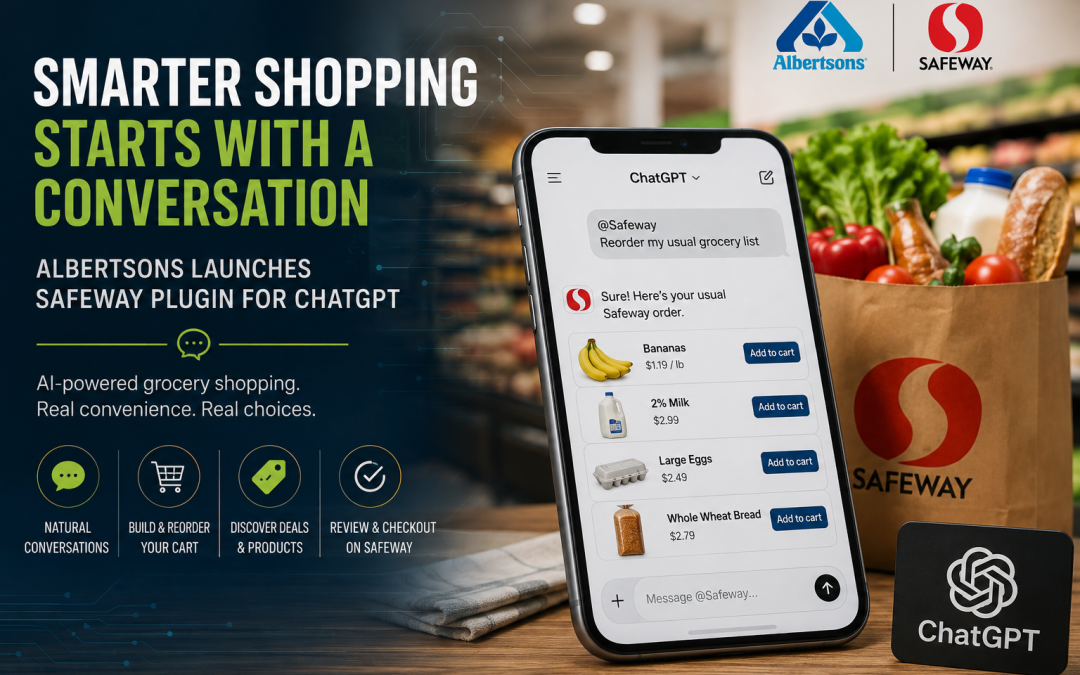
Boise-based Albertsons Companies has launched a Safeway integration for ChatGPT designed to help customers find products and assemble grocery carts through a conversational interface. It may sound like another e-commerce feature, but for those of us watching Boise commercial real estate, the bigger story is what happens when the digital shopping experience becomes increasingly disconnected from the physical store visit.
According to reporting by IBR Staff in the Idaho Business Review, shoppers can use the Safeway integration to search for groceries, rebuild recurring shopping lists, find deals, and add products to their carts through conversational requests. Customers still review their selections and complete the transaction through Safeway’s own platform. You can read the original Idaho Business Review article.
Albertsons is a particularly interesting company to watch from Boise. It is headquartered here and operates thousands of stores nationally, making its technology strategy relevant not only to retail but also to the future of grocery-anchored commercial property.
Grocery Shopping Is Becoming Less About Searching
Traditional online grocery shopping still requires work.
You open a website or app.
You search for individual products.
You compare choices.
You add everything to the cart.
Then you repeat the process the following week.
Conversational AI has the potential to shorten that process considerably.
Instead of searching item by item, a customer could make a natural-language request based on what they actually want to accomplish.
That might be recreating a regular grocery order, planning meals, finding ingredients, or identifying discounted products.
The difference seems small, but it represents a larger change in online retail.
Consumers increasingly don’t want to search for products.
They want technology to understand the goal and help complete the task.
Albertsons has already been investing in AI-powered shopping tools, and this latest move expands that strategy by putting grocery discovery inside another digital environment consumers may already be using.
For retailers, that creates a new competitive battleground.
The winner isn’t necessarily the company with the best website.
It may be the retailer that makes purchasing easiest wherever the customer happens to start.
Why Digital Grocery Still Matters to Physical Real Estate
It would be easy to look at this trend and conclude that technology makes grocery stores less important.
I think the opposite may be closer to the truth.
Online grocery orders still need to be picked, stored, refrigerated, assembled, and delivered or collected somewhere.
That makes the physical store part of the logistics network.
A modern grocery store increasingly performs several jobs at once.
It is a traditional retail location.
It is a fulfillment center.
It can be a pickup location.
It supports delivery operations.
It houses pharmacy services.
And it acts as a local inventory hub positioned close to customers.
That combination makes grocery stores unusually interesting commercial real estate assets.
For Boise retail real estate, the implications could become significant.
A grocery property’s value may increasingly depend on more than household demographics and in-store sales.
Site selection may also need to consider:
- Delivery access and drive times
- Pickup circulation
- Employee parking
- Back-of-house storage
- Loading efficiency
- Refrigeration and power capacity
- Proximity to dense concentrations of households
- Ability to handle both customers and fulfillment activity
In other words, the grocery store of the future could look increasingly like a combination of retail and last-mile industrial real estate.
Grocery Anchors May Become Even More Important
Grocery stores have traditionally been some of the strongest anchors in neighborhood shopping centers because people buy food frequently.
That creates repeat traffic.
A customer visiting a grocery store might also stop for coffee, pick up dry cleaning, visit a restaurant, get a haircut, or use another service within the shopping center.
That’s one reason grocery-anchored centers have historically been attractive to commercial real estate investors.
But what happens if more grocery purchases happen through AI, apps, pickup, and delivery?
The answer isn’t necessarily fewer stores.
Instead, the role of the store may evolve.
Well-positioned locations can become increasingly valuable because retailers need inventory close to consumers if they want fast fulfillment.
That could strengthen the importance of stores in densely populated and rapidly growing trade areas.
The Treasure Valley is a good example.
As residential development continues across Boise, Meridian, Nampa, Caldwell, Kuna, and Star, grocery retailers need locations capable of serving new households.
Whether those customers walk the aisles or order groceries digitally, the product still needs to originate somewhere nearby.
That’s an important distinction for Boise commercial real estate investors.
E-commerce doesn’t always eliminate physical real estate.
Sometimes it changes what the real estate is used for.
What This Could Mean for Retail Leasing in Boise
There could also be secondary effects for neighboring tenants.
A traditional grocery customer may spend 30 or 45 minutes walking through a store. During that trip, they may notice neighboring businesses or combine several errands.
A pickup customer behaves differently.
They may enter the center, collect groceries, and leave within minutes.
A delivery order might not bring the customer to the shopping center at all.
That changes traffic patterns.
For landlords involved in retail leasing in Boise, simply counting grocery transactions may eventually tell less of the story.
It could become increasingly important to understand how customers are using the anchor.
Are they shopping inside?
Picking up curbside?
Using delivery?
How long are they staying?
Which entrances are busiest?
Where are pickup customers circulating?
Those behaviors can influence where restaurants, service businesses, and smaller retailers should be positioned within a center.
For example, a coffee shop near a grocery pickup area could benefit from traffic that another tenant on the opposite side of the center never sees.
Site planning becomes more important as shopping behavior becomes more fragmented.
Boise Has a Front-Row Seat to Grocery Technology
There is also a local economic development angle here.
Albertsons isn’t simply another national retailer operating stores in Idaho.
It is a major Boise-based company.
The company operates approximately 2,240 retail stores across 35 states and Washington, D.C., under numerous grocery banners. Its network also includes more than 1,700 in-store pharmacies, according to the Idaho Business Review.
When a company of that scale experiments with artificial intelligence from a Boise headquarters, it reinforces the connection between technology and traditional industries in Idaho.
AI isn’t only about software companies.
It’s increasingly about grocery stores, restaurants, healthcare, construction, logistics, banking, and commercial real estate.
For Boise, that matters because large employers adopting new technologies can influence the type of talent, office environments, infrastructure, and business services the market needs.
Convenience Is Becoming the New Location
Commercial real estate has always been built around the phrase:
Location, location, location.
That isn’t going away.
But digital commerce is adding another layer.
Convenience.
A retailer can have the best corner in town and still lose a transaction if purchasing from a competitor is significantly easier.
Conversely, a well-located physical store can become even more powerful when combined with an excellent digital experience.
That’s where Albertsons’ strategy becomes interesting.
The company already has a large network of physical stores positioned close to millions of households.
AI potentially makes that physical network easier to access digitally.
The combination can be stronger than either strategy alone.
Pure e-commerce companies may have excellent technology but need expensive fulfillment infrastructure.
Traditional retailers already have the infrastructure but sometimes struggle with digital experience.
Companies that successfully combine both could have a meaningful advantage.
Local Insight: Retail Real Estate Isn’t Disappearing — It’s Becoming Infrastructure
For Boise commercial real estate, I think this is the bigger takeaway.
We need to stop thinking about physical retail and e-commerce as opposing forces.
Increasingly, they’re parts of the same system.
A grocery store isn’t just where customers shop.
It’s where inventory is stored close to neighborhoods.
It’s where online orders can be assembled.
It’s where customers can collect purchases.
It’s where delivery drivers can begin the last mile.
And it’s still where thousands of people may shop traditionally every week.
That makes location extremely important.
In some ways, digital shopping could actually increase the strategic value of well-positioned grocery properties.
For developers, this means thinking carefully about circulation, loading, pickup areas, power, parking, and future flexibility.
For landlords, it means understanding how an anchor’s digital strategy changes traffic throughout the shopping center.
For smaller tenants, it means paying attention to where those new traffic patterns develop.
And for investors, it means evaluating grocery real estate as both a consumer destination and a fulfillment asset.
My Take
The most interesting thing about Albertsons’ latest AI move isn’t the technology itself.
It’s what happens when the friction between deciding what you need and buying it continues to disappear.
If customers can increasingly describe what they want and have technology build the order, retailers will compete harder on fulfillment speed, inventory availability, convenience, and proximity.
Every one of those factors has a real estate component.
That is why I don’t see AI as a story about the end of physical retail.
I see it as another step in the evolution of what physical retail needs to do.
For Boise landlords, developers, and investors, the best properties will likely be the ones that can adapt as shopping behavior changes.
The stores may look familiar from the street.
But behind the scenes, they are becoming much more sophisticated pieces of the retail and logistics network.
And with one of America’s largest grocery companies headquartered right here, Boise has a front-row seat to that transformation.
Mike Gioioso (joy-OH-so) has for 16+ years been helping companies of all sizes buy, build, and lease perfect places for business in greater Boise, Idaho and beyond.
www.streetsmartidaho.com mike@streetsmartidaho.com 208-209-9166
Tags: #boisecommercialrealestate, #boiseretailrealestate, #boiserealestate, #boisedevelopment, #boiseretaildevelopment, #retailleasingboise, #boiseretailleasing, #boiseinvestmentproperty, #boiseshoppingcenters, #boisegrocerystores, #boisegroceryanchoredrealestate, #boisegroceryanchoredshoppingcenters, #albertsonsboise, #albertsonscompanies, #albertsonsrealestate, #albertsonsai