
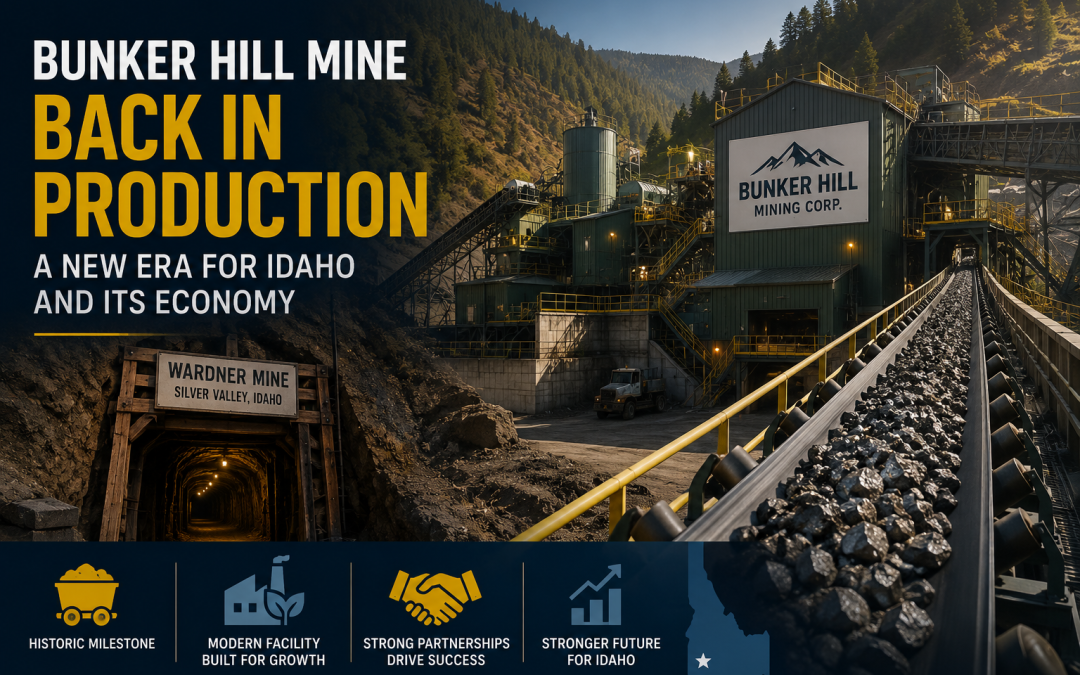
Bunker Hill Mine Revival Signals New Economic Activity for Idaho Commercial Real Estate
One of Idaho’s historic mining operations is producing again after more than four decades—and the impact could extend well beyond the mine itself.
Bunker Hill Mining Corp. has begun shipping mineral concentrate from its newly commissioned facility in Kellogg. For Idaho commercial real estate, the bigger story is what renewed industrial investment can mean for jobs, suppliers, transportation, housing and commercial demand in communities tied to natural-resource industries.
According to reporting by IBR Staff in the Idaho Business Review, Bunker Hill has completed its first revenue-producing concentrate shipment since the mine shut down more than 45 years ago. The original Idaho Business Review article provides additional details on the redevelopment and production ramp-up.
While Kellogg and the Silver Valley are far from Boise, projects like this offer useful lessons for Boise commercial real estate investors and developers about the economic ripple effects created by major industrial investment.
An Old Idaho Industry Gets a New Investment Cycle
Bunker Hill isn’t simply reopening an old mine. The company has built new processing infrastructure designed for modern production.
The Kellogg processing facility is designed to handle approximately 1,800 tons of material per day. Ore comes from the underground mine near Wardner, roughly 3.5 miles away, and is processed into separate lead and zinc concentrates.
The first shipment went to Teck Resources’ lead and zinc operation in Trail, British Columbia, about 140 miles from Kellogg, under an existing offtake arrangement.
Bunker Hill’s current processing capacity is significant for the Silver Valley. According to the Idaho Business Review report, the new facility can process more material per day than several nearby mining operations.
And the company has already planned for potential growth.
The plant was designed so capacity could eventually increase to roughly 2,500 tons per day with additional investment.
That scalability is important because industrial projects don’t operate in isolation. Higher production can mean more workers, contractors, equipment, transportation and support services moving through the surrounding market.
Bunker Hill is targeting full commercial production by the end of 2026.
Industrial Investment Creates Real Estate Demand Beyond the Mine
The commercial real estate impact of a project like this isn’t necessarily found inside the mine gates.
It’s found around them.
Large industrial operations require an ecosystem of supporting businesses. Equipment suppliers, trucking companies, maintenance contractors, engineering firms, environmental consultants, laboratories and other vendors all need places to operate.
That can create demand for:
- Industrial and warehouse buildings
- Contractor yards and outdoor storage
- Flex space
- Trucking and logistics facilities
- Office and professional service space
- Workforce housing
- Restaurants, retail and everyday services
For smaller Idaho communities, even modest increases in employment and business activity can have an outsized impact on commercial property demand.
That is one reason industrial development is such a powerful economic driver.
A new retail store primarily creates activity at that particular location. A large industrial employer can support an entire network of businesses around it.
What This Means for Boise’s Industrial Market
The Bunker Hill project is in North Idaho, but there is a connection to Boise industrial real estate.
Idaho continues attracting businesses involved in manufacturing, construction, technology, agriculture, food production and natural resources. Many of those industries depend on statewide supply chains rather than a single local market.
Boise and the Treasure Valley increasingly serve as a regional hub for companies providing services throughout Idaho.
A contractor may be headquartered in Meridian but work statewide. An equipment supplier may warehouse products in Nampa while serving customers across Idaho. An engineering or environmental firm could maintain a Boise office while supporting industrial projects hundreds of miles away.
That makes major capital investment elsewhere in Idaho relevant to the Boise market.
The stronger Idaho’s industrial economy becomes, the greater the opportunity for supporting businesses that may choose Boise, Meridian, Nampa or Caldwell as their regional base.
Transportation and Logistics Become More Important
The first Bunker Hill concentrate shipment also highlights another major commercial real estate theme: transportation.
The material is being moved from Kellogg to a processing operation in British Columbia.
That requires infrastructure.
Mining, manufacturing and heavy industrial operations depend on highways, rail networks, trucking capacity and strategically located industrial facilities.
The same principle applies to the Treasure Valley.
For Boise development, industrial land with good access to Interstate 84, major arterials and freight routes continues to have strategic value.
That is especially true in markets such as Nampa and Caldwell, where larger parcels and interstate access can accommodate logistics, manufacturing and outdoor-storage users that may be difficult to place closer to Boise’s urban core.
As Idaho’s economy becomes more industrially diverse, transportation access could become an even larger part of commercial land values.
Modern Industrial Projects Are Also Infrastructure Projects
Another interesting part of the Bunker Hill redevelopment is the infrastructure being built around environmental management.
The company’s process includes filtering tailings, with material either reused underground as backfill or placed in dry-stack storage. According to the company information cited by Idaho Business Review, the approach is intended to lower water usage and reduce environmental impacts.
A separate paste-backfill facility at the mine was also nearing commissioning when the article was published.
These details may sound specific to mining, but they point to a broader trend in commercial real estate and industrial development.
Modern industrial projects increasingly need sophisticated infrastructure.
Power capacity, water, wastewater, environmental systems and transportation access can be just as important as the building itself.
We’re seeing versions of that same issue in the Boise market.
Manufacturers need significant electrical capacity. Food processors need water and wastewater infrastructure. Data centers require enormous amounts of power. Distribution companies need highway access and large truck courts.
The land is only one piece of the development equation.
Capital Still Matters During the Ramp-Up
Starting production doesn’t mean a project immediately becomes financially mature.
Bunker Hill also announced that it drew $5 million from a standby credit facility provided by Teck to help fund working capital while production increases.
That’s another useful commercial real estate lesson.
Major development projects often need substantial capital after construction is technically complete.
The same issue applies to businesses occupying commercial properties.
A manufacturer moving into a new facility may need equipment, inventory and operating capital in addition to money for the building. A restaurant needs working capital after completing an expensive buildout. A retailer still needs inventory and payroll after opening its doors.
Landlords and developers evaluating tenants should therefore look beyond whether a company can afford the initial construction or deposit.
The stronger question is whether the business has enough capital to successfully operate after opening.
Local Insight: Follow the Businesses That Follow the Investment
For commercial real estate investors, the most interesting opportunities surrounding a major industrial project aren’t always the obvious ones.
Sometimes the better opportunity is the supplier moving into a 10,000-square-foot industrial building.
Or the contractor needing an acre of fenced yard space.
Or the engineering company leasing an office.
Or the restaurant opening because hundreds of workers now need somewhere to eat.
That is why major economic development announcements deserve attention even when they aren’t happening directly in the Treasure Valley.
The commercial real estate opportunity often appears one or two steps removed from the original investment.
My Take
Bunker Hill returning to production after more than 45 years is a remarkable Idaho business story, but I think the broader lesson is about economic ecosystems.
Large industrial investments create secondary demand.
They need contractors. Contractors need buildings. Workers need housing. Suppliers need warehouses. Trucks need yards. Businesses need offices. Employees spend money at nearby restaurants and stores.
For Boise commercial real estate, the opportunity is to identify those ripple effects early.
Boise doesn’t have to be home to the mine itself to benefit from a stronger Idaho industrial economy.
Companies serving mining, manufacturing, construction and other industries often want access to the Treasure Valley’s workforce, airport, interstate system and growing business community.
That can support continued demand for Boise industrial space, Nampa warehouses, Caldwell industrial land, Meridian flex space and commercial development throughout the Treasure Valley.
The reopening of Bunker Hill is ultimately a North Idaho story. But it is also another sign that industrial investment remains an important part of Idaho’s economic future—and commercial real estate tends to follow economic activity.
Mike Gioioso (joy-OH-so) has for 16+ years been helping companies of all sizes buy, build, and lease perfect places for business in greater Boise, Idaho and beyond.
www.streetsmartidaho.com mike@streetsmartidaho.com 208-209-9166
Tags: #boisecommercialrealestate, #idahocommercialrealestate, #boiseindustrialrealestate, #idahoindustrialrealestate, #boiseindustrialdevelopment, #boisedevelopment, #boiseinvestmentproperty, #boisecommercialproperty, #treasurevalleycommercialrealestate, #treasurevalleyindustrialrealestate, #idahoeconomicdevelopment, #idahomining, #bunkerhillmine, #bunkerhillmining